AI Is Moving From the Chat Window Into the Scientific Laboratory
New Genesis Mission commitments connect frontier models with national laboratories, supercomputers and experiments, where validation matters more than eloquence.
Friday, July 31, 2026/2 min read
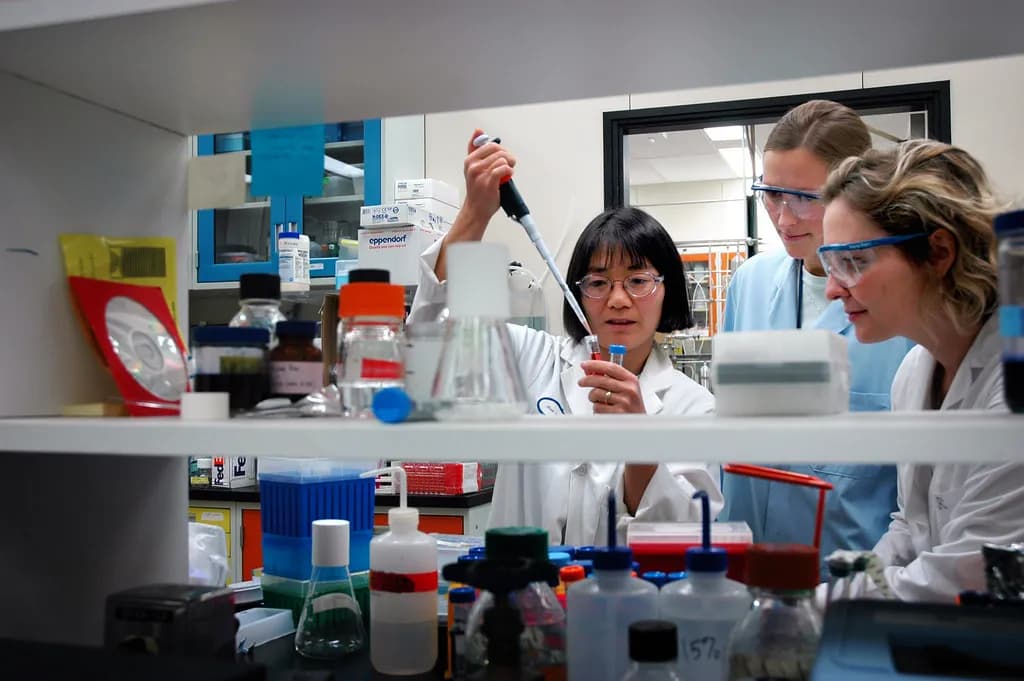
The most consequential artificial intelligence trend may not happen in a chatbot. It may happen inside a laboratory where a model proposes a material, a simulation tests it, a robot runs an experiment and a scientist decides whether the evidence is real.
OpenAI announced new support for the US Department of Energy's Genesis Mission on July 22, including Codex access for about 2,000 researchers and API resources for large scientific campaigns. Its science commitment focuses on high-temperature superconductors and mapping problems that may already be tractable with current data and computation.
Why science is different from ordinary AI work
A fluent answer can be useful in an office and disastrous in a laboratory. Scientific systems need provenance, uncertainty, reproducibility and physical validation. A model may help generate hypotheses or code, but an experiment, instrument or independent dataset must decide whether the result survives contact with reality.
This makes AI for science an orchestration problem. Models must connect securely to supercomputers, curated data, simulation tools, laboratory equipment and expert review. The difficult work sits in the interfaces, permissions and standards between those pieces.
What the Genesis Mission is building
The Department of Energy describes Genesis as an integrated platform connecting national laboratories, experimental facilities, AI systems and unique datasets. Its national science and technology challenges include autonomous laboratories, advanced reactors, critical minerals, biotechnology, materials, quantum computing and microelectronics.
The ambition is to shorten discovery cycles. Instead of waiting weeks between hypothesis, simulation, experiment and analysis, an integrated workflow could run parts of the loop continuously. A system might notice a failed experiment, update its model and recommend the next test while preserving a full record for human review.
Where the gains could be real
Materials research often explores enormous combinations of composition and processing. AI can narrow that space before expensive experiments. In biology, models can connect genomic, imaging and molecular data to suggest mechanisms worth testing. In energy, digital twins can evaluate designs and anticipate dangerous operating conditions.
The benefit is not replacing the scientist. It is spending more scientific time on questions, interpretation and experimental design while software handles search, code, scheduling and repetitive analysis.
The risks are also scientific
Automation can reproduce bias at greater speed. Poorly documented datasets can send an entire experimental program in the wrong direction. A closed model may make a useful prediction that nobody can explain or reproduce. Sensitive biological and national-security work introduces access and dual-use concerns beyond ordinary enterprise AI.
Strong programs therefore need benchmark tasks, independent replication, secure data boundaries and publication rules that disclose meaningful AI involvement. Researchers must be able to challenge the system rather than defer to it.
The next interface is an instrument panel
For years, public AI progress was measured through conversation. Scientific AI will be measured through discoveries that survive peer review, experiments that reproduce and technologies that work outside a demo. That is a much higher bar.
The Genesis commitments matter because they place models beside the infrastructure and people capable of testing them. If the approach succeeds, the defining AI product of the next decade may not be a smarter answer box. It may be a reliable, auditable discovery loop that helps scientists ask better questions and reach physical evidence faster.
Published in The Outspoken Digest
Newsletter
The Digest, in your inbox
One edition, sent when it is ready. No noise, and your address is never passed on.
Read Next
More Latest Trends →
Lapid Says He Does Not Trust Netanyahu Not to Strike Iran Before Israel's 27 October Election
Oct 18, 2026/2 min read

Hormuz Ship Attacks Hit a Weekly Record as Iran Says a Supertanker Struck a Mine
Oct 18, 2026/2 min read

Trump Waives New Russia Sanctions and Tariffs Two Days Before They Were Due, the Second Waiver in Two Weeks
Oct 18, 2026/2 min read

Roughly Half a Million March Across France as Student Anger Over Schools Merges With Fuel Price Fury
Oct 18, 2026/2 min read