Jordan Sank Nineteen Military Vehicles to Build a Dive Site
Tanks, troop carriers, anti-aircraft guns and a helicopter sit in ordered rows off Aqaba. It is the world's first underwater military museum, and the reasoning behind it is economic.
Thursday, August 6, 2026/4 min read
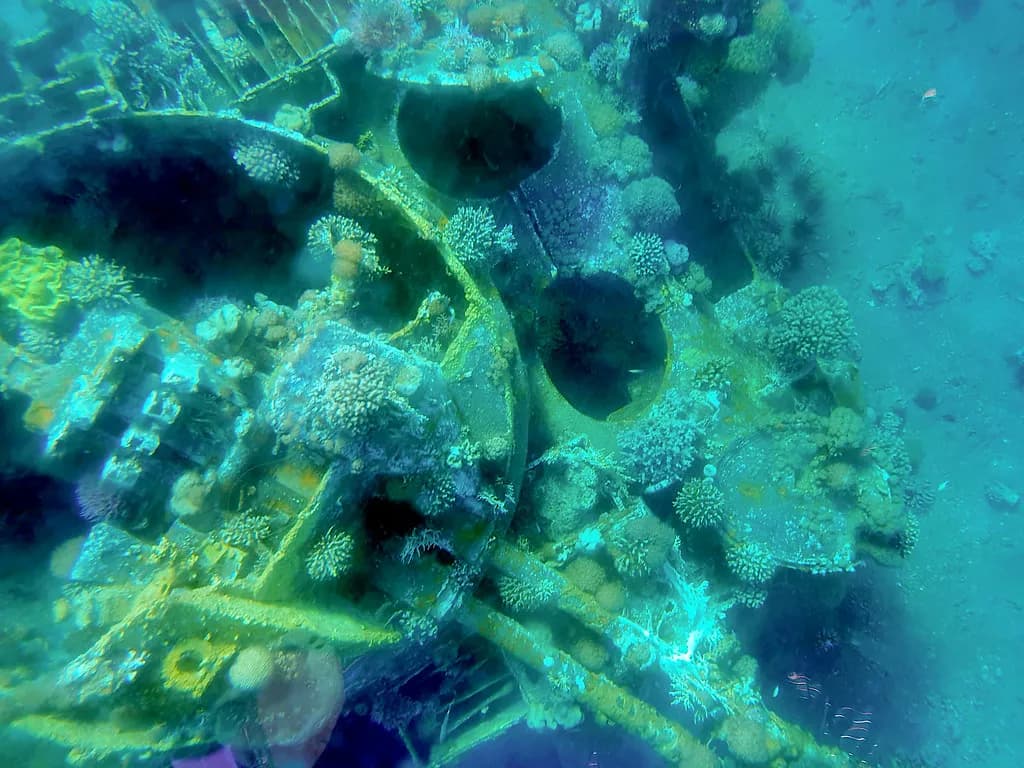
Sinking military hardware on purpose sounds like a stunt. In Aqaba it is a coastal management strategy, and it has been running for forty years.
Jordan has about 26 kilometres of coastline. Every dive operator, hotel and reef in the country is compressed into that strip, which means the natural reefs carry a load that would be distributed across hundreds of kilometres almost anywhere else. Artificial sites exist to take some of that weight off.
In July 2019 the Aqaba Special Economic Zone Authority sank nineteen vehicles across seven days at depths between 15 and 28 metres. DIVE Magazine reported it as the world's first underwater military museum, with tanks, troop carriers, anti aircraft guns and a helicopter among the additions.
The wreck that started it
The programme did not begin in 2019. It began in 1985 with the Cedar Pride, a Lebanese freighter abandoned after a fire and scuttled at the request of Jordan's royal household to create an artificial reef.
The 74 metre hull lies on its side in about 28 metres of water. Four decades on, it is thoroughly colonised, which is the point of the exercise: the argument for artificial reefs rests entirely on whether they eventually become biological rather than staying industrial.
A Lockheed C-130 Hercules from the Royal Jordanian Air Force followed in 2017, placed at around 17 metres. It went down intact and was later broken up by a storm, which gave it a more dramatic appearance than the placement intended, as X-Ray Magazine describes. With a 30 metre length and a 40 metre wingspan, it is a large object to meet underwater.
Does it actually help the reef
This is the honest question and the answer is qualified.
Artificial structures do attract marine life, and they do redirect diver traffic away from fragile natural coral. Both effects are real and measurable in visitor numbers.
What is less certain is whether they increase total marine life or simply concentrate what was already there. The distinction matters: a site that aggregates fish from surrounding reefs looks spectacular while producing no net gain. Careful preparation, removing fuel, oil, plastics and anything that leaches, is what separates a reef project from dumping, and Aqaba's programme has been run through a formal authority rather than informally.
What the diving is like
Accessible, is the short answer, and that is deliberate. Depths between 15 and 28 metres put most of the museum within recreational limits, and several vehicles sit shallow enough for divers early in their training.
The vehicles are arranged in formation on sand rather than scattered, which produces the slightly surreal quality the site is known for: an ordered column of armour on a seabed, as though it drove there.
Aqaba's conditions help. The Gulf of Aqaba is sheltered, generally calm, with good visibility and water that stays comfortable year round. Shore entries are common and boat trips are short.
The risks nobody should skip
Vehicles are not ships, and they carry their own hazards. Hatches, turrets and interior spaces are overhead environments, and a tank interior is a confined space with silt, edges and no second exit.
Storm damage is a live factor, as the Hercules demonstrated. Structures move, break and develop new entanglement points, so local briefing matters more here than at a static natural site.
Depth discipline applies as always. The deeper vehicles sit at 28 metres, and it is easy to lose track of a dive plan while moving between objects that each invite a few more minutes.
What sinking a vehicle properly involves
The difference between an artificial reef and marine dumping is preparation, and it is substantial.
Every fluid has to be removed: fuel, oil, hydraulics, coolant. Plastics, insulation, wiring and anything that leaches or breaks into fragments comes out. Loose components that could shift are secured or stripped. Openings are cut or sealed depending on whether the intention is to allow access or prevent entrapment.
Then there is placement. The seabed has to be sand or rubble rather than living coral, which sounds obvious and has been got wrong in other countries, producing a reef project that destroyed reef to create one.
The Aqaba programme has run through a formal authority, which is what makes it assessable at all. Documentation from operators covering Jordan's wrecks describes a placed, ordered site rather than an improvised one.
Diving a site built to be dived
There is an honest aesthetic question buried in all this, and divers split on it.
A natural reef developed over centuries and a column of tanks placed in formation in 2019 are not the same experience, whatever grows on them. Some divers find the military museum compelling precisely because of its strangeness. Others find a deliberately arranged site closer to an underwater theme park than to exploration.
Both reactions are reasonable. What is not in dispute is the function: every diver on a tank is a diver not on the coral, and on a 26 kilometre coastline that arithmetic is the entire justification.
What to watch next
Watch whether the model spreads. Several coastal states with short shorelines and heavy dive tourism face the same arithmetic Jordan does, and a formally sanctioned artificial reef programme is a cheaper intervention than reef restoration.
Watch, too, the colonisation data on the 2019 vehicles. Seven years in is early. Whether they follow the Cedar Pride into becoming genuine habitat, rather than remaining metal that fish visit, is the measure that decides if this was conservation or theatre.
Published in The Outspoken Digest
Editorial desk
Outspoken Digest Diving DeskCovers freediving, recreational and technical diving, dive medicine and the incidents the sport learns from.
Newsletter
The Digest, in your inbox
One edition, sent when it is ready. No noise, and your address is never passed on.
Read Next
More Diving →
Breathless and Coughing Pink Froth After a Dive: Immersion Pulmonary Edema Explained
Oct 17, 2026/3 min read
Your Gas Consumption Is Not One Number: Why Depth, Cold and Nerves Change It
Oct 16, 2026/3 min read
SS United States Reef Sinking Targeted for November: What Divers Should Know
Oct 16, 2026/2 min read
Divers Excavating Off Kekova Find a Wreck Believed to Be the World's Oldest, Turkey Says
Oct 15, 2026/2 min read