Black Swallower Filmed With a Hugely Swollen Belly 1,259 Metres Down Off Trinidad and Tobago
Footage from a remotely operated vehicle shows a deep-sea fish carrying a meal far larger than itself, one highlight of the first Caribbean-led deep-sea expedition in the country's history.
Tuesday, October 13, 2026/2 min read
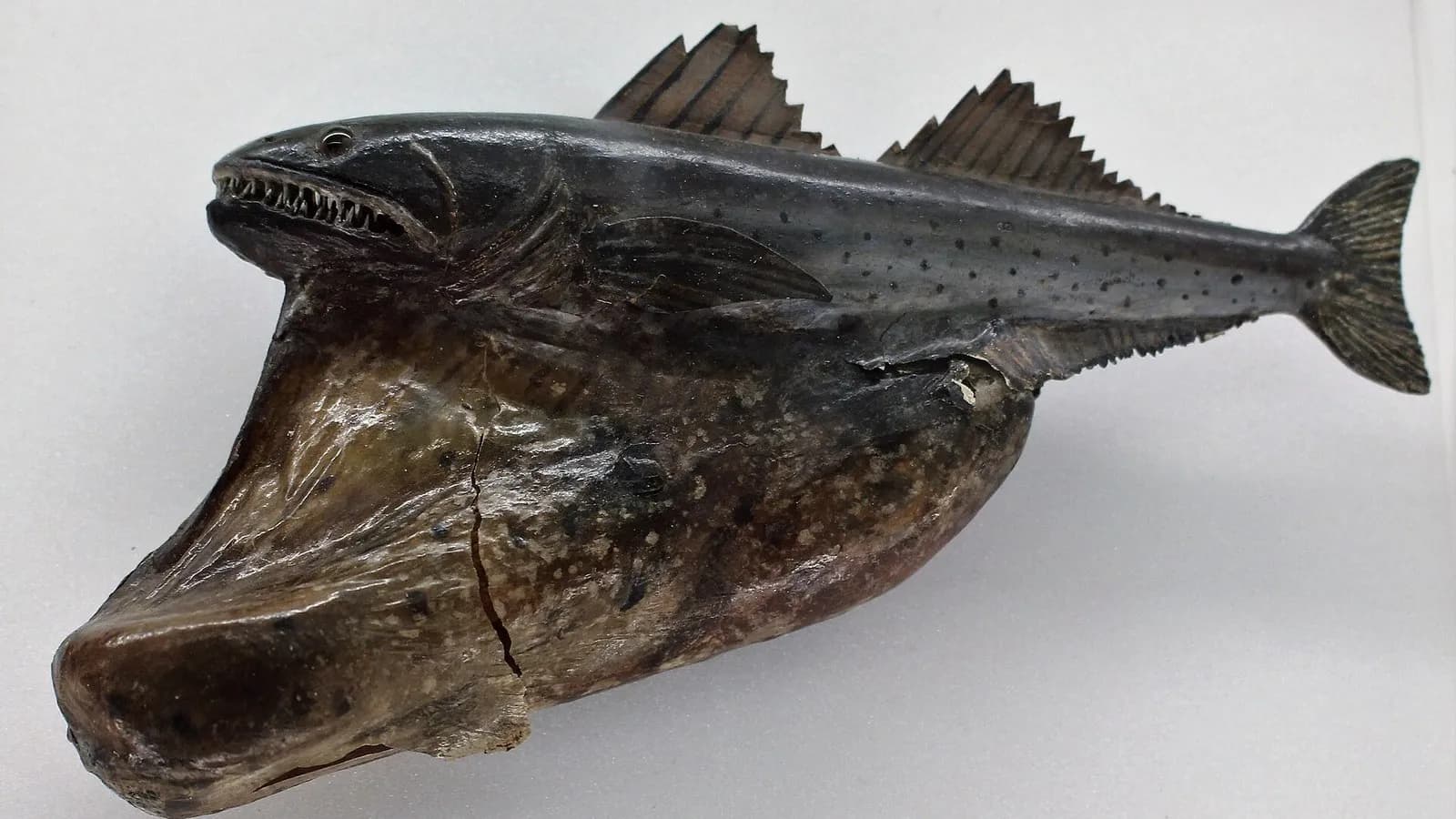
In the dark at 1,259 metres, a fish no longer than a hand has swallowed something far bigger than itself. Cameras on a remotely operated vehicle (ROV) caught a black swallower, Chiasmodon niger, with its belly distended to a startling size off Trinidad and Tobago, ScienceAlert reported on 12 October.
This is ROV footage, not a human dive: the depth is far beyond anything a scuba diver could reach, and the species lives in the dark waters scientists seldom see.
How did the footage happen?
The fish was filmed during a month-long expedition in July aboard the Schmidt Ocean Institute's research vessel Falkor (too), using its ROV SuBastian. Diva Amon, the expedition's chief scientist, said she never imagined she would get a second chance to see one. "If only we had a CT scanner at sea," she said of working out what the fish had eaten.
Black swallowers typically measure 10 to 20 centimetres. ScienceAlert notes that they can eat prey up to ten times their mass, and cites a 2007 case in the Cayman Islands in which a 19 centimetre specimen had swallowed an 86 centimetre snake mackerel.
What else did the expedition find?
The Institute calls it the first locally led deep-sea expedition in Trinidad and Tobago's history. Ninety-three percent of the country lies below recreational scuba depths, so the work targeted the mesophotic zone, from 30 to 199 metres, and the deep ocean beyond.
The team mapped 11,335 square kilometres of uncharted seafloor, about 13 percent of the country's marine territory. They confirmed 25 cold seep ecosystems, found about 20 suspected new species, three of which may be new genera, and recorded at least 54 species never before seen in the country's waters, including ghost sharks and zombie worms. A manta ray carcass lay at 1,025 metres, feeding crabs and worms.
Among the animals confirmed was a Graneledone octopus first seen during a 2014 expedition that Amon joined, which this time was collected for study. The ship also ran a ship-to-shore programme that reached more than 2,000 people, and school and university visits before sailing reached over 1,000 more.
Where do the specimens go?
More than 700 specimens will go to the Zoology Museum at the University of the West Indies, St Augustine, which will grow its deep-sea collection twelve-fold. The team also tested a new cryoprotectant, preserving tissues from more than 86 species of sponges, corals and sea cucumbers, a step toward what one scientist described as the Caribbean's first frozen zoo.
The Institute also reports that the cameras found human litter on the deep seafloor. Amon said the discoveries prove Caribbean scientists can uncover their own deep-sea backyard. Next come the formal descriptions of the new species, which will show how many of those suspected finds hold up.
Published in The Outspoken Digest
Editorial desk
Outspoken Digest Diving DeskCovers freediving, recreational and technical diving, dive medicine and the incidents the sport learns from.
Newsletter
The Digest, in your inbox
One edition, sent when it is ready. No noise, and your address is never passed on.
Read Next
More Diving →
Playing Recordings of a Healthy Reef Drew More Coral and Fish Larvae to Artificial Structures Off Hawaii
Oct 9, 2026/3 min read
Blacktip Sharks Can Hear a Sound From Nearly 250 Feet Away and Swim Straight Toward or Away From It
Oct 1, 2026/2 min read
A Sea Turtle Species Never Recorded Nesting in the United States Laid Eggs on a Southern California Beach
Oct 1, 2026/2 min read
Marine Surveyors Confirmed Living Coral Off Benin, More Than Sixty Years After the Reef Was Presumed Dead
Sep 29, 2026/2 min read