Why Cave Diving Runs on Its Own Set of Rules
Cave diving safety rests on a small set of hard rules built from decades of accident analysis. Here is what those rules are and why the sport enforces them so strictly.
Tuesday, June 2, 2026/4 min read
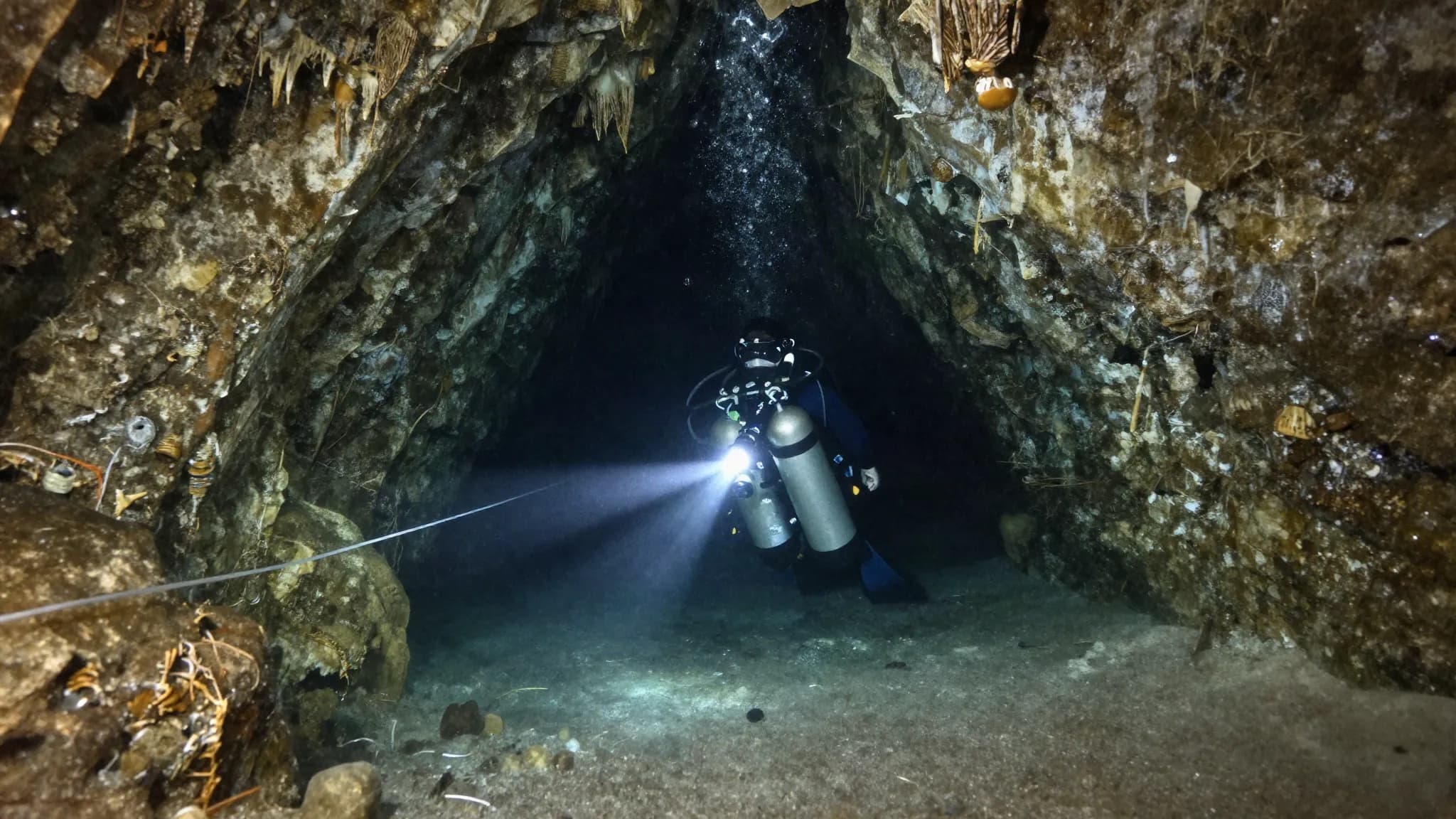
Cave diving looks, on video, like exploration: a torch beam sweeping across white limestone, a diver drifting through water so clear it barely seems to be there. What the footage rarely shows is the rulebook running underneath it, a set of hard constraints that has been refined, largely through the analysis of past fatalities, into some of the strictest procedural discipline in any recreational or technical sport.
This piece is about that rulebook in general terms. It is not a verdict on any specific accident, including the recent tragedy in the Maldives, where investigations remain open. It is an explanation of why cave diving is treated as a categorically different activity from open water diving, and what the accepted mitigations for its risks actually are.
Why caves are treated differently from open water
The defining fact of cave diving is that it takes place in what divers call an overhead environment: there is solid rock between the diver and the surface, and a direct emergency ascent is not possible. If something goes wrong, the only way out is back the way the diver came in, often through the same silt, the same tight sections, sometimes with degraded visibility from disturbed sediment. That single structural fact changes almost everything about how the dive has to be planned.
The rule of thirds and why it exists
The best known gas planning rule in cave diving is the rule of thirds: use one third of the breathing gas for the way in, reserve one third for the way out, and keep the final third entirely in reserve for an emergency, such as sharing air with a dive partner whose supply has failed. As explained in a summary from Wikipedia's entry on the practice, the rule generally applies only to overhead environments precisely because there is no option to simply surface if gas planning goes wrong. The margin it builds in has repeatedly proven sufficient even when an exit is slowed by poor visibility, a lost guideline, or elevated gas consumption from stress.
Violating the rule of thirds, technical diving analysis consistently finds, is one of the more common contributing factors in cave diving fatalities. Running low on gas while still inside a cave, particularly if compounded by disorientation, removes any margin for the unexpected.
Sheck Exley's five rules and their legacy
Much of modern cave diving safety practice traces back to an unusually rigorous piece of internal industry work. In 1979, cave explorer Sheck Exley conducted a systematic analysis of cave diving fatalities and distilled the recurring causes into what became known as the five rules of survival, generally summarised as training, guideline, depth, gas and lights, as described in coverage from InDEPTH magazine. Each rule maps directly onto a documented pattern in fatal accidents: divers without cave-specific training attempting cave penetration, divers losing a continuous guideline back to open water, divers exceeding depths appropriate to their training or gas mix, divers running out of breathing gas, and divers losing light with no adequate backup.
The guideline: cave diving's most basic tool
A continuous guideline, a physical line run from open water into the cave and never left, is treated as close to non-negotiable in cave diving training. Guidance from operators such as Adrex and Koox Diving frames the line as the one thing standing between a diver and disorientation in zero visibility, since silt disturbed by fin kicks can reduce visibility to nothing within seconds in some caves. A diver who loses contact with the line in a silted-out cave has lost their only reliable route back to the surface.
Training as the rule underneath all the other rules
Every agency that certifies cave divers, and every serious analysis of cave diving accidents, treats training as the foundational rule rather than one item among five. Cave-specific certification teaches not just the mechanics of running a line or planning gas, but the judgment to turn a dive around early, the ability to manage task loading under stress, and specific drills for silt-out and lost-line scenarios that open water training never covers. As one review of technical diving fatalities in California Diver Magazine puts it, most fatal cave and technical diving accidents involve a chain of smaller decisions rather than one single catastrophic failure, and training is largely what teaches divers to interrupt that chain early.
This is journalism, not instruction. Anyone considering cave or technical diving training should pursue it through a certified agency and a qualified instructor, not through an article. The rules described here exist because divers before us paid to learn what happens when they are ignored, and the sport has spent decades trying to make sure that price is not paid twice for the same lesson.
Published in The Outspoken Digest
Editorial desk
Outspoken Digest Diving DeskCovers freediving, recreational and technical diving, dive medicine and the incidents the sport learns from.
Newsletter
The Digest, in your inbox
One edition, sent when it is ready. No noise, and your address is never passed on.
Read Next
More Diving →
Playing Recordings of a Healthy Reef Drew More Coral and Fish Larvae to Artificial Structures Off Hawaii
Oct 9, 2026/3 min read

Blacktip Sharks Can Hear a Sound From Nearly 250 Feet Away and Swim Straight Toward or Away From It
Oct 1, 2026/2 min read

A Sea Turtle Species Never Recorded Nesting in the United States Laid Eggs on a Southern California Beach
Oct 1, 2026/2 min read

Marine Surveyors Confirmed Living Coral Off Benin, More Than Sixty Years After the Reef Was Presumed Dead
Sep 29, 2026/2 min read