Deep Dive Dubai: 60 Metres of Water and No Weather at All
The world's deepest pool holds 14 million litres at a constant 30C, with a sunken city at the bottom. What it removes from diving turns out to be the interesting part.
Thursday, August 6, 2026/4 min read
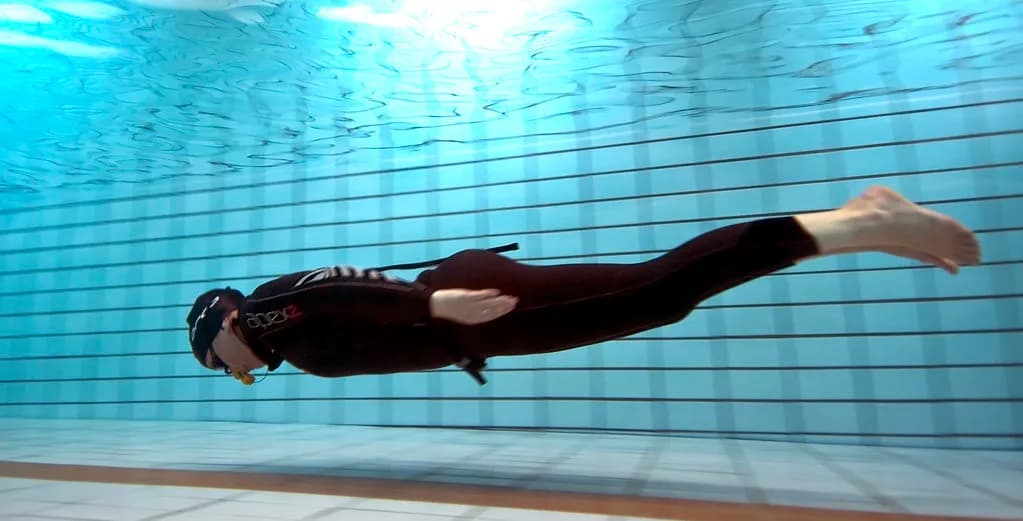
Every open water dive carries a set of variables the diver does not control. Visibility, current, surface conditions, temperature, and the weather that decides whether the boat goes out at all.
Deep Dive Dubai removes every one of them, and what is left is an unusually pure version of the activity.
The pool in Nad Al Sheba reaches 60.02 metres and holds 14 million litres, about six Olympic pools' worth. It holds the Guinness World Record for the deepest swimming pool for diving, taking the title from Poland's Deepspot at 45 metres.
The sunken city
The depth alone would be a curiosity. What makes it strange is what has been built at the bottom.
Divers descend through an abandoned streetscape: an apartment, a garage, an arcade. There is a working foosball table, a chess board and a pool table down there, as Gulf News described when it opened.
It reads as a theme park detail and functions as something more useful. A structured environment with rooms, doorways and defined spaces is a better training environment than open blue water, because navigation, buoyancy and awareness all become measurable against fixed reference points.
The engineering underneath
Keeping 14 million litres clear enough to see across is the actual achievement.
The water is filtered and fully circulated every six hours through a system using siliceous volcanic rock, with UV treatment and technology originally developed by NASA, according to CNBC's reporting at the opening. The temperature is held at 30C throughout.
That last figure is doing more work than it appears. Thermal stress is a significant contributor to fatigue and to poor decision making on deep dives, and eliminating it removes a variable that open water can never remove.
What it is genuinely good for
Training, primarily, and for freedivers more than anyone.
Competitive freediving depth attempts require calm conditions, a safety team, and a line, and open water supplies none of that reliably. A facility with constant conditions and immediate surface access lets a freediver work on equalisation, on mouthfill technique and on depth adaptation without waiting for a weather window.
For scuba divers it is a controlled place to build comfort at depth, and for instructors it is a place where a skills assessment is not disrupted by a passing current. The facility offers both scuba and freediving experiences and certifications for a range of abilities.
What it cannot replace
This deserves saying plainly, because the marketing will not.
Depth in a pool is real depth. Sixty metres of freshwater produces genuine pressure, genuine gas loading and a genuine decompression obligation, and nitrogen narcosis does not check whether you are indoors. The physics is unchanged.
What is absent is everything else. There is no current to read, no boat to re board in a swell, no navigation problem, no marine life behaving unpredictably, and no situation where the surface is a long way away and the conditions have turned. Those are the skills that keep divers alive in open water, and they cannot be learned in a tank however deep it is.
A diver who is comfortable at 40 metres in Nad Al Sheba is not thereby ready for 40 metres offshore. The pool builds a component of competence, not the whole of it.
What 60 metres of fresh water does to a body
The pool is often described as safe, and it is worth being precise about what that does and does not mean.
At 60 metres the ambient pressure is around seven atmospheres. A diver breathing air at that depth is subject to nitrogen narcosis, and the impairment is real regardless of the surroundings being controlled. Gas consumption rises proportionally with depth, so a cylinder that lasts an hour at the surface lasts a fraction of that at the bottom.
Decompression obligation accrues exactly as it would in the sea. A dive profile that takes a diver to the deepest point and back without staged ascent is not made acceptable by the tiles.
The genuine safety advantage is response time. A problem at depth in open water may be a long way from help; here the surface is directly overhead, supervised, with staff and equipment immediately available. That changes outcomes without changing physiology.
The freediving case specifically
For freedivers the facility solves a scheduling problem that has constrained the discipline for its whole history.
Depth training requires a vertical line, calm water, safety divers and good visibility. Open water supplies all four unpredictably, and a training block can lose a week to weather. A controlled 60 metre column removes that variance entirely, letting athletes work on equalisation and adaptation on a schedule.
Freediving has spent the last two decades building formal safety structures, and a facility of this type fits that direction. Practising the hardest part of the sport in the most controlled available environment is the same logic that produced counterballast systems and standardised safety protocols. The record documentation covers the facility's scale; what it is used for day to day is training.
What to watch next
The interesting question is whether facilities like this change how diving is taught. If depth training becomes something done in controlled conditions before anyone goes to sea, that is a safety gain worth having.
The risk runs the other way too. A generation that learns depth without weather may arrive at open water with confidence that has not been tested by anything unpredictable, and the sea supplies the unpredictable reliably.
Published in The Outspoken Digest
Editorial desk
Outspoken Digest Diving DeskCovers freediving, recreational and technical diving, dive medicine and the incidents the sport learns from.
Newsletter
The Digest, in your inbox
One edition, sent when it is ready. No noise, and your address is never passed on.
Read Next
More Diving →
Breathless and Coughing Pink Froth After a Dive: Immersion Pulmonary Edema Explained
Oct 17, 2026/3 min read
Your Gas Consumption Is Not One Number: Why Depth, Cold and Nerves Change It
Oct 16, 2026/3 min read
SS United States Reef Sinking Targeted for November: What Divers Should Know
Oct 16, 2026/2 min read
Divers Excavating Off Kekova Find a Wreck Believed to Be the World's Oldest, Turkey Says
Oct 15, 2026/2 min read