Lebanon Dives Its Own History, Including a Vichy Submarine
A French submarine at 36 metres, a 1939 freighter at 40, and a Victorian battleship far beyond recreational limits. Lebanon's coast is a wreck list before it is a reef.
Thursday, August 6, 2026/4 min read
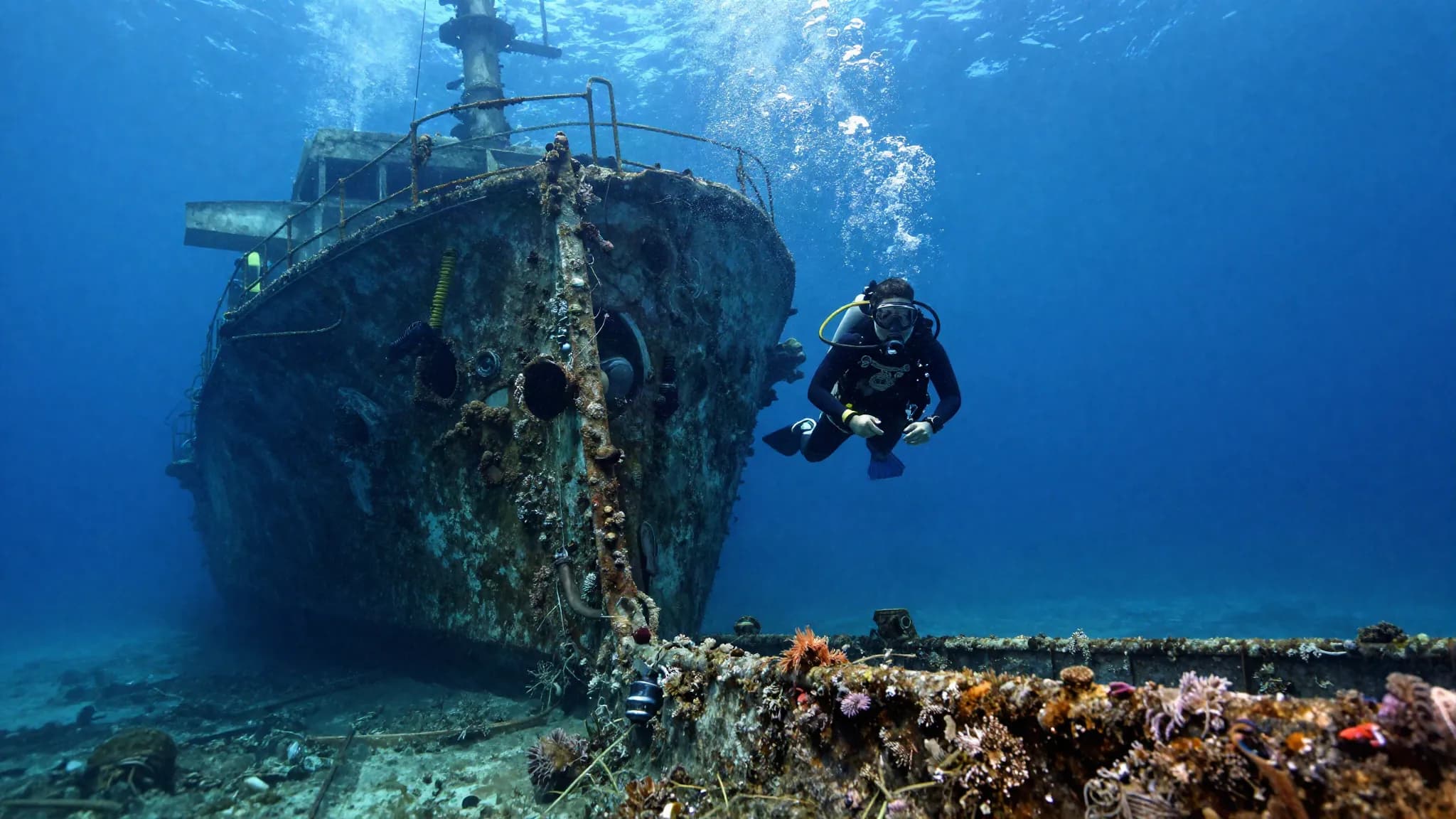
Lebanon does not appear on many dive holiday lists, and the reason is not the diving. The eastern Mediterranean has thinner marine life than the Red Sea and nothing resembling a tropical reef. What it has instead is a coastline that people have been fighting over, trading along and sinking ships beside for several thousand years.
The result is a wreck list rather than a reef list, and some of the entries are remarkable.
The submarine
The Souffleur was a French submarine of the Vichy period, and she lies at around 36 metres. TDI SDI's account of Lebanon's wrecks places her among the country's significant sites.
A submarine is an unusual thing to dive. The scale reads wrong at first, narrower and longer than instinct expects, and the pressure hull gives very few of the visual cues that make a surface ship legible underwater.
At 36 metres she is a technical or advanced recreational dive with a short working window. Nitrogen loading at that depth leaves little room for wandering.
Batroun and the freighters
The stretch between Byblos and Batroun is where most recreational diving happens, helped by clear water and good visibility, according to local dive guides.
The Cement Freight wreck, a freighter that sank in 1939, sits at about 40 metres. The Alice B, a cargo ship, lies shallower at around 30 metres with a hull well colonised by coral and fish, which makes it the more accessible of the two and the usual introduction to Lebanese wreck diving.
Thirty metres in the Mediterranean is a different proposition from thirty metres in the Red Sea. Water temperatures across the season run from about 15C to 30C, so a dive in spring wants considerably more exposure protection than a dive in late summer.
The wreck nobody dives
HMS Victoria is the site that makes Lebanon interesting to a particular kind of diver, and impossible for almost everyone else.
The British battleship collided with HMS Camperdown near Tripoli and sank on 22 June 1893, killing 358 crew. She lies in an extraordinary position: bow buried in the seabed, roughly a third of the hull standing vertical, with the propeller starting at around 73 metres and the wreck dropping to about 150.
Those numbers put her far outside recreational diving and outside most technical diving too. A dive to 100 metres and beyond on a vertical wreck is a serious mixed gas undertaking with a decompression obligation measured in hours, and it belongs to a small number of divers with specific training, equipment and support.
It is also, again, a grave for 358 people. The respect that fact demands is not optional.
What conditions actually ask
Lebanese diving is mostly boat or shore access along a developed coast, with the practical constraints that implies: harbour traffic, variable runoff after rain, and visibility that depends heavily on recent weather.
Depth is the recurring theme. The interesting wrecks sit at 30 metres and below, which pushes almost everything worth seeing into advanced territory and makes gas planning and ascent discipline the defining skills rather than buoyancy alone.
Check what recompression facilities are accessible before diving deep here, and dive with operators who can answer that question without hesitating. That applies anywhere, and it applies with more force on a coast where the good sites are deep.
What the eastern Mediterranean actually offers
It is worth setting expectations honestly, because divers arriving from the Red Sea are frequently disappointed for the wrong reasons.
The eastern Mediterranean is a comparatively low nutrient sea with far less coral cover and fewer large fish than tropical destinations. There is no wall of anthias, no reef shark, no soft coral garden. What lives here is smaller, subtler and heavily affected by a long history of fishing pressure.
Diving Lebanon for marine life is the wrong reason to go. Diving it for structure, history and water that is often extremely clear is the right one.
Seasonality decides more than anything
Water temperature across the year runs roughly from 15C to 30C, which is an enormous operational range.
At the bottom of that range a 30 metre dive needs a serious exposure suit, and cold accelerates gas consumption and fatigue in ways that shorten an already limited deep window. At the top end the same dive is comfortable in a thin wetsuit.
Surface conditions follow the same pattern. Winter storms in the eastern Mediterranean close sites for days, and the diving season concentrates accordingly. Local guides such as Lebanon Traveler's site list are the practical reference for what is reachable when.
The archaeology nobody has finished counting
Lebanon's coast carried Phoenician, Roman, Crusader, Ottoman and twentieth century shipping, and the seabed holds the consequences of all of it.
Much of that material sits in shallow water near ports that have been continuously occupied for millennia, which is both why it survives and why it is difficult to work on. Modern harbour development, dredging and construction have destroyed an unknown quantity of it.
For divers the practical point is that anything on the seabed here may be archaeology rather than debris, and the correct response to an interesting object is to photograph its position and leave it exactly where it is.
What to watch next
Lebanon's dive scene is small, locally run and largely undocumented compared with its neighbours. The wrecks are not going anywhere, but the knowledge about them sits with a limited number of operators.
The interesting development would be systematic survey and documentation, of the kind that has turned other Mediterranean coastlines into archaeological resources rather than just dive sites. A country with a Victorian battleship standing on its nose off Tripoli has more to work with than most.
Published in The Outspoken Digest
Editorial desk
Outspoken Digest Diving DeskCovers freediving, recreational and technical diving, dive medicine and the incidents the sport learns from.
Newsletter
The Digest, in your inbox
One edition, sent when it is ready. No noise, and your address is never passed on.
Read Next
More Diving →
Breathless and Coughing Pink Froth After a Dive: Immersion Pulmonary Edema Explained
Oct 17, 2026/3 min read
Your Gas Consumption Is Not One Number: Why Depth, Cold and Nerves Change It
Oct 16, 2026/3 min read
SS United States Reef Sinking Targeted for November: What Divers Should Know
Oct 16, 2026/2 min read
Divers Excavating Off Kekova Find a Wreck Believed to Be the World's Oldest, Turkey Says
Oct 15, 2026/2 min read