England Had 8 Percent of Its Normal July Rain. Now Come the Bills.
Wheat and oat yields are poor, livestock farmers are eating into winter feed in August, and growers are running out of irrigation water. The Farmers' Union calls this the third drought in five years.
Outspoken Digest Food Economics Desk
Tuesday, August 4, 2026/4 min read
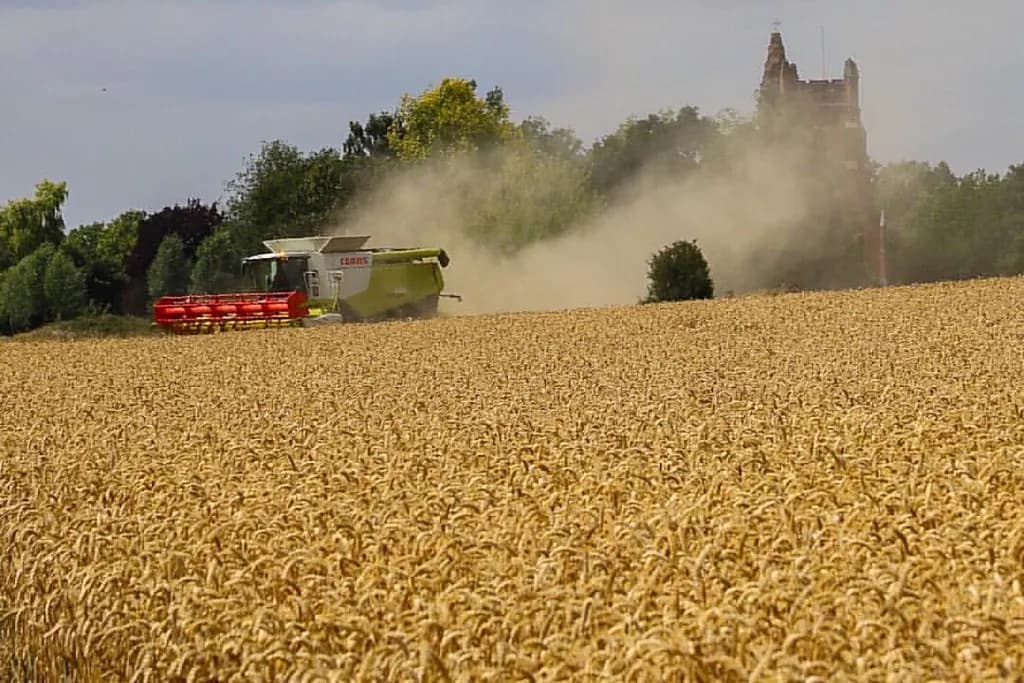
Droughts are usually discussed as a weather story, which is why they are usually discussed too late. The economic consequence arrives months after the dry spell, in a shop, attached to a price.
England recorded 5.6mm of rain in July, around 8 percent of the long term monthly average, making it likely the driest July since records began. That is not a dry month. That is an absence of one.
What farmers are actually reporting
The National Farmers' Union has been specific rather than atmospheric about it. NFU president Tom Bradshaw described wheat and oat yields this year as very, very poor, and said livestock farmers have been forced into their winter feed rations because grass simply has not grown.
That second detail is the one to sit with. Winter feed exists to get animals through winter. Using it in August means buying more later, at whatever price it costs by then.
Vegetable growers face a different squeeze. As reporting on the union's warning sets out, they are running low on irrigation water, which reduces how much food is produced domestically and raises the cost of producing it.
Why one bad summer becomes a multi year problem
British agriculture went into this from a waterlogged winter, and the combination is what makes it unusual. Fields too wet to plant, followed by fields too dry to grow.
Farming groups are no longer describing this as bad luck. It is the third drought in five years, and the language coming from the sector treats it as the new operating condition rather than an outlier to be endured.
The Gulf News account of the spring drought, the worst in nearly seventy years, gives a sense of how long this has been building.
What it means for prices
Domestic shortfalls do not usually empty shelves in a country that imports as much as Britain does. They change what is on them and what it costs, because the gap gets filled from abroad at whatever the world market charges, with freight and currency on top.
The effect is slow and cumulative rather than dramatic. A poor cereal harvest feeds into animal feed, which feeds into meat and dairy, which arrives on a receipt several months later.
The part that is a policy question
Water restrictions and calls to reduce unnecessary use are sensible in a drought and irrelevant to the underlying problem. Agriculture needs water at specific moments in a growing season, and a hosepipe ban does not move water to a field in June.
The real question is storage and irrigation infrastructure built for a climate that no longer shows up reliably. That is a capital spending decision, and capital spending decisions are made in years, not growing seasons.
Why irrigation is not the simple answer
The obvious response to drought is to water the crops, and in England that runs into a licensing system rather than a technical limit. Abstraction from rivers and groundwater is permitted under licence, and in dry conditions those licences are exactly what gets restricted, because the same water is needed for public supply and for the rivers themselves.
So the moment a farmer most needs to irrigate is the moment abstraction is most likely to be curtailed. That is not a design flaw so much as an unavoidable conflict, and it is why on farm reservoirs, filled in wet months and drawn down in dry ones, keep coming up as the structural fix.
Reservoirs are expensive, require planning permission and take years. They are also the sort of investment a farm makes only if it expects to still be farming in a decade.
The livestock arithmetic
The grass failure deserves more attention than the cereal headline. Grazing livestock convert grass, which is nearly free, into meat and milk. When grass fails, that free input is replaced by bought feed at market prices, in a year when everyone else is buying too.
Farmers facing that choice can buy feed and lose margin, or reduce the herd. Herd reduction lowers demand for feed and lowers supply of meat and milk the following year, which is how a dry summer turns into higher prices twelve to eighteen months later.
Rebuilding a herd afterwards takes years, because the constraint is biological. This is the mechanism by which a single bad season leaves a mark on supply long after the rain returns.
Where the imports come from
A domestic shortfall gets covered by buying abroad, and that exposes British food prices to conditions in other growing seasons as well as its own.
The complication is that heat and drought are not confined to England. When several producing regions have a poor year at once, the global market that is supposed to absorb one country shortfall is absorbing several, and the buffer thins exactly when it is needed.
Currency matters too. Imported food is priced in other currencies, so a weak pound raises the shelf price without anything happening to a harvest at all.
Who absorbs the cost
A shortfall does not distribute evenly through the supply chain. Supermarkets buy on contracts agreed in advance, so in the short run growers carry the gap between what it cost to produce and what they agreed to sell for.
That is survivable once. Repeated across successive difficult seasons it pushes marginal producers out of the sector entirely, and the capacity does not come back when conditions improve, because re-entering arable or dairy farming requires capital that a departing farmer has usually already lost.
This is the mechanism that turns a run of bad weather into a permanent reduction in domestic production, and it operates quietly, farm by farm, without ever producing a headline.
What to watch next
Watch the autumn planting window. A dry, hard seedbed makes drilling difficult, and a poor autumn planting sets up a second constrained harvest before anybody has recovered from the first.
That is how a weather event becomes a food price story, and it is why this one is worth following after the heatwave stops being on the news.
Published in The Outspoken Digest
Editorial desk
Outspoken Digest Food Economics DeskCooking, ingredients, restaurants and the economics of what ends up on the table.
Newsletter
The Digest, in your inbox
One edition, sent when it is ready. No noise, and your address is never passed on.
Read Next
More Business →
Tesla Beats Profit Estimates on $28.05 Billion in Revenue, Then Slips After Hours
Oct 22, 2026/2 min read
Nasdaq Jumps 1.05% as SpaceX and Super Micro Revive the AI Trade While Netflix and AT&T Slide
Oct 22, 2026/2 min read
Jio Platforms Raises Rs 8,110 Crore From Anchors at the Top of Its Range as India's Biggest IPO Opens
Oct 21, 2026/2 min read
Netflix Beats on Profit, Then Slides After Hours as It Trims Its Ad Forecast and Guides Lower
Oct 21, 2026/2 min read