ESA's Euclid Telescope Finds Its First New Comet, Spotted by Software as a Streak Across Five Images
A dark-energy survey telescope has picked up a long-period comet 1.3 billion km away, and ESA says the discovery was a happy accident rather than part of the mission plan.
Monday, October 19, 2026/2 min read
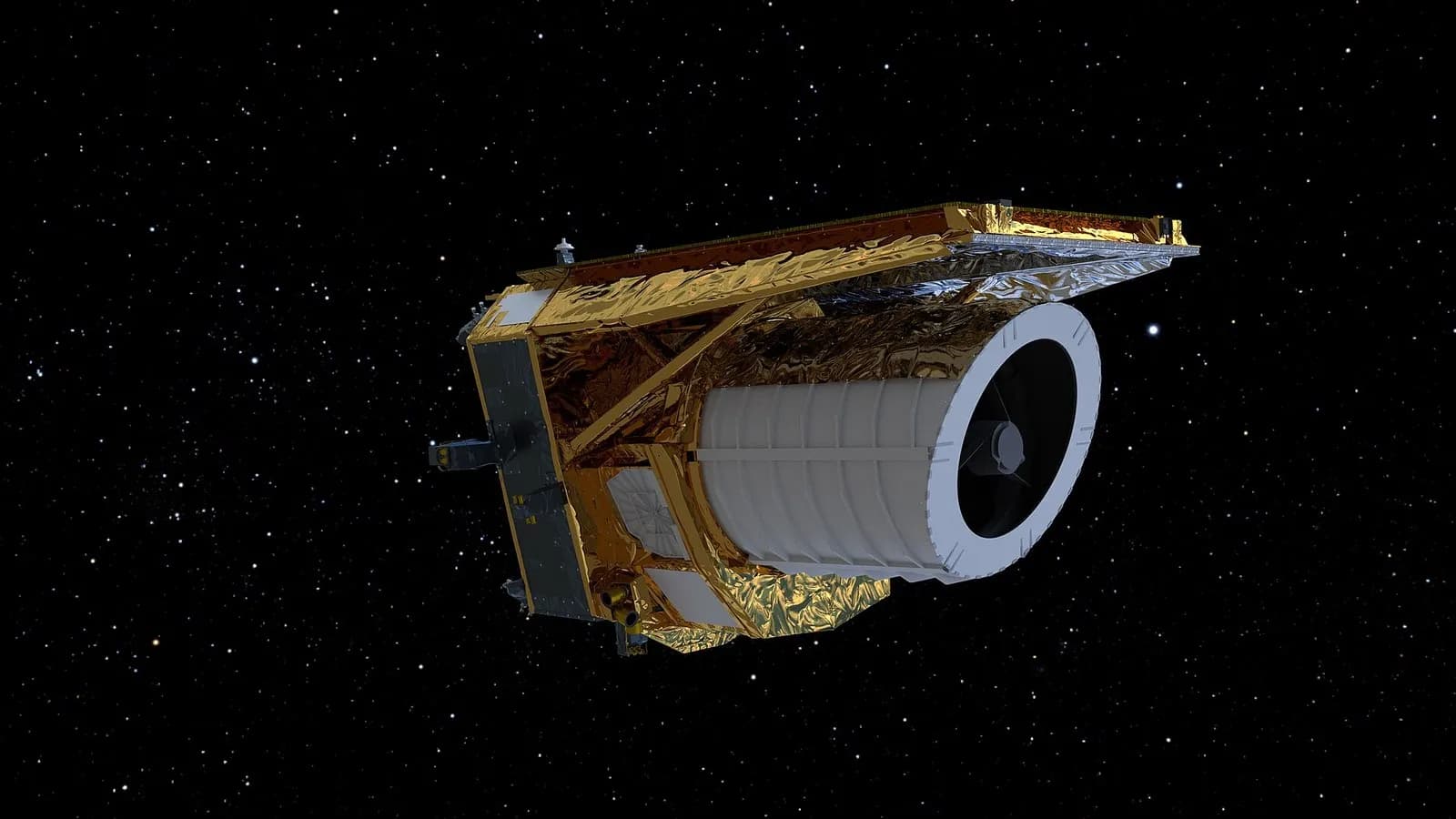
The European Space Agency's Euclid telescope was built to map the dark side of the universe, not to hunt comets. It has just found one anyway. ESA announced on 19 October that Euclid has discovered a previously unknown comet, now designated C/2026 S1 (Euclid), the first new comet in the mission's history, according to ESA's release.
The object is about 1.3 billion kilometres from Earth, in the region between the orbits of Jupiter and Saturn as measured from the Sun, and it takes thousands of years to complete one orbit around it.
How did Euclid find the comet?
With software. Mikko Pontinen of the University of Helsinki, working with the Solar System Objects Science Working Group of the Euclid Consortium, had written a moving-object detection tool for the telescope's images. It flagged a streak smeared across several exposures taken between 16 and 24 September 2026. "I was excited to see my software flag a 'streak' smeared across several images," he said in ESA's account, quoted by Universe Today.
Pontinen predicted where the object should appear in other images and found it in five sets of fields, 16 exposures in total. A fuzzy cloud around the streak suggested it was a comet shedding dust and gas rather than a rock. The images came from Euclid Deep Field North, which Universe Today places in the constellation Draco.
Is C/2026 S1 a real comet?
Yes. After checks found no match in known catalogues, Pontinen reported the object to the Minor Planet Center of the International Astronomical Union, which confirmed it as a comet on 8 October, ESA said. Follow-up observations from the ground helped.
The timeline is short. The last of those images was taken on 24 September, the Minor Planet Center confirmed the comet on 8 October, and ESA published its announcement on 19 October, about three and a half weeks after the final exposure.
It is also an oddball in orbit. Unlike most objects in the Solar System, which follow the plane of the planets, this one sits well above it. ESA describes it as currently straight up from the Sun's point of view, which is how it passed through one of Euclid's survey fields.
Why does it matter for Euclid and for Comet Interceptor?
The discovery is a happy coincidence, Euclid Archive Scientist Bruno Altieri said, because very few comets are expected from the survey. Euclid Project Scientist Valeria Pettorino said this comet is not a suitable candidate for Comet Interceptor, ESA's planned mission to a comet, but described it as a real test case for how the two mission teams will coordinate in future.
The orbital period will be refined as more observations arrive. That is the next step: more follow-up from ground telescopes, and a firmer answer on how long this visitor takes to loop back, which ESA says is likely thousands of years.
Published in The Outspoken Digest
Editorial desk
Outspoken Digest Science DeskReports for The Outspoken Digest across Technology, Latest Trends, Health.
Newsletter
The Digest, in your inbox
One edition, sent when it is ready. No noise, and your address is never passed on.
Read Next
More Technology →
What PHP2Shell Reveals About Maintaining the Code Behind Most of the Web
Oct 22, 2026/3 min read

PHP2Shell for Hosts, Developers and Security Teams: Backports, WAF Rules and Incident Response
Oct 22, 2026/3 min read
PHP2Shell: What Website Owners and Small Businesses Should Do Right Now
Oct 22, 2026/3 min read

PHP2Shell Timeline: From a Quiet August Report to a Leak, Early Attacks and a Day-Early Patch
Oct 22, 2026/3 min read