Freedivers on Breath-Hold Have Pulled 1.3 Million Pounds of Ghost Nets Off Hawaii's Remote Reefs
The Papahanaumokuakea Marine Debris Project works without scuba, in dives of 30 feet or less, and has just closed a five-year campaign with 147,000 pounds removed this season.
Tuesday, November 3, 2026/3 min read
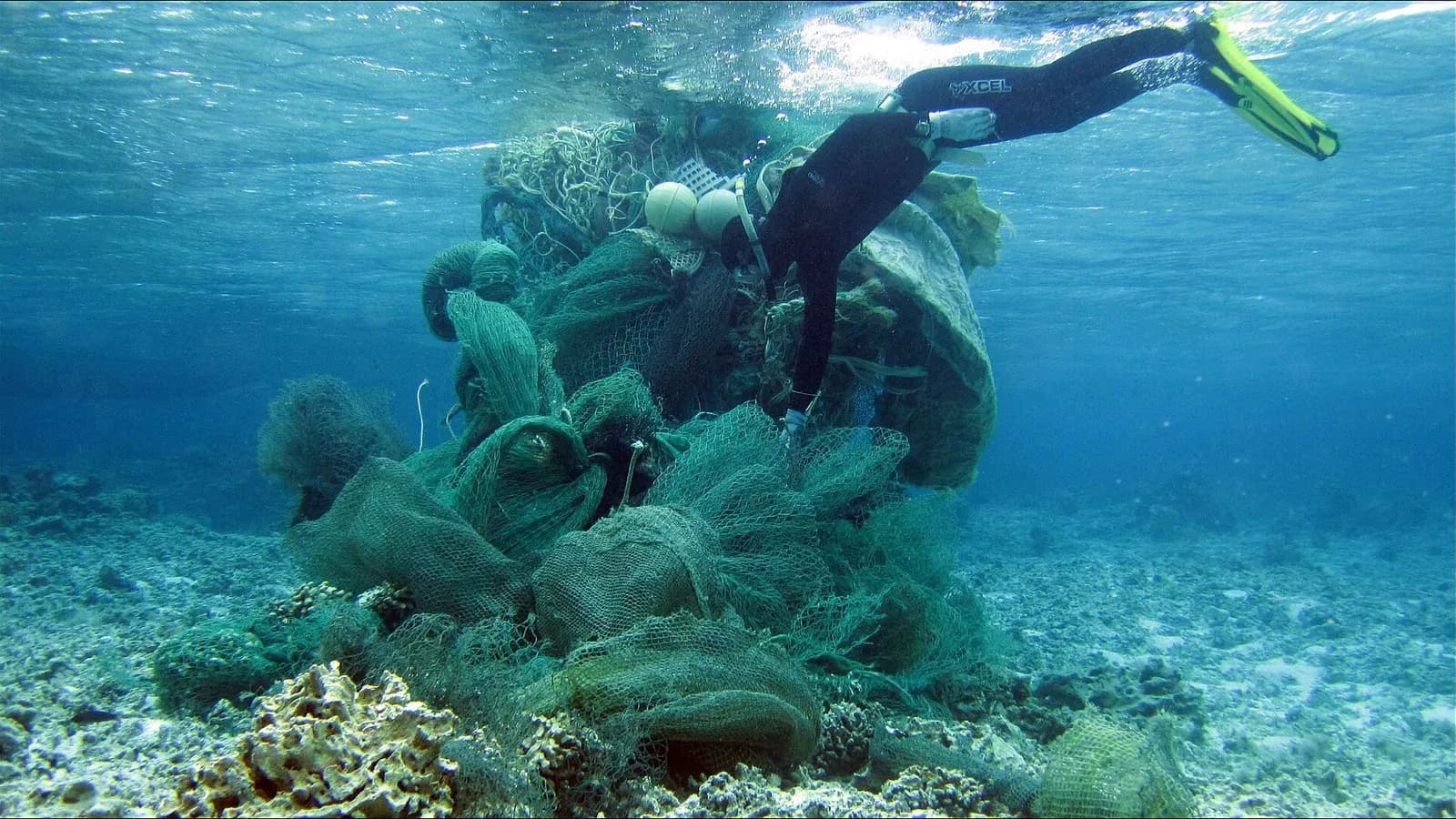
Nobody on the Papahanaumokuakea Marine Debris Project's boats wears a tank. Every net the Hawaii nonprofit has cut off a coral reef in the Northwestern Hawaiian Islands since 2020, more than 1.3 million pounds of it, came up on a single breath. The Scuba News set out the method on Sunday: dives limited to about 30 feet, within each diver's breath-hold, repeated hundreds of times a day from small inflatable workboats hundreds of miles from Honolulu.
The timing is a milestone. In October the project, known as PMDP, wrapped up Catch Up and Keep Up, a five-year campaign begun in 2022, and Hawaii News Now reported that the 2026 season alone removed more than 147,000 pounds of debris across three expeditions and 65 days at sea.
Why freedive instead of scuba?
The reefs where nets snag are shallow, and the work is fast and repetitive: locate a net, cut it free of the coral with hand tools, break a large mass into pieces and float them to the boat. Without cylinders, regulators or a compressor on board, divers move between surface and reef in seconds and the logistics of a remote, multi-week expedition get simpler. The Scuba News is careful to note that this is working freediving, not the competitive discipline, and that depth is kept well inside each diver's comfortable range.
Papahanaumokuakea, a national marine sanctuary and marine national monument, stretches about 1,200 miles northwest of the main islands. Expeditions take several days by vessel to reach it. PMDP estimates that around 200,000 pounds of new debris arrives each year, roughly 115,000 pounds of it as nets on shallow reefs and 85,000 pounds along shorelines, so the campaign's name describes the problem: catch up on the backlog, then keep up with the inflow.
What the 2026 season brought home
The final 2026 expedition left Honolulu on 14 September and worked Kamole, Kapou, Manawai and Holaniku, returning with about 47,000 pounds, including 28,730 pounds of derelict nets from reefs, 15,290 pounds of nets from shorelines and nearly 3,000 pounds of shoreline plastics, Hawaii News Now reported in October. Crews freed five entangled green sea turtles on that trip; since 2020 the project counts 20 turtles and three Hawaiian monk seals rescued. Operations ended a day early as Hurricane Nolo moved through.
About 80 percent of everything recovered is abandoned fishing gear. The heaviest single net the team has lifted weighed more than 23,000 pounds. Recovered nets go to Honolulu, where PMDP works with partners including Hawaii Pacific University's Center for Marine Debris Research and the city's H-POWER waste-to-energy plant, and is testing recycling into plastic lumber and 3D-printing filament.
What happens after the five-year campaign
James Morioka, PMDP's executive director, who has spent more than 500 days in the Northwestern Hawaiian Islands since 2011, is now looking for new funding and partners to keep large-scale removal going, with paid positions advertised from January 2027. The group is also testing better cutting tools, flotation and towing systems, mechanical lifting gear, aerial surveys and diver propulsion vehicles, and wants to measure success by entanglements prevented and reef damage avoided, not pounds alone. In September it ran the first live broadcast from a remote reef in the monument, reaching more than 300 participants, most of them Hawaii students.
This article is journalism, not instruction: freediving, even in shallow water, carries real risks, including shallow water blackout, and training belongs with a certified instructor and agency. Nets will keep arriving on the current whatever happens to PMDP's budget; the question for 2027 is whether the breath-hold crews will be there to meet them.
Published in The Outspoken Digest
Editorial desk
Outspoken Digest Diving DeskCovers freediving, recreational and technical diving, dive medicine and the incidents the sport learns from.
Newsletter
The Digest, in your inbox
One edition, sent when it is ready. No noise, and your address is never passed on.
Read Next
More Diving →
Divers Find the SS Cornwallis, a Canadian Freighter Torpedoed Off Maine in 1944, Nearly 400 Feet Down
Oct 30, 2026/2 min read
IUCN's First Red List of Coral Reef Ecosystems Rates 96 Percent of Shallow Reefs Critically Endangered
Oct 29, 2026/2 min read
Carabinieri Divers Rediscover Roman Wine Amphorae Off Camogli, 67 Years After They Were First Reported
Oct 28, 2026/2 min read
Divers Cement Storm-Torn Corals Back Onto Hawaii's Reefs While a 45-Day Clock Runs
Oct 25, 2026/2 min read