Freediving's 2026 Pool Season Ran Twice, in Two Rulebooks
Budapest and Novi Sad staged world championships nine days apart under rival federations. Four AIDA world records fell, then CMAS records fell again, often to the same athletes.
Tuesday, August 4, 2026/4 min read
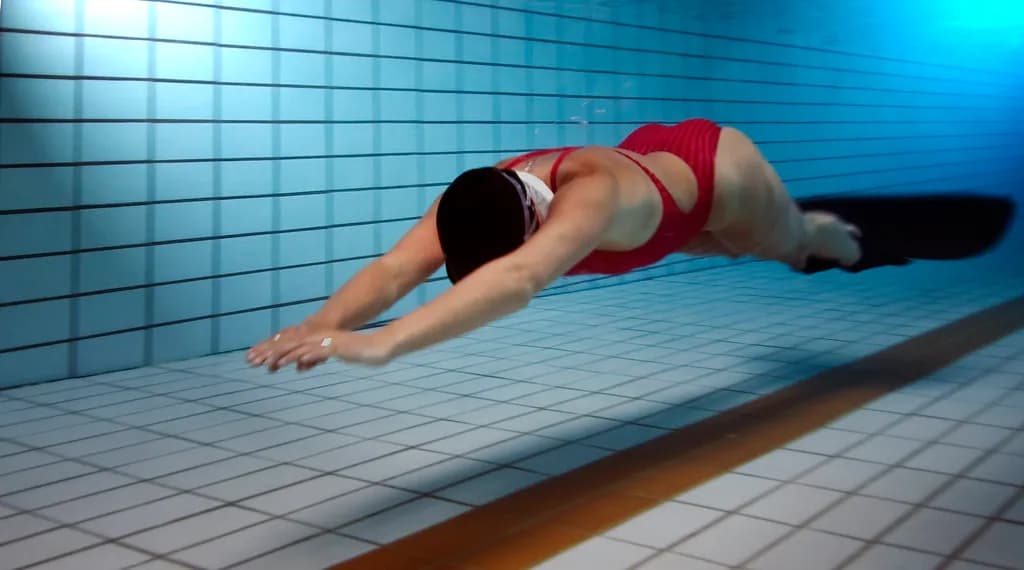
In June, the best pool freedivers in the world flew to Budapest, competed for five days, won world titles, and set world records. Nine days later a large number of them flew to Novi Sad and did it again, for different medals, on a different record list, under a different federation.
Nobody in the sport finds this strange any more. Everyone outside it should.
Freediving is governed by two bodies that do not recognise each other's records. AIDA International grew out of the competitive freediving community in the 1990s. CMAS, the older World Underwater Federation, is the body with the international sports-governance pedigree, a split explained in this comparison of the two organisations. Both run world championships. Both certify world records. An athlete can hold a world record in one list and not appear at the top of the other.
What happened in Budapest
The AIDA Pool World Championships ran from 2 to 6 June at the Danube Arena in Budapest, drawing 264 athletes from 60 countries, according to the meet summary published by Molchanovs.
Four world records went down in five days.
- Magdalena Solich-Talanda of Poland swam 270 metres in dynamic with bifins on 2 June.
- Mateusz Malina of Poland covered 252 metres in dynamic without fins on 3 June.
- Heike Schwerdtner of Germany held her breath for 9 minutes 39 seconds in static apnea on 5 June.
- Malina then swam 325 metres in dynamic with fins on 6 June.
Malina took gold in all three dynamic disciplines and finished as men's overall champion on 539.4 points. Bevin Reynolds of South Africa took the women's overall title on 420.2 points, a result worth noting because it came without a single world record, on consistency across three very different events.
What happened in Novi Sad
The CMAS Freediving Indoor World Championship followed from 11 to 14 June at the SC Futog pool in Novi Sad, Serbia, in a 50 metre pool held at 26C.
Two CMAS world records fell there, according to the championship report. Mirela Kardasevic of Croatia swam 278.5 metres in dynamic with bifins on 12 June. Schwerdtner repeated her 9 minutes 39 seconds in static on 13 June, which stood as a CMAS world record as well.
The men's dynamic podium in Novi Sad reads 322.5 metres for Malina, 299 for Romain Hinfray of France and 292.5 for Guillaume Bourdila, also of France. Goran Colak of Croatia won the bifins event at 300 metres.
Read those two paragraphs against the Budapest results and the oddity becomes obvious. Malina swam 325 metres in Budapest and 322.5 in Novi Sad. The first is an AIDA world record. The second is not a record at all, because CMAS keeps its own list.
Why two federations, and does it matter
The split is historical rather than technical. The disciplines are nearly the same, the pools are the same, and in June 2026 the athletes were largely the same people.
The differences that do exist sit in the rules around a performance rather than in the performance itself: how judges apply the surface protocol, what counts as a clean exit, how equipment is specified, how records are ratified. Those details are not trivial to athletes, but they are not the reason two federations exist.
The practical effect is a calendar that asks elite athletes to peak twice inside a fortnight, and a record book that a newcomer cannot read without knowing which body sanctioned what. When a headline says a freediver set a world record, the honest version always includes the discipline and the federation.
There is an argument that the duplication is healthy, that two organisations mean two sets of opportunities and less concentration of power over athletes' careers. There is a counter-argument that a sport this small cannot afford to divide its audience, its sponsorship and its record book three ways when it is trying to be taken seriously.
Nine minutes thirty-nine
The result that deserves separating out is Schwerdtner's static.
Static apnea is the discipline that looks like nothing at all. The athlete floats face down in a pool and does not move. There is no distance to admire and no depth to be impressed by, only a clock, and a body being asked to tolerate a rising carbon dioxide load without the reflex to breathe winning.
Nine minutes and thirty-nine seconds is a very long time to be doing that, and Schwerdtner did it twice inside nine days, in two countries, for two federations.
Static is also the discipline that most needs its safety warning attached, because it is the one an untrained person can most easily imitate. Breath-hold training in a pool without a trained partner watching is how competent people die: shallow water blackout arrives without a struggle, and an unconscious face-down swimmer with nobody attending drowns quietly. Competition static happens with a judge, a safety team and a strict protocol for a reason.
What comes next in the calendar
The pool season closes and the depth season opens, which moves the sport from chlorinated water and stopwatches into open ocean, where the constraint is not the athletes but the number of places a proper safety operation can run.
Depth results this year have already come out of Mabini and Panglao in the Philippines, and the CMAS World Cup depth event at Vertical Blue was scheduled for Long Island in the Bahamas across late June.
Whether the two federations ever converge is a question the sport has been asking for two decades. On the evidence of June, the athletes have stopped waiting for an answer and simply entered both.
This article is journalism, not instruction. Freediving, including pool disciplines, is taught by certified instructors through recognised agencies, and breath-hold training is never a solo activity.
Published in The Outspoken Digest
Editorial desk
Outspoken Digest Diving DeskCovers freediving, recreational and technical diving, dive medicine and the incidents the sport learns from.
Newsletter
The Digest, in your inbox
One edition, sent when it is ready. No noise, and your address is never passed on.
Read Next
More Diving →
Divers Cement Storm-Torn Corals Back Onto Hawaii's Reefs While a 45-Day Clock Runs
Oct 25, 2026/2 min read
Polish Diver Reaches 338 Metres in North Macedonia's Vrelo Cave, a Claimed Depth Record
Oct 23, 2026/3 min read
Breathless and Coughing Pink Froth After a Dive: Immersion Pulmonary Edema Explained
Oct 17, 2026/3 min read
Your Gas Consumption Is Not One Number: Why Depth, Cold and Nerves Change It
Oct 16, 2026/3 min read