Equalisation: Why Ears End Most Freedivers' Progress
Frenzel and mouthfill solve the one problem that stops more beginner freedivers than fitness or fear ever does: equalising the ears under rising pressure.
Thursday, December 5, 2024/4 min read
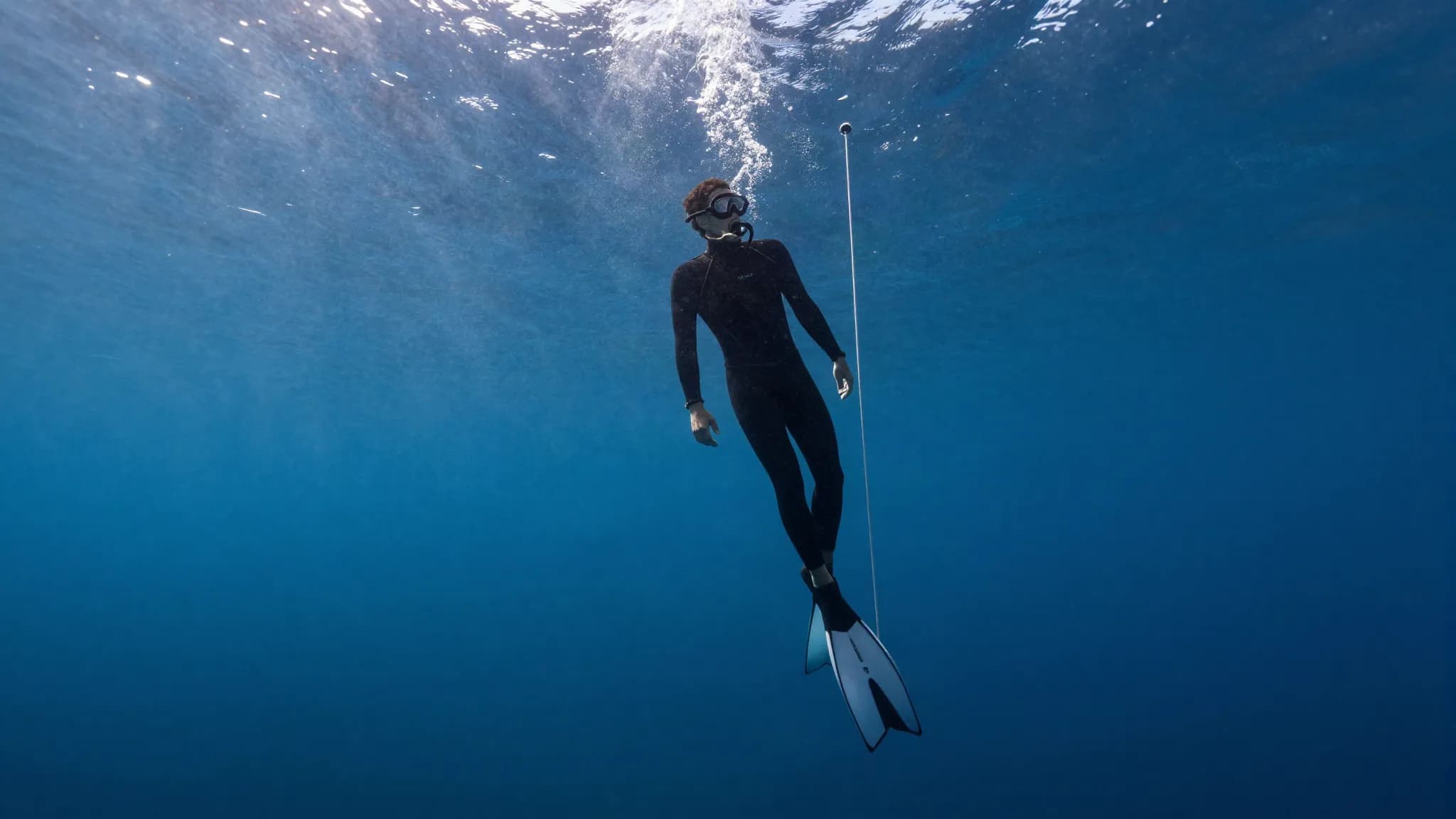
Most people who quit freediving do not quit because of fear, or fitness, or even breath hold time. They quit because of their ears. Somewhere between five and fifteen metres down, an untrained diver hits a wall of pain in the middle ear that no amount of willpower solves, and unless someone teaches them the mechanics of equalisation properly, that wall does not move.
The fix is not a matter of toughness. It is a specific, learnable technique, and understanding why it works explains why so many beginners get stuck at exactly the same shallow depth, year after year, until someone finally corrects their method rather than their nerve.
Why does depth hurt the ears in the first place?
As a diver descends, water pressure increases and pushes inward on the eardrum from outside, while the air pocket in the middle ear stays at the pressure it was at the surface. That pressure difference is what causes the pain, and left unresolved it can perforate the eardrum. Equalising means adding air to the middle ear space to match the rising outside pressure, via the Eustachian tubes that connect the middle ear to the throat.
Left unmanaged, the discomfort typically starts as a dull pressure sensation and can progress quickly to sharp pain, and pushing through that pain rather than stopping to equalise is how beginners injure themselves. A ruptured eardrum from forcing a descent is entirely preventable and entirely common among people who never learned proper technique.
What is the Frenzel technique, and why did a fighter pilot invent it?
The dominant method taught in modern freediving is called Frenzel equalisation, developed in 1938 by Hermann Frenzel, a Luftwaffe commander and ear, nose and throat specialist, originally as a way for dive bomber pilots to equalise pressure changes without discomfort during steep descents, according to SSI's explainer on Frenzel equalisation.
Frenzel works by using the tongue as a kind of piston rather than relying on the diaphragm the way a beginner instinctively tries to, by attempting to blow against a pinched nose from the chest, the way people equalise on an aircraft. With Frenzel, the air in the mouth is sealed off by closing the glottis, then the tongue pushes upward and back, compressing that trapped air and forcing it through the Eustachian tubes, as detailed in Go Freediving's guide to the Frenzel technique. Because it does not rely on the diaphragm or the lungs, it keeps working at depths where lung volume has already compressed significantly, which is precisely where the diaphragm-driven method stops working altogether.
What is mouthfill, and why do only advanced divers use it?
Past a certain depth, roughly where a diver's lungs have compressed close to what is called residual volume, even Frenzel alone runs out of air to push. This is where mouthfill comes in, an advanced technique credited to freediver Eric Fattah. A diver takes a mouthful of air before their lung volume compresses too far to draw more from the lungs, seals it in the mouth by closing the glottis, and then manages that fixed reservoir of air using the cheeks, jaw and tongue to keep equalising all the way to depth, according to Deep Med Centre's step by step guide to mouthfill.
Mouthfill is not a beginner technique and is not something to attempt without direct supervision from a qualified instructor, because managing it incorrectly at depth carries real risk to the lungs and sinuses. It is mentioned here to explain why the sport's competitive depths are possible at all, not as something to try alone.
Even among divers who have moved past Frenzel into mouthfill, progress tends to be measured in single metres added over months, not sudden leaps, because managing a fixed pocket of air correctly under increasing pressure is an unforgiving skill to refine.
Why do so many beginners stall at the same shallow depth?
The common failure mode among new divers is trying to equalise the way they learned on an aeroplane or in a swimming pool as a child, a Valsalva style push from the chest against a pinched nose. That method works fine in shallow water and stops working reliably as lung volume compresses with depth, precisely the range where Frenzel keeps functioning. Instructors report that switching a struggling student from Valsalva to Frenzel is often the single change that unlocks meaningful depth progress, according to the same Deep Med Centre resources on Frenzel technique.
Learning it properly typically means working with a certified instructor who can watch a student's throat and jaw movement directly, sometimes with the aid of an equalisation training tool used on dry land before ever getting in the water.
The part that has nothing to do with technique
None of this changes the sport's fundamental safety principle. Equalisation problems on their own are painful, not usually life threatening, but any freediving session, regardless of how shallow or how technically sound a diver's equalisation, should happen with a buddy or safety diver present, because shallow water blackout can occur independently of depth or equalisation skill entirely.
This article is journalism, not instruction. Learning Frenzel or mouthfill safely means training with a certified freediving instructor and agency, not a video and a home pool.
For a sport this dependent on a handful of small throat muscles working correctly, it is a strange kind of levelling: Olympic level fitness will not get a diver past a badly equalising ear, but a few properly taught sessions with the right instructor often will.
Published in The Outspoken Digest
Editorial desk
Outspoken Digest Diving DeskCovers freediving, recreational and technical diving, dive medicine and the incidents the sport learns from.
Newsletter
The Digest, in your inbox
One edition, sent when it is ready. No noise, and your address is never passed on.
Read Next
More Diving →
Playing Recordings of a Healthy Reef Drew More Coral and Fish Larvae to Artificial Structures Off Hawaii
Oct 9, 2026/3 min read
Blacktip Sharks Can Hear a Sound From Nearly 250 Feet Away and Swim Straight Toward or Away From It
Oct 1, 2026/2 min read
A Sea Turtle Species Never Recorded Nesting in the United States Laid Eggs on a Southern California Beach
Oct 1, 2026/2 min read
Marine Surveyors Confirmed Living Coral Off Benin, More Than Sixty Years After the Reef Was Presumed Dead
Sep 29, 2026/2 min read