The Grand Egyptian Museum Is Making Ancient History Part of a Green Future
Solar panels integrated into the Grand Egyptian Museum show how cultural landmarks can cut operating emissions without compromising architecture or visitor experience.
Outspoken Digest Culture & Travel Desk
Monday, August 3, 2026/2 min read
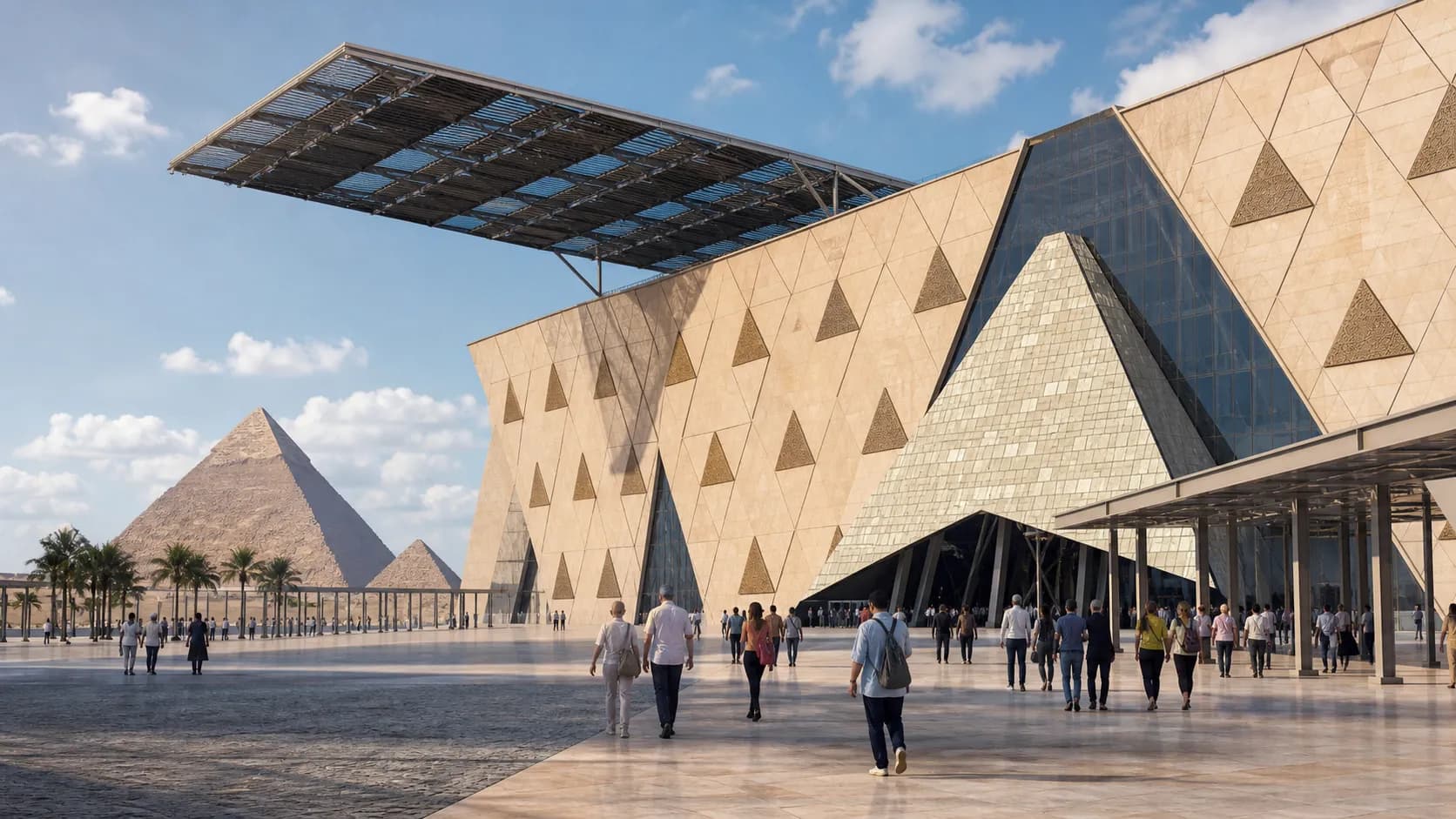
The Grand Egyptian Museum was designed to place the world's most famous ancient civilization inside a modern cultural institution. Its newest story is about the building itself. A solar installation is helping the museum reduce electricity demand and position sustainability as part of Egypt's tourism offer.
Solar power designed around the architecture
The initial system includes panels along a side perimeter wall and building-integrated photovoltaic material at the Khufu Boats building. The technology was chosen to sit more naturally within the museum's visual language, including panel treatments intended to resemble marble in sensitive areas.
A UN Development Programme project account describes a 200-kilowatt installation supported by Japan and UNDP. It is expected to cover about 12 percent of electricity consumption, with further expansion planned toward approximately one megawatt.
Why museums are good climate laboratories
Museums have demanding operating profiles. They control temperature, humidity, lighting, security and visitor circulation while protecting objects that may be thousands of years old. Energy efficiency cannot come at the cost of conservation. That makes a successful museum project a useful demonstration for hotels, galleries, airports and other large public buildings.
Egypt's State Information Service reports that the expanded system could cover about a quarter of the museum's consumption. The institution also uses natural light, ventilation, water-management measures and electric mobility as part of a broader green-building strategy.
Tourists increasingly notice operations
Travelers do not choose a museum only because it has solar panels, but resource efficiency affects the destination around them. Lower operating costs can support programming and maintenance. Cleaner power improves the credibility of national tourism campaigns that promise environmental responsibility. Visible design choices can also turn a technical system into an educational exhibit.
A separate UNDP update presents the project as a model for combining heritage conservation with clean energy. The key word is model: the real value grows if the engineering and procurement lessons are documented and repeated across other sites.
What visitors should look for
The Grand Egyptian Museum offers the monumental experience people expect, including the Grand Staircase, the Tutankhamun galleries and the Khufu boats. It now also invites visitors to notice how a twenty-first-century museum supports that experience behind the scenes.
The most compelling sustainability projects do not compete with heritage. They protect the institution's ability to preserve it. Egypt's experiment shows that the story of a civilization can remain visually rooted in the past while the building that tells it prepares for a lower-carbon future.
Published in The Outspoken Digest
Editorial desk
Outspoken Digest Culture & Travel DeskDestinations, airlines, borders and the practicalities of getting there.
Newsletter
The Digest, in your inbox
One edition, sent when it is ready. No noise, and your address is never passed on.
Read Next
More Travel →
Western Sydney Airport Opens to Passengers on Sunday: First Flights, Airlines and How to Get There
Oct 22, 2026/2 min read

Alaska and Hawaiian Airlines Will Fly Nonstop From Seattle to Osaka and Tahiti From Spring 2027
Oct 20, 2026/2 min read

Norte Fire Put 16,000 Under Evacuation Orders in San Clemente, and They Are Now Lifted: What Travelers Should Know
Oct 18, 2026/2 min read
Tropical Storm Trudy Is Forecast to Become a Major Hurricane as It Nears Mexico's Pacific Coast
Oct 15, 2026/2 min read