How Competitive Freediving Made Itself Safer, Metre by Metre
Safety divers, counterballast lines and strict medical protocol turned a high risk sport into one of the most closely supervised in the water.
Tuesday, March 11, 2025/4 min read
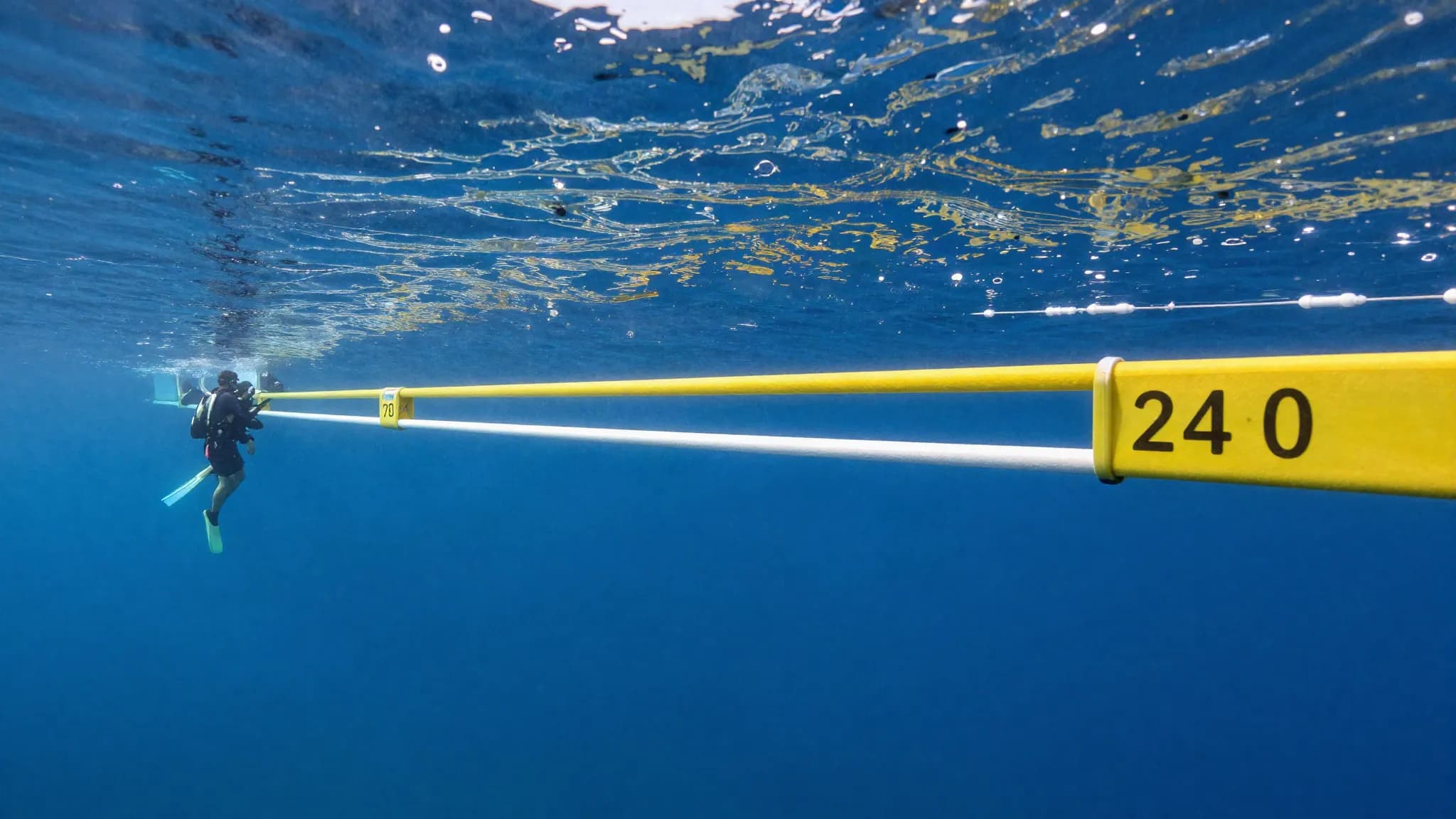
Freediving competitions look, from a distance, like the least protected extreme sport on earth. One person, one breath, one thin rope disappearing into blue water. Get closer and the picture changes completely. Beneath the surface, at almost every depth interval, there is a stationed safety diver watching that one person descend, and the competitor is physically attached to a system built for exactly one purpose: getting them out if something goes wrong.
The sport did not arrive at this structure by accident. It built it, piece by piece, in direct response to the risk that defines breath hold diving more than any other: blackout, the sudden loss of consciousness from oxygen deprivation that can happen without warning, often in the final metres before the surface.
What does the counterballast system actually do?
The centrepiece of modern depth competition safety is the counterballast system. A competitor is attached to the vertical descent line by a running lanyard, and if they show signs of trouble and cannot complete their ascent under their own power, the counterballast can be released to haul them to the surface mechanically and quickly, without waiting on a diver to physically swim them up from depth. AIDA regulations now require every depth event to use a lanyard, according to reporting compiled by Molchanovs' guide to freediving lanyard safety.
The system has an unusually strong track record. In the years since counterballast systems became mandatory in sanctioned competition, there has not been a single documented emergency that required the counterballast to actually be activated, a statistic cited in coverage of competition safety by DeeperBlue.com's reporting on lanyard use in the sport. That is not evidence the system is unnecessary. It is closer to the opposite: a safety net built to be used rarely, precisely because everything upstream of it, training standards, medical screening, safety diver positioning, is designed to prevent a diver from ever needing it.
Who are the safety divers, and what do they actually do?
Beneath the competitor, scuba and rebreather divers are stationed at set intervals along the descent line, ready to intervene and bring the freediver to the surface immediately if something goes wrong on the way up, according to DAN Europe's overview of freediving competition safety. Safety divers typically work in pairs during open water sessions, one focused on the rescue itself, the other responsible for removing the lanyard and overseeing the procedure, a structure echoed in DAN Southern Africa's account of the same protocols. A third safety diver typically stands by as backup, so the team can manage an emergency even if a primary responder is fatigued from a long day in the water.
Positioning matters as much as headcount. Safety divers are staged at the specific depth range where a returning competitor is statistically most likely to show early signs of trouble, rather than spread evenly across the entire line, which concentrates attention where it is actually needed most.
This is skilled, judgment heavy work. Safety divers need real experience to make correct calls at depth under stress, sometimes after hours already spent underwater themselves, and competitions rely on that judgment as much as on the mechanical systems around it. Many safety divers are former competitors themselves, which means the team watching the line often has firsthand knowledge of exactly what a struggling athlete looks like in the final metres of an ascent.
What happens before a diver is even allowed to compete?
Formal risk assessment now runs through the entire competition structure, not just the moment of the dive. DAN's article on freediving risk assessments describes how organisers evaluate site conditions, medical readiness and safety staffing before divers ever get in the water, and pre-competition procedure includes physically testing the speed and reliability of the counterballast retrieval system to confirm it meets required operating parameters before a single competitor descends.
Why this matters beyond the competition pool
The safety architecture built for elite competition has filtered down into how recreational courses are taught. Buddy protocol, supervised sessions and a refusal to let anyone breath hold dive alone are not competition rules exclusively, they are baseline practice taught from a diver's very first certified course, because the mechanism that threatens an Olympic level competitor, blackout, threatens a recreational diver identically.
None of this removes risk from the sport entirely, and no governing body claims it does. What it has done is turn an activity that could easily be reckless into one of the more procedurally rigorous disciplines in competitive sport, closer in spirit to the checklist culture of aviation than to the image of a lone athlete chasing depth on nerve alone. Athletes themselves largely credit that structure for letting them push depth progression with genuine confidence, rather than the reckless bravado outsiders sometimes assume the sport runs on.
This article is journalism, not instruction. The safety systems described here exist for supervised, sanctioned competition and training, not as a substitute for learning to freedive properly from a certified instructor and agency.
As the sport keeps pushing its record depths further, its safety protocols have had to keep pace just as fast, and so far, by the sport's own numbers, they have. The absence of a single counterballast activation across eight years of mandatory use is not a coincidence organisers take lightly, and it is the standard the sport now holds every future safety upgrade against.
Published in The Outspoken Digest
Editorial desk
Outspoken Digest Diving DeskCovers freediving, recreational and technical diving, dive medicine and the incidents the sport learns from.
Newsletter
The Digest, in your inbox
One edition, sent when it is ready. No noise, and your address is never passed on.
Read Next
More Diving →
Playing Recordings of a Healthy Reef Drew More Coral and Fish Larvae to Artificial Structures Off Hawaii
Oct 9, 2026/3 min read
Blacktip Sharks Can Hear a Sound From Nearly 250 Feet Away and Swim Straight Toward or Away From It
Oct 1, 2026/2 min read
A Sea Turtle Species Never Recorded Nesting in the United States Laid Eggs on a Southern California Beach
Oct 1, 2026/2 min read
Marine Surveyors Confirmed Living Coral Off Benin, More Than Sixty Years After the Reef Was Presumed Dead
Sep 29, 2026/2 min read