Interstellar Comet 3I/ATLAS May Have Lost Metres of Its Surface to the Sun, a New Estimate Finds
Two Michigan State astronomers added up every measured gas and dust loss and estimate the nucleus shed from under two metres to more than ten. The layers may have been cooked or stripped.
Wednesday, October 21, 2026/2 min read
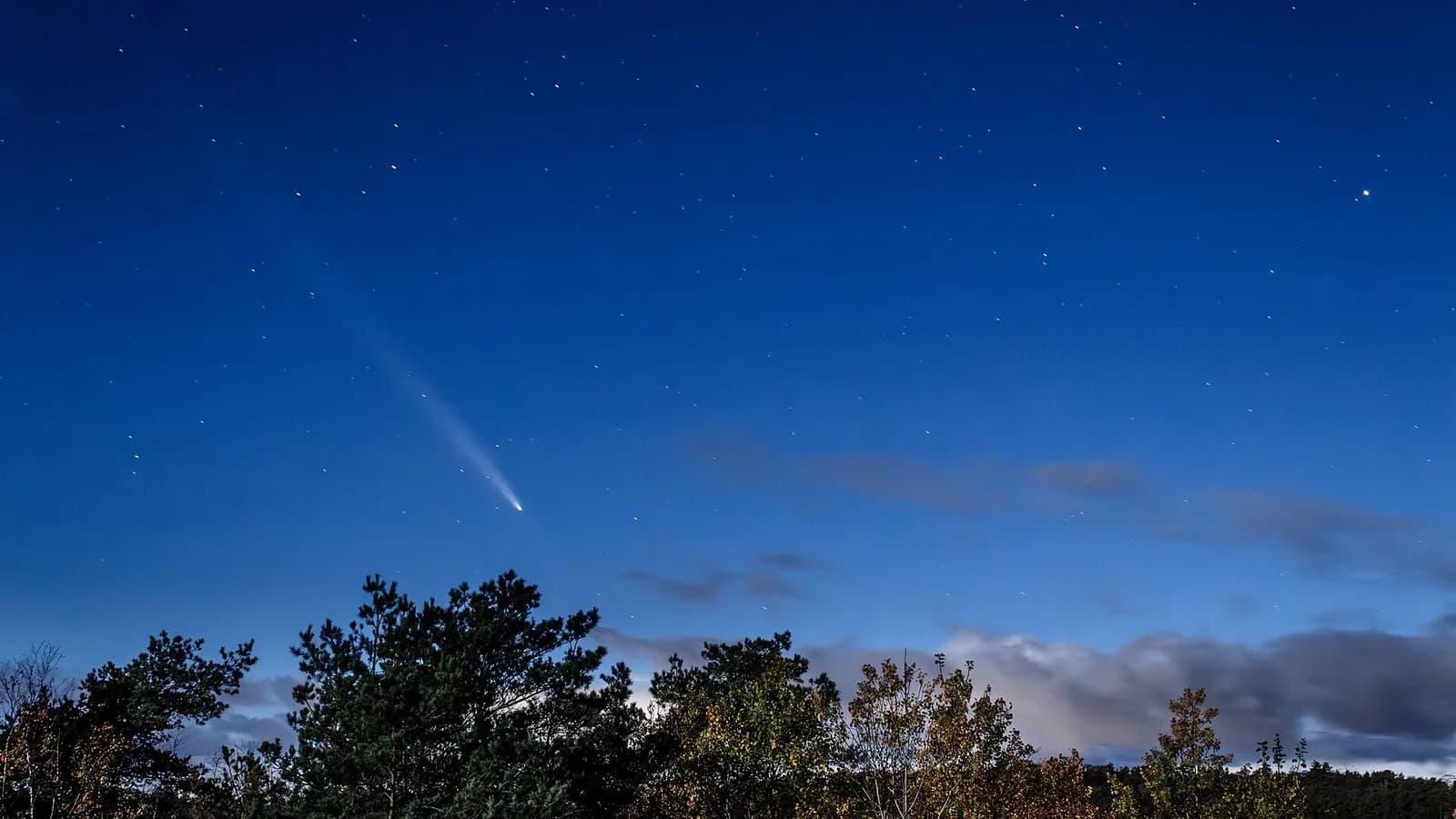
When 3I/ATLAS swung past the Sun, it did not just glow. It wore away. A new estimate says the third interstellar object ever seen in our solar system may have lost a layer of its surface somewhere between under two metres and more than ten metres deep, which matters because the outer skin of a comet carries a record of how it has been treated on its journey.
The work, by Tessa Frincke and Darryl Seligman of Michigan State University, is an accepted manuscript in Monthly Notices of the Royal Astronomical Society, Phys.org reported on 20 October. The comet was discovered in July 2025.
How do you measure what a comet has lost?
Nobody weighed the nucleus. Instead the pair compiled published measurements of how fast gas and dust left the comet before and after its closest approach to the Sun, modelled how those rates changed along its path, and summed the total. They treated the nucleus as a sphere with a starting radius of 1.3 kilometres and a density typical of solar system comets, then worked out how much the radius shrank.
The preprint on arXiv, first posted on 31 May and updated on 12 October, also supplies a machine-readable table of production rates from every reported observation.
How much surface did 3I/ATLAS lose?
Counting gas alone, mostly water, carbon dioxide and carbon monoxide, they estimate a loss of about 18 billion to 58 billion kilograms. Spread evenly, that is a layer roughly 1.7 to 5.2 metres thick. The abstract puts it at 0.40 to 1.25 percent of the comet's initial mass.
Dust raises the number. If dust and gas left in equal mass, the modelled erosion is about 3.4 to 10.5 metres. If there was four times as much dust as gas, it reaches 8.6 to 26.7 metres, according to Phys.org. The authors call these approximate lower limits because the data are sparse and come from different instruments.
Did it dig down to pristine ice?
That is the interesting question, and the answer is a careful maybe. An earlier study proposed that radiation had converted carbon monoxide into carbon dioxide in the outer 15 to 20 metres, which could explain the unusually carbon dioxide-rich gas. The new gas-only estimates fall short of that depth, but some dust-inclusive scenarios reach it. The authors write that it is possible the surface has been eroded down to layers of unaltered material.
They do not claim to have shown it. The figures are averages over the whole surface and say nothing about how deep any single patch wore away. They also depend on the assumed size and density and on how much activity is extrapolated to times when nobody could see a given gas escaping. The authors suggest that comparing material released earlier and later in the passage could separate what the comet inherited at birth from what happened on the way, a test that depends on further measurements of the dust.
Published in The Outspoken Digest
Editorial desk
Outspoken Digest Science DeskReports for The Outspoken Digest across Technology, Latest Trends, Health.
Newsletter
The Digest, in your inbox
One edition, sent when it is ready. No noise, and your address is never passed on.
Read Next
More Technology →
Astronomers Say a Pulsar's Odd Slowdown Is Explained by a Hidden Sunlike Star, Making It a Rare Stellar Trio
Oct 21, 2026/2 min read

A Power Event in Google Cloud's London Region Knocked Out Banking Apps and Delivery Services for Hours
Oct 21, 2026/2 min read

An Indian Certificate Authority's Private Keys Were Trivially Guessable, and Browsers Have Revoked Them
Oct 21, 2026/2 min read

Anthropic Is Pitching Congress a Bill That Could Block an AI Model Only if It Risks Killing More Than 50 People
Oct 21, 2026/2 min read