Japan Launches MMX to Bring Back the First Samples From Mars' Moon Phobos
A five-agency mission lifted off from Tanegashima before dawn on Tuesday, and will reach Mars in 2027 and aim to return at least 10 grams of Phobos soil to Earth in 2031.
Thursday, October 22, 2026/2 min read
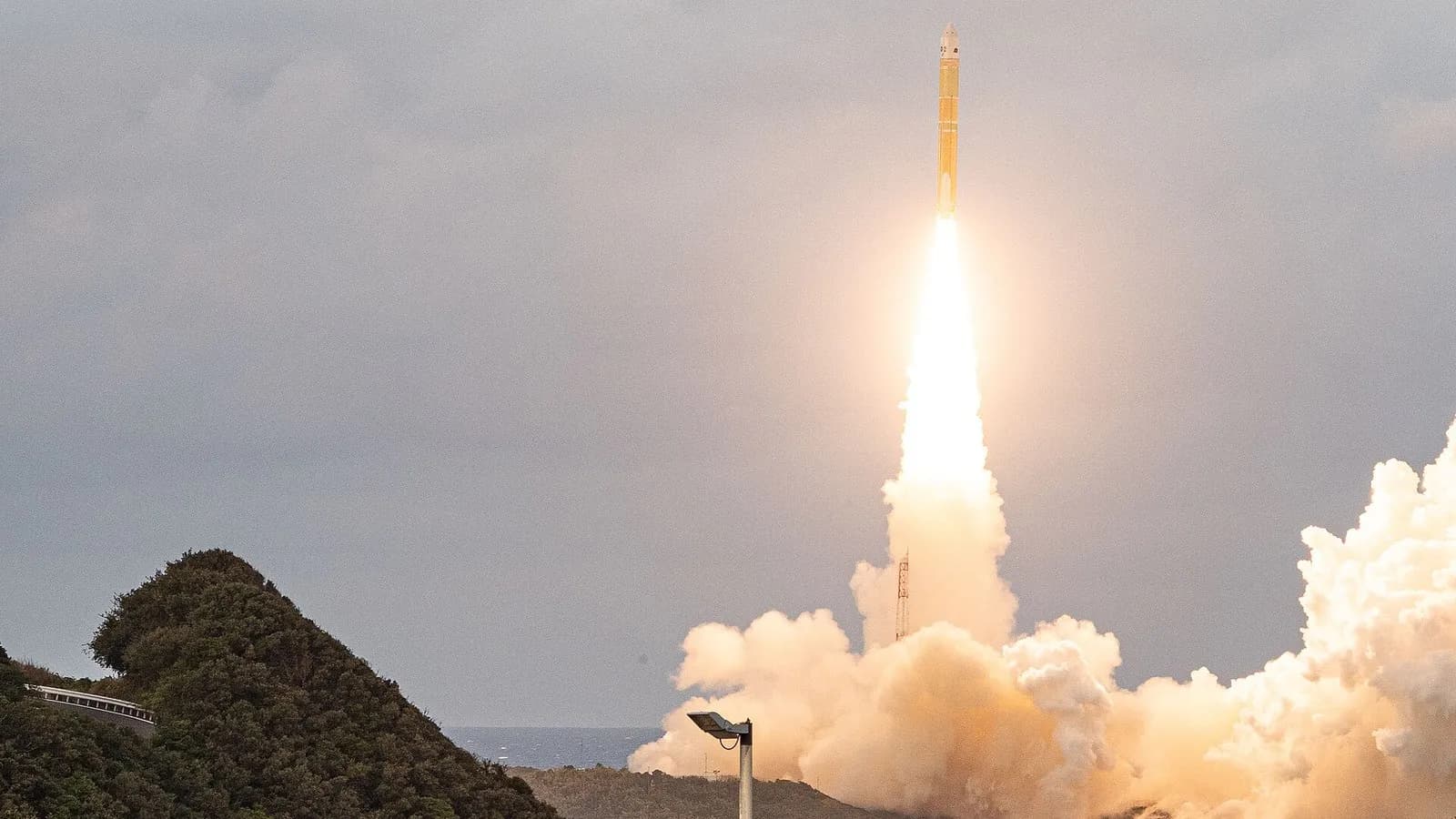
Before dawn on Tuesday in southern Japan, a rocket carried a probe toward the larger of Mars's two moons with a promise attached: bring a piece of it home. Japan's Martian Moons eXploration (MMX) mission launched on an H3 rocket from the Tanegashima Space Center, according to Phys.org.
The European Space Agency put the launch time at 04:41 Japan time on 20 October, which was 20:41 in London on 19 October. Officials declared success about an hour later, once the spacecraft separated from the upper stage as planned.
What is MMX trying to do?
MMX is meant to be the first mission to collect a sample from Phobos and return it to Earth, ESA says. The spacecraft weighs about 4.5 tonnes and carries a French-German rover called Idefix, Phys.org reports. Phobos is roughly 22 kilometres across, which makes it the larger of the two moons yet still tiny by planetary standards. MMX will also fly past the other moon, Deimos. The sample lander and the rover will work in very different ways, with the lander sampling for hours and Idefix roving for months.
Scientists still argue over how Mars got its moons, whether from captured asteroids or from debris thrown up by a giant impact. Material from the surface could help settle that.
When will it arrive and return samples?
ESA's mission timeline shows arrival at Mars in August 2027 and entry into orbit around Phobos in September 2027. According to Phys.org, the lander will touch down late in 2028 or in 2029 and spend about two hours on the surface, collecting at least 10 grams of material. The sample is due back on Earth in 2031, delivered to the Australian desert. The whole mission runs five years.
Idefix will explore the surface for about 100 days, moving at roughly one millimetre per second.
Who is paying for MMX?
Five agencies are involved. JAXA leads the sampling effort. Phys.org lists NASA's contribution as $87 million, the French space agency's as about $68 million, the German space agency's as about $56 million and ESA's as some $17 million. Total mission cost is $578 million, of which Japan is investing $350 million.
NASA astrophysicist Tom Statler said there was "a lot of adrenaline and a lot of excitement and a lot of wow."
What could go wrong?
The trip is long and the landing is short. Phobos has very weak gravity, and the sampling window is only about two hours. Every date after launch depends on the spacecraft reaching Mars on schedule.
The next milestone is arrival at Mars in the summer of 2027, when the first close images of Phobos will show whether the planned landing sites look as safe as the engineers hope.
Published in The Outspoken Digest
Editorial desk
Outspoken Digest Science DeskReports for The Outspoken Digest across Technology, Latest Trends, Health.
Newsletter
The Digest, in your inbox
One edition, sent when it is ready. No noise, and your address is never passed on.
Read Next
More Technology →
What PHP2Shell Reveals About Maintaining the Code Behind Most of the Web
Oct 22, 2026/3 min read
PHP2Shell for Hosts, Developers and Security Teams: Backports, WAF Rules and Incident Response
Oct 22, 2026/3 min read
PHP2Shell: What Website Owners and Small Businesses Should Do Right Now
Oct 22, 2026/3 min read

PHP2Shell Timeline: From a Quiet August Report to a Leak, Early Attacks and a Day-Early Patch
Oct 22, 2026/3 min read