Kousa Mahshi: Lebanese Stuffed Courgettes, Cored and Simmered
Hollowing a courgette without splitting it is a skill worth twenty minutes of practice. What goes inside is rice, lamb and enough spice to season both at once.
Wednesday, July 29, 2026/4 min read
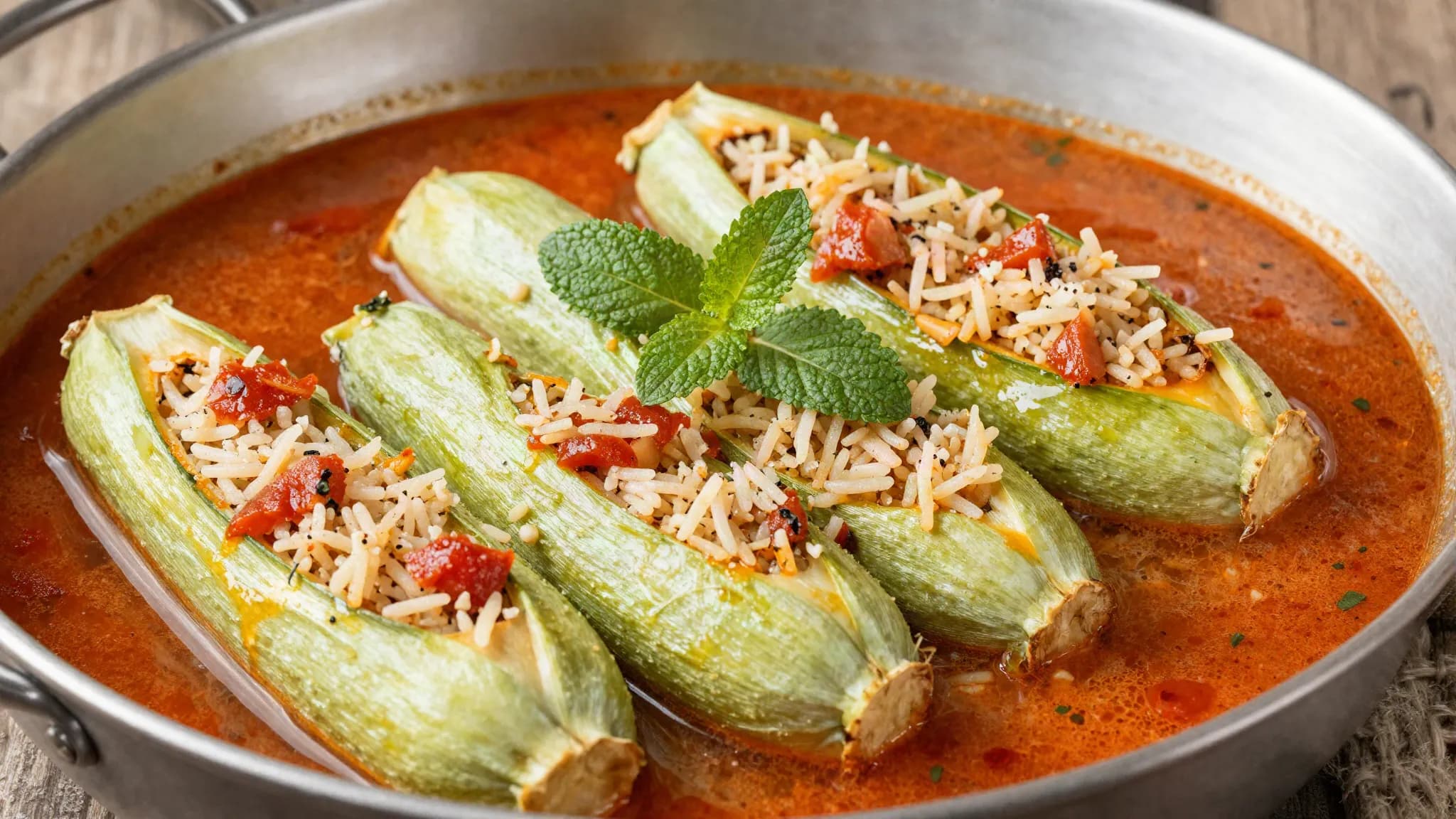
Stuffed vegetables are the part of Levantine cooking that most resists shortcuts. There is no way to speed up coring thirty courgettes, and every household that makes kousa mahshi regularly owns a specific narrow tool for doing it.
The dish itself is simple to describe and fussy to execute: courgettes hollowed out and filled with rice and minced meat, then simmered in a tomato broth until the shells give and the rice inside has swollen to fill every gap. The Matbakh's survey of traditional Lebanese dishes places it among the staples, described plainly as courgette stuffed with meat and rice.
It belongs to a much wider family of mahshi across the Levant, where the same principle is applied to aubergines, peppers, vine leaves and cabbage. A closely related dish, sheikh al-mahshi, takes the aubergine version and treats it with more ceremony, as the record on that dish describes. What unites them is a technique rather than an ingredient.
Ingredients
Serves 5 to 6. Total time: 1 hour 45 minutes, of which about 40 minutes is coring and stuffing.
- 1.4 kg small pale courgettes, roughly 12 cm long, as straight as possible
- 200 g short grain or Egyptian rice, rinsed and drained
- 350 g minced lamb
- 1 tsp ground allspice
- 0.5 tsp ground cinnamon
- 0.5 tsp ground black pepper
- 1.5 tsp salt, plus more for the broth
- 2 tbsp ghee or butter, softened
- 700 ml passata or chopped tomatoes
- 600 ml water or light stock
- 4 garlic cloves, crushed
- 2 tsp dried mint
- 1 tbsp tomato paste
- Juice of half a lemon
Method
- Wash the courgettes and cut off the stem end flat, leaving the base intact. Do not peel them.
- Core each one with a narrow corer, working in from the cut end and turning as you go. Leave a wall about 5 mm thick. Go slowly at the base: pushing too far punches through the bottom and the filling escapes during cooking.
- Combine the rice, lamb, allspice, cinnamon, pepper, salt and softened ghee. Mix well with your hands.
- Fill each courgette to about three quarters full, pressing gently with a finger. This is the step people get wrong. Rice expands, and a courgette packed tight will split along its length in the pot.
- Whisk the passata, water, garlic, tomato paste and a good pinch of salt in a wide heavy pot. Bring to a simmer.
- Lay the stuffed courgettes into the pot in a single layer if you can, or two loose layers if not. The liquid should just cover them; top up with water if needed.
- Cover and simmer very gently for 45 to 55 minutes. A hard boil batters the shells until they break. The courgettes are done when a knife tip slides through the flesh without resistance and the rice inside is tender.
- Stir the dried mint and lemon juice into the broth in the last 5 minutes, off the boil, so the mint keeps its aroma. Rest 10 minutes before serving, with plenty of broth spooned over.
Why the packing rule matters more than the recipe
Every failure of this dish traces back to the same mistake, which is filling the shells too tightly.
Rice absorbs several times its own volume in liquid and expands accordingly. A courgette packed full has nowhere to put that expansion, so the pressure goes outward and the shell splits along its length, releasing the filling into the broth and leaving an empty tube.
Three quarters full looks under filled and is correct. If anything, err further down. A slightly loose courgette produces a tender, evenly cooked result; a tight one produces a pot of loose rice with skins floating in it.
The second common error is heat. This wants the gentlest possible simmer, barely breaking the surface. A rolling boil knocks the shells against each other and against the pot until they break, which no amount of careful stuffing survives.
Swaps, notes and getting ahead
Look for the pale, slender courgettes sold in Middle Eastern shops, often labelled kousa. They have thinner skins and firmer flesh than the dark green supermarket kind, which tends to collapse. If those are all you can find, choose the smallest and shorten the simmer by about 10 minutes.
Do not throw away the flesh you core out. It fries beautifully with onion and egg, and treating it as a byproduct rather than waste is standard practice in kitchens where this dish is made often.
For a vegetarian version, replace the lamb with cooked brown lentils and a spoon of tomato paste, and use vegetable stock. The texture is different but the seasoning carries it. A yoghurt broth version, cooked as for shakriyeh, is also traditional and worth trying once you are comfortable with the coring.
Kousa mahshi keeps three days refrigerated and improves overnight as the broth settles into the rice. Reheat gently with a splash of water. It does not freeze well; the shells turn watery on thawing.
Published in The Outspoken Digest
Editorial desk
Outspoken Digest Food DeskCooking, ingredients, restaurants and the economics of what ends up on the table.
Newsletter
The Digest, in your inbox
One edition, sent when it is ready. No noise, and your address is never passed on.
Read Next
More Recipes →
Cheesy Ramen on the Stove: Instant Noodles in a Real Cheese Sauce in Ten Minutes
Oct 18, 2026/3 min read
Beer-Battered Jalapeno Cheese Curds: The Wisconsin Bar Snack, Fried Properly at Home
Oct 18, 2026/3 min read
A Thanksgiving Turkey Sub With Hot Stuffing, Cranberry and Gravy to Dip
Oct 17, 2026/3 min read

Pecan Pie Bars With a Shortbread Base and a Caramel Filling That Slices Cleanly
Oct 17, 2026/3 min read