Astronomers Say a Pulsar's Odd Slowdown Is Explained by a Hidden Sunlike Star, Making It a Rare Stellar Trio
China's FAST radio telescope tracked the millisecond pulsar for nearly five years. A distant star's pull seems to account for much of why it appeared to spin down so fast.
Wednesday, October 21, 2026/2 min read
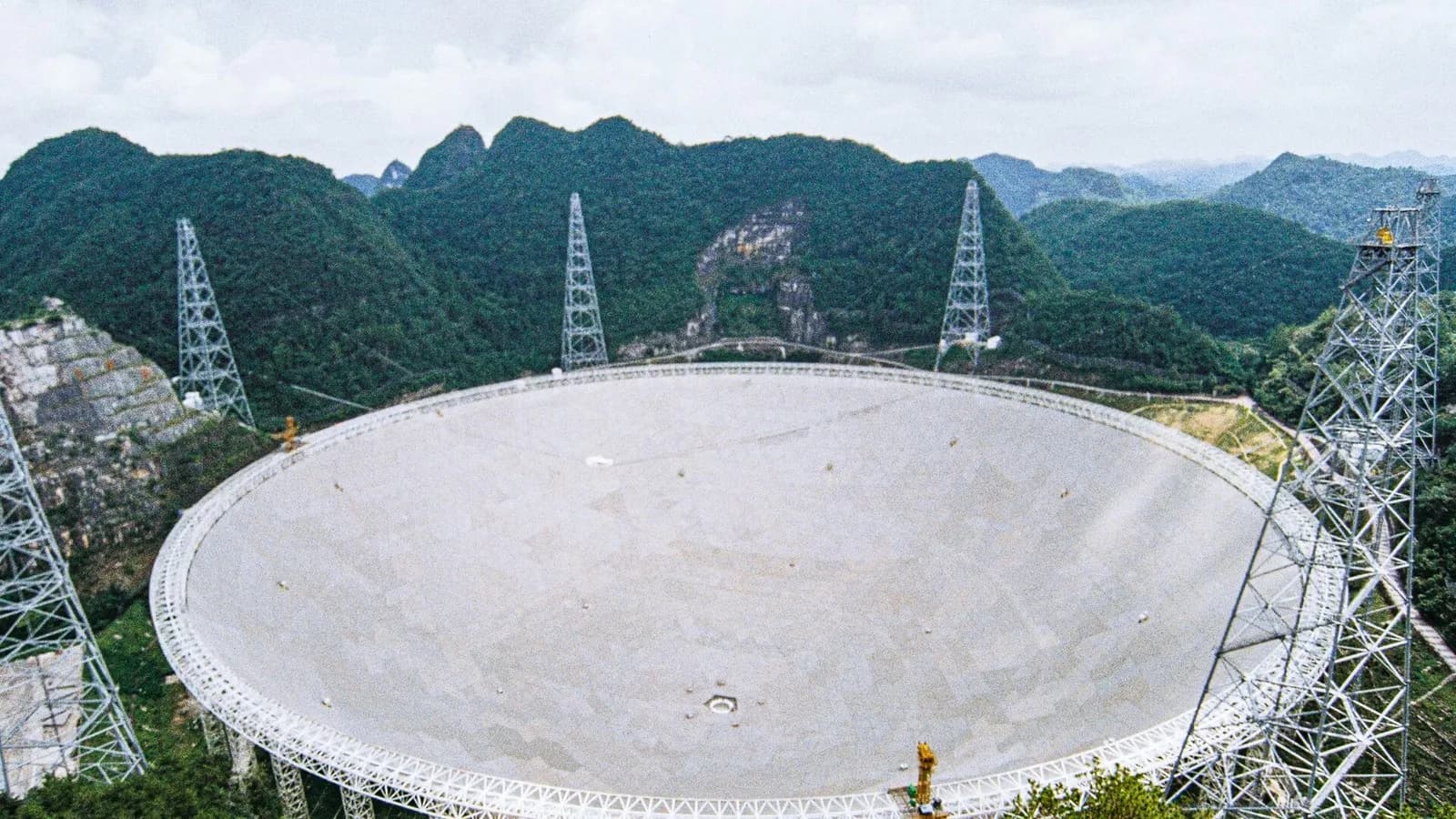
A pulsar that seemed to be slowing down far too quickly has turned out to have company. Two independent teams now agree that PSR J0435+3233 is part of a triple system, with a white dwarf close in and a sunlike star far out, and that the third body explains much of the oddity.
One of those studies, led by Z. L. Yang of the National Astronomical Observatories of the Chinese Academy of Sciences, was published in The Astrophysical Journal Letters, and Phys.org covered it on 20 October.
What is PSR J0435+3233?
It is a millisecond pulsar, a neutron star spinning more than 300 times a second, with pulses arriving about 3.2 milliseconds apart. A helium white dwarf orbits it every 8 days in a nearly circular path. The odd part was its apparent spin-down, which looked much faster than other pulsars of its kind.
How was the third star found?
The team reprocessed 192 observing sessions from FAST, China's Five-hundred-meter Aperture Spherical radio Telescope, spanning almost five years. Changes in the pulse frequency and in the inner orbit pointed to an outside acceleration acting on both remnants. Archive optical and infrared images then showed a sunlike star sitting close to the pulsar on the sky and sharing its motion. Gamma-ray pulses from NASA's Fermi satellite helped reconstruct the wide orbit.
The paper's abstract puts the outer orbit at about 73.5 years with an eccentricity near 0.6. The authors describe the outer star as a Sun-like G-type subgiant.
Why does a third star change the slowdown?
If the pulsar is being pulled away from Earth, its pulses arrive further apart, the Doppler effect. That makes the pulsar seem to slow faster than it truly does. Phys.org says the outer star's pull explains much of the apparent slowdown.
A separate team led by Paulo Freire supports the triple interpretation but concludes the true slowdown is much smaller, using overlapping data and classifying the visible star differently. That paper is accepted in Astronomy and Astrophysics. Details such as the third star's mass and type are not settled between the two papers.
How could such a system survive?
Probably not often. The explosion that made the neutron star could have thrown the outer star loose. In the authors' baseline simulation, about 35 percent of systems stayed bound even with no kick, and they conclude survival remains relatively low. The star lies outside a dense cluster, where encounters could otherwise explain a triple.
The observations cover only part of the outer orbit, so its exact geometry is open, and the authors say not every effect on pulse timing was fully accounted for. Another stretch of timing should narrow it. If the current picture holds, the system will end as a neutron star bound to two white dwarfs.
Published in The Outspoken Digest
Editorial desk
Outspoken Digest Science DeskReports for The Outspoken Digest across Technology, Latest Trends, Health.
Newsletter
The Digest, in your inbox
One edition, sent when it is ready. No noise, and your address is never passed on.
Read Next
More Technology →
Interstellar Comet 3I/ATLAS May Have Lost Metres of Its Surface to the Sun, a New Estimate Finds
Oct 21, 2026/2 min read

A Power Event in Google Cloud's London Region Knocked Out Banking Apps and Delivery Services for Hours
Oct 21, 2026/2 min read

An Indian Certificate Authority's Private Keys Were Trivially Guessable, and Browsers Have Revoked Them
Oct 21, 2026/2 min read

Anthropic Is Pitching Congress a Bill That Could Block an AI Model Only if It Risks Killing More Than 50 People
Oct 21, 2026/2 min read