Playing Recordings of a Healthy Reef Drew More Coral and Fish Larvae to Artificial Structures Off Hawaii
Two Scripps studies in Kaneohe Bay found coral larvae settled most near an underwater speaker, and fish larvae arrived four to 14 times more often than at an identical silent site.
Friday, October 9, 2026/3 min read
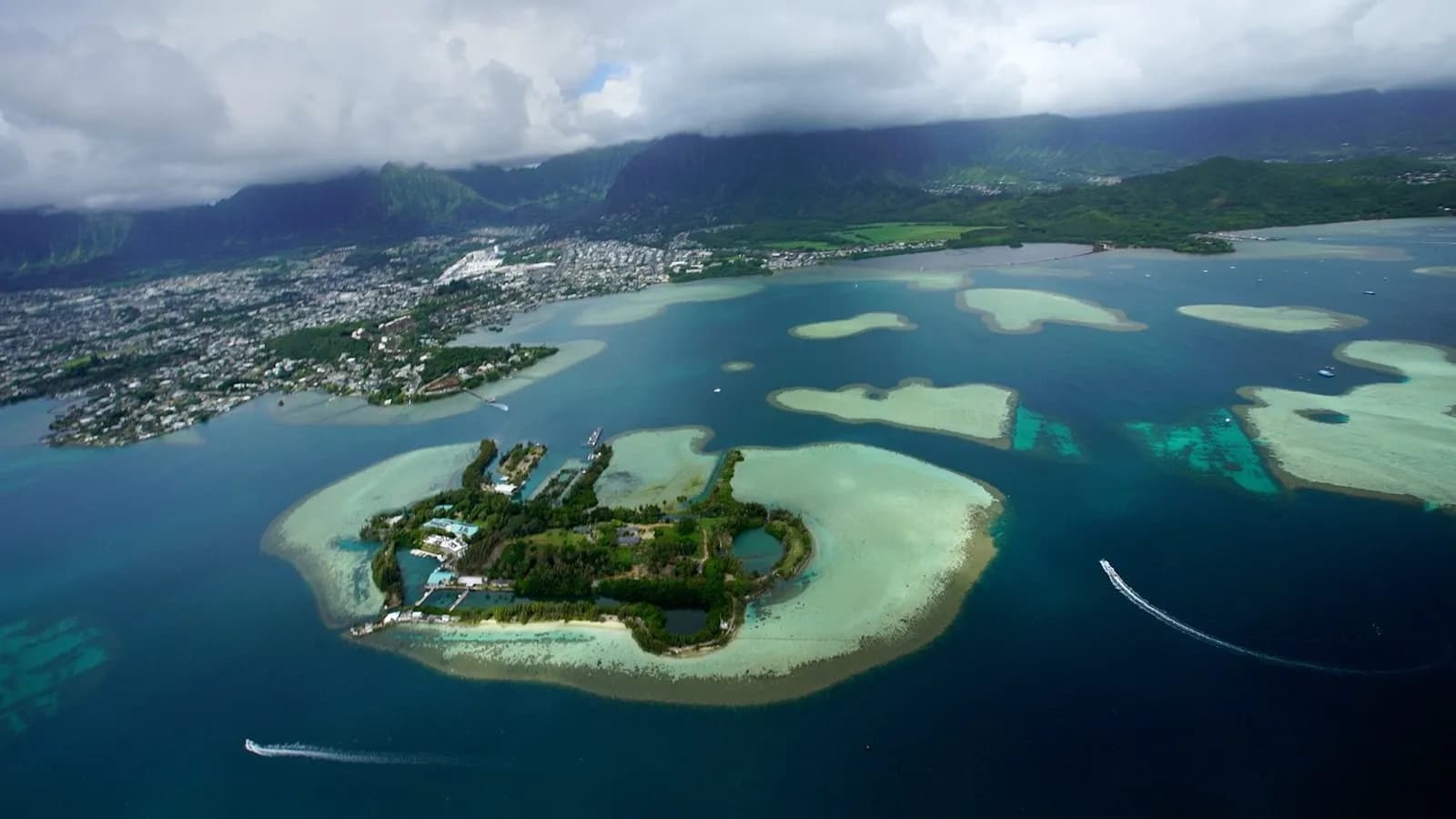
Reefs are noisy places, full of fish, snapping shrimp and other crustaceans, and drifting young corals and fish appear to use that racket to find home. Scientists at the Scripps Institution of Oceanography have now shown that playing recordings of a healthy reef over bare seabed can draw both towards it. The results appear in two studies, one in Communications Biology, published on 8 October, and one in Scientific Reports, according to the UC San Diego newsroom. It describes them as the first field tests of underwater sound on fish and coral larvae at the same time.
How do you play a reef to its larvae?
The team recorded a healthy reef off Oahu over a lunar cycle. It then played the recordings from an underwater speaker, from sunset to sunrise for two weeks, at a flat, sandy site off Moku o Loe, also known as Coconut Island, in Kaneohe Bay. Thirty-seven artificial structures sat on the seabed at 4.5 metres (15 feet) depth, between 1 and 42 metres from the speaker. Some were engineered microhabitats with crevices. Some were coated with BRINK, a "reef ink" containing living bacteria developed in the lab of Daniel Wangpraseurt. The experiments ran across spawning events in 2023 and 2024.
Divers did the counting. One and two weeks after each new moon, they logged the coral larvae that had settled, using blue light and a yellow filter.
What did the divers find?
Structures closest to the speaker had the most coral settlement, and the BRINK-coated ones did best. Lead author Aaron Thode, who heads the Scripps Environmental Acoustics Lab, told EcoMagazine that the sound helps, and that it helps a lot more with the living coating. Crevice structures combined with sound also worked well. 3D-printed structures from the Hawaii Institute of Marine Biology did well too, but they were tested with sound alone, not with BRINK. The press materials do not report the settlement counts.
What about the fish?
A companion study, led by PhD candidate Océane Boulais, used low-power autonomous cameras that can detect and count fish larvae for up to three weeks. They sat near the entrances of 3D-printed "fish hotels" at two sites, one with a speaker playing reef sound and a control with an identical speaker that stayed silent. Larval counts at both peaked around the new moon, but the sound-enriched site attracted four to 14 times more fish larvae overall. The result held when the two speakers swapped positions.
What this does and does not show
Both studies used small artificial structures at one shallow site in one bay, over spawning events in two years. Settlement is only the first step in building a reef, and the coverage does not say how many of the settled corals survived. The 3D-printed designs were not tested with the living coating, so the combined effect is unknown, and the camera system is relatively new. The work was funded by the Defense Advanced Research Projects Agency (DARPA) as part of its Rapid Resilient Reefs for Coastal Defense project, with the University of Hawaii and other partners, and more than 50 researchers are credited as co-authors.
The next test is much bigger. Phys.org reports that DARPA plans a $22 million, 50-metre hybrid reef off Oahu, the Kalaeloa Hybrid Reef, with installation this fall and coral planting likely in late 2026 or early 2027. It will include Scripps-developed microstructures and an acoustic enrichment system, and ownership will then pass to the Hawaii Department of Transportation as a living breakwater.
Published in The Outspoken Digest
Editorial desk
Outspoken Digest Diving DeskCovers freediving, recreational and technical diving, dive medicine and the incidents the sport learns from.
Newsletter
The Digest, in your inbox
One edition, sent when it is ready. No noise, and your address is never passed on.
Read Next
More Diving →
Blacktip Sharks Can Hear a Sound From Nearly 250 Feet Away and Swim Straight Toward or Away From It
Oct 1, 2026/2 min read
A Sea Turtle Species Never Recorded Nesting in the United States Laid Eggs on a Southern California Beach
Oct 1, 2026/2 min read
Marine Surveyors Confirmed Living Coral Off Benin, More Than Sixty Years After the Reef Was Presumed Dead
Sep 29, 2026/2 min read
Divers Pulled 1,400 Metres of Abandoned Fishing Net Off an Oman Beach After Six Sea Turtles Were Found Dead in It
Sep 27, 2026/3 min read