Spearfishing and Freediving: The Overlap and the Added Risk
Spearfishing shares its breath hold physiology with freediving, but a hunting mindset changes the risk calculation entirely, and blackout remains the top cause of death.
Wednesday, April 8, 2026/4 min read
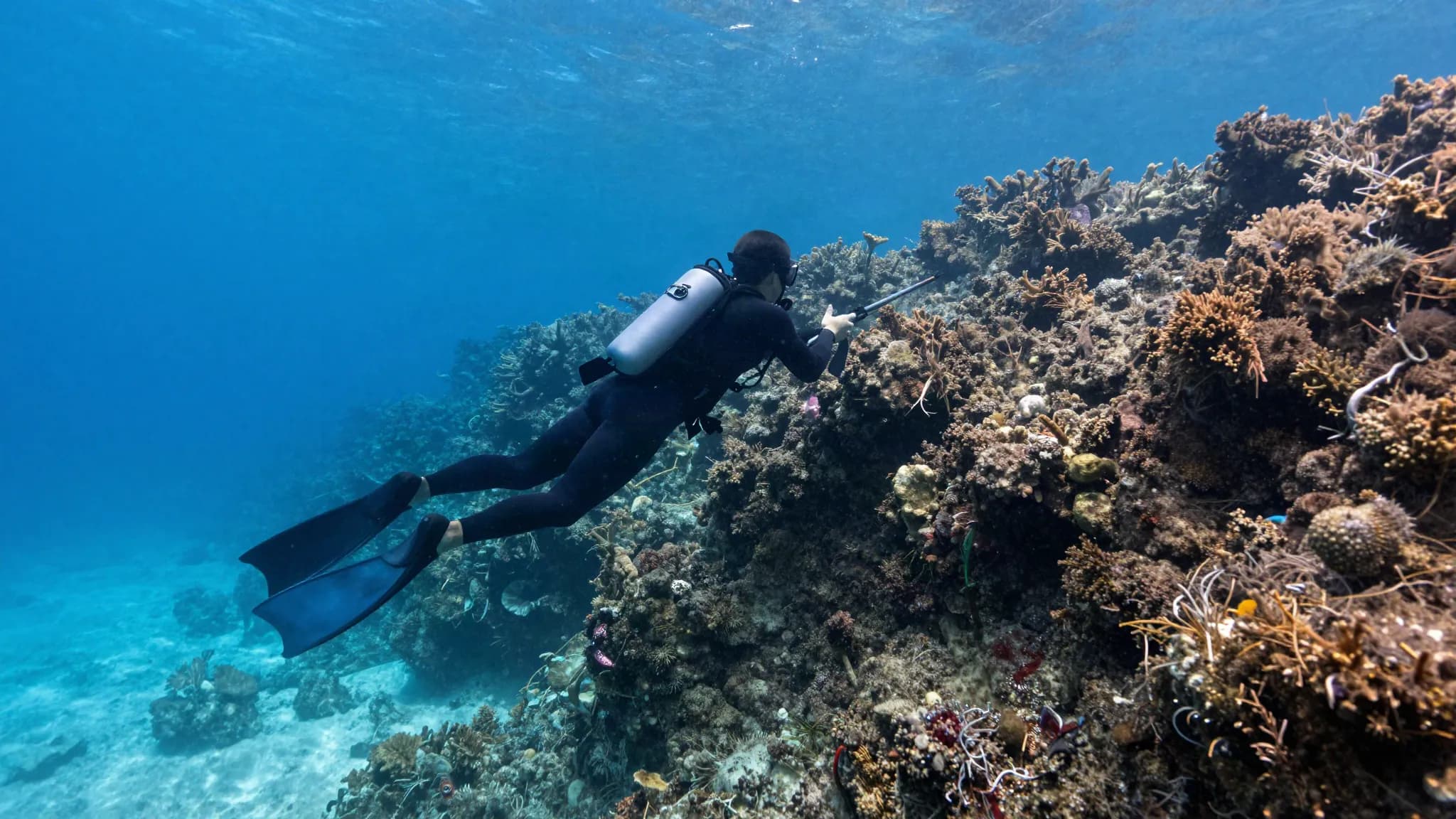
Ask a spearo where they learned to hold their breath and most will not say a freediving course. They will say the ocean, years of it, chasing fish through surf and current and reef long before anyone taught them a formal breath hold technique. That water confidence is real and often considerable. It is also, according to safety researchers who study the sport, part of why spearfishing carries risks that pure competitive freediving has spent years engineering away.
Where do spearfishing and freediving actually overlap?
The physiology is identical. Both activities put a person underwater on a single breath, both rely on the same mammalian dive reflex, and both carry the same fundamental danger: shallow water blackout, the sudden loss of consciousness from oxygen deprivation that can happen with no warning at all. Many experienced spearfishers grow up in the water and develop genuine comfort and skill long before completing any formal freediving certification, according to background from The Pressure Project's analysis of applying freediving safety systems to spearfishing, which is precisely why the article argues spearfishing should never be treated as casual, informal freediving despite the shared skillset.
Why does blackout risk rise specifically in spearfishing?
Research into diving fatalities points squarely at blackout as the dominant cause of death in the sport. An Australian fatality study covering 2000 to 2021 identified blackout as the number one risk for spearfishers, a finding significant enough that safety researchers now treat it as the primary concern to design around, rather than one risk among several, according to the same Pressure Project analysis.
The reason spearfishing amplifies that risk compared to line based freediving training comes down to task load. A competitive freediver on a training line typically has a planned depth, a planned turnaround point, a known dive time and a safety diver stationed specifically to watch for trouble. A spearo underwater is doing several things simultaneously, scanning the terrain, tracking a fish, managing current, handling a speargun and a floatline, and making real time decisions based on opportunity rather than a fixed plan, which pulls attention away from the internal signals that would otherwise warn of a hold going too long. A spearo chasing a fish into a slightly deeper gully than planned is making that call in the moment, under real time pressure, in a way a competitive freediver following a pre-agreed dive plan simply is not.
Why is blackout especially hard to self-detect while spearfishing?
One of the most counterintuitive and dangerous features of hypoxic blackout is that a diver who experiences it typically felt completely fine right up until it happened. There is rarely a warning sensation the diver can act on in time, according to Immersion Freediving's account of blackout risk while spearfishing, which notes that a diver who has already blacked out obviously cannot report feeling anything wrong beforehand, because consciousness is exactly what has been lost. That makes self-assessment ("I know my limits") an unreliable safety strategy on its own, regardless of experience level.
What has this driven in terms of public safety response?
The pattern of near-surface deaths among experienced divers, not just beginners, has prompted policy attention in several places. Legislative efforts such as Hawaii's proposed shallow water blackout bill have pushed for clearer public safety warnings specifically targeting breath hold divers and spearfishers, according to Honolulu Civil Beat's reporting on divers dying near the surface and a related analysis from Spearfactor's coverage of the Hawaii bill, both underscoring how frequently the fatalities involved skilled, experienced water people rather than novices.
What does ethical, safer spearfishing actually look like in practice?
Safety guidance across the sport converges on a small number of non-negotiables: never dive or swim alone, always fish with a buddy who can see you and respond immediately if you surface unresponsive, and treat prompt rescue and resuscitation as the only real countermeasure to blackout, since recovery is impossible for a diver who blacked out with nobody there to notice, a point made directly in guidance published by the Michigan Spearfishing Association. Ethical spearfishing practice also asks divers to take only what they need and to respect the marine environment they are hunting in, treating selectivity as part of the sport's discipline rather than an afterthought. That same discipline extends to knowing when to end a session, calling a dive off because fatigue, cold or current has quietly raised the risk, rather than pushing for one more fish because the conditions still feel manageable.
What this means for anyone drawn to the sport
None of this is an argument against spearfishing. It is an argument for treating it with the same structured caution competitive freediving has built into its own safety architecture, buddy systems, planned dive limits, and an honest acknowledgment that comfort in the water is not the same protection as a trained partner watching for blackout signs.
This article is journalism, not instruction. Anyone taking up spearfishing or breath hold diving of any kind should train with a certified instructor and agency and never dive alone, however strong a swimmer they already are.
The ocean does not care how many years of water confidence a diver is carrying when they go under. The only thing that reliably does is a buddy, watching, close enough to reach them in time. Every account collected by safety researchers of a diver actually surviving a blackout in open water shares the same detail: someone else was close enough, and paying enough attention, to notice within seconds rather than minutes.
Published in The Outspoken Digest
Editorial desk
Outspoken Digest Diving DeskCovers freediving, recreational and technical diving, dive medicine and the incidents the sport learns from.
Newsletter
The Digest, in your inbox
One edition, sent when it is ready. No noise, and your address is never passed on.
Read Next
More Diving →
Playing Recordings of a Healthy Reef Drew More Coral and Fish Larvae to Artificial Structures Off Hawaii
Oct 9, 2026/3 min read
Blacktip Sharks Can Hear a Sound From Nearly 250 Feet Away and Swim Straight Toward or Away From It
Oct 1, 2026/2 min read
A Sea Turtle Species Never Recorded Nesting in the United States Laid Eggs on a Southern California Beach
Oct 1, 2026/2 min read
Marine Surveyors Confirmed Living Coral Off Benin, More Than Sixty Years After the Reef Was Presumed Dead
Sep 29, 2026/2 min read