Whatever Happened to Tanghulu, the Candied Fruit Craze?
Sugar-glazed fruit skewers turned into a shop-opening frenzy across Korea in 2023, then collapsed almost as fast as the chains had multiplied.
Thursday, February 5, 2026/4 min read
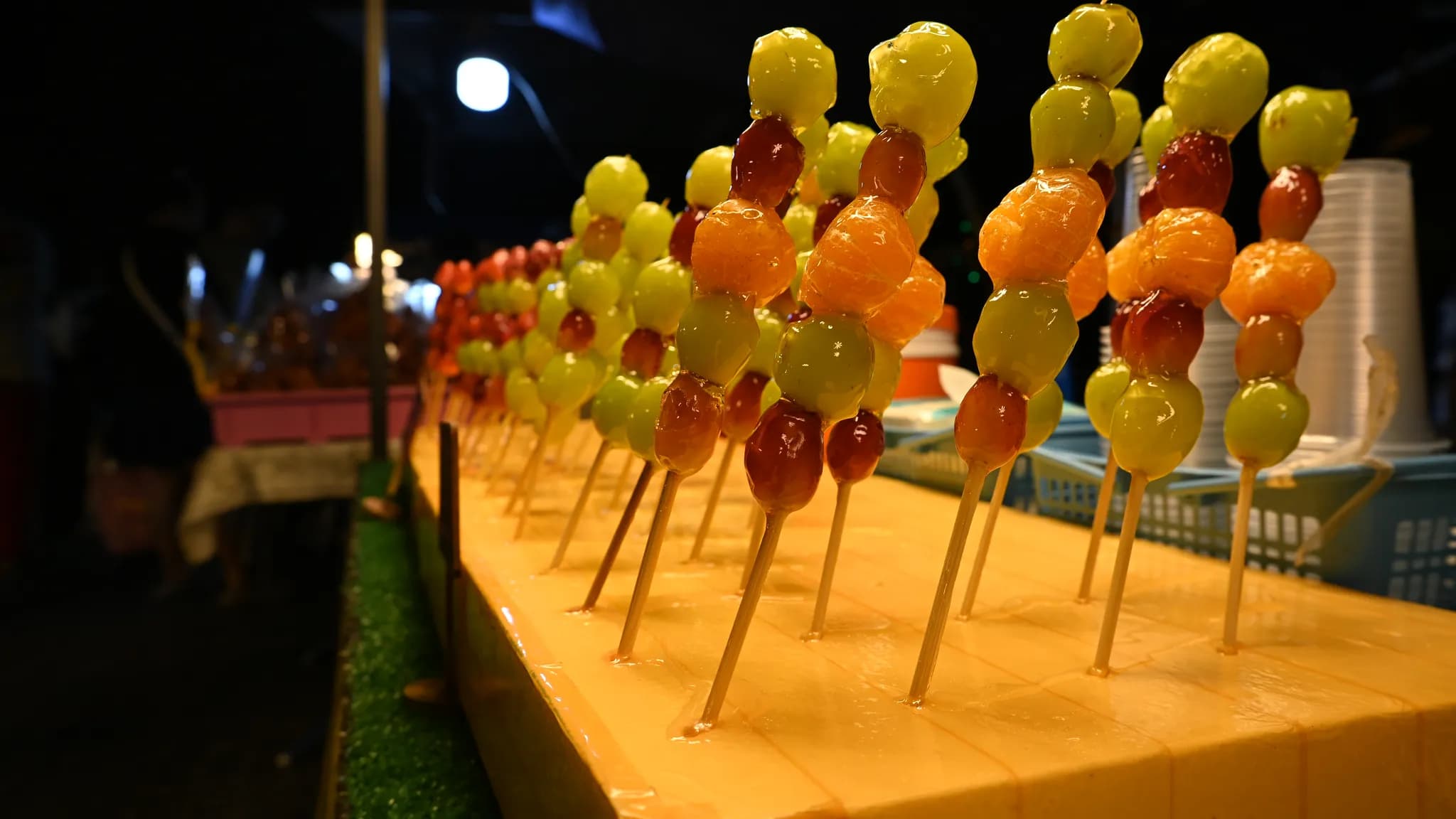
For about eighteen months, it seemed like every teenager in Seoul had a red, glass-shelled skewer of fruit in hand. Then, almost as suddenly as the shops opened, they started closing. Tanghulu's boom-and-bust cycle turned out to be one of the sharpest of any recent food fad, and looking back at it now tells you something about how fast viral food trends can burn through their own novelty.
Tanghulu itself is old. It's a traditional Chinese snack, typically hawthorn fruit or strawberries dipped in hot sugar syrup that hardens into a thin, crackable shell. What was new was the scale of its sudden popularity in Korea, and the speed with which it then evaporated.
How did tanghulu go viral in the first place?
The trend caught fire on TikTok and YouTube in 2023, when the combination of glossy visuals and an ASMR-friendly crunch made it an easy fit for short-form video, according to the South China Morning Post. Tanghulu became the most searched term in the frozen and convenient food category among Korean teenagers in the first half of 2023, a sign of just how quickly a decades-old snack could become a Gen Z obsession through nothing more than a well-shot video.
The visual appeal did most of the heavy lifting. A skewer of glossy red fruit encased in a hard sugar shell photographs and films exceptionally well, and hashtags like #Tanghulu and #CandiedFruit racked up millions of views as creators competed to film the cleanest crack and the most satisfying bite.
How fast did tanghulu shops expand?
The growth was staggering by any retail standard. Dalkom Wang Ga Tanghulu, South Korea's biggest tanghulu chain, grew from roughly 50 locations in February 2023 to more than 300 by that August, according to the same SCMP reporting, a sixfold expansion in about six months that outpaced almost any other snack chain's growth in recent memory.
Why did the tanghulu trend collapse so quickly?
By May 2024, the craze had already begun to wane, accompanied by a rising wave of shop closures, according to the Korea Times, which grouped tanghulu alongside other short-lived Korean food fads like the honey butter chip boom and dujjonku bread. The pattern is a familiar one in viral food culture: a trend explodes on the strength of pure novelty and video appeal, retailers overbuild to meet demand that's really just curiosity, and once the initial wave of TikTok users moves on to the next thing, there isn't enough repeat demand to sustain the number of shops that opened during the peak.
Tanghulu also had a structural weakness that some other viral snacks don't: it's genuinely easy to make at home with just fruit, sugar, and water, and it doesn't keep well once made, since the sugar shell absorbs moisture and turns sticky within hours. That combination, low barrier to home replication and short shelf life, made it hard for a dedicated retail category to hold onto customers once the initial curiosity wore off.
Was the tanghulu trend worth all the attention?
As a piece of food culture, tanghulu's run was a useful case study in how fast social media can manufacture and then abandon a category. The snack itself never really changed, it's the same fruit-and-sugar preparation that's existed in Chinese street food for a long time. What changed was the packaging of that preparation into a short, visually satisfying video format that an algorithm could spread at enormous speed.
A handful of tanghulu shops have survived the shakeout by diversifying into other candied and skewered snacks, and the format still shows up periodically in new video waves. But the mass storefront boom that defined 2023 has largely receded, leaving tanghulu closer to where it started: a traditional snack, rather than a retail category, that occasionally goes viral again for a week or two before fading back into the background.
What other Korean snacks followed the same boom-and-bust pattern?
Tanghulu wasn't an isolated case. Korean food culture has produced several short, intense viral snack cycles in recent years, honey butter chips triggered a similar retail scramble when they first launched, with shortages and resale markups driven almost entirely by social buzz, and dujjonku bread saw a comparable wave of specialty bakeries open and then thin out once the initial curiosity faded. Grouped together, these cases suggest a recognizable cycle specific to Korea's fast-moving, hyper-connected food media environment, one where a single viral clip can trigger retail expansion at a pace few other markets match, followed by an equally fast contraction once attention moves elsewhere.
Is there a lesson here for other viral food trends?
Tanghulu's rise and fall offers a useful caution for any retailer chasing a viral snack's momentum: the speed at which a trend can multiply storefronts is not a reliable predictor of how long customer demand will actually last. Chains that expanded fastest during the peak were often left carrying the most overhead once the trend cooled, a pattern likely to repeat with whatever the next viral Korean snack turns out to be.
Published in The Outspoken Digest
Editorial desk
Outspoken Digest Food DeskCooking, ingredients, restaurants and the economics of what ends up on the table.
Newsletter
The Digest, in your inbox
One edition, sent when it is ready. No noise, and your address is never passed on.
Read Next
More Latest Trends →
Navi Pillay, the South African Jurist Who Led the UN Gaza Inquiry, Wins the 2026 Nobel Peace Prize
Oct 9, 2026/3 min read

Trump Says the US Will Not Attack Iran Before the Midterms, While Tanker Attacks Cut Hormuz Traffic to a Two-Month Low
Oct 9, 2026/3 min read

Russian Strikes Killed 22 in Pryluky and at Least 30 on Two Buses in Kramatorsk Within Two Days
Oct 9, 2026/2 min read

A Year After the Gaza Ceasefire, More Than 100 Aid and Rights Groups Say It Exists in Name Only
Oct 9, 2026/2 min read