The Thistlegorm: A 1941 Cargo Manifest You Can Swim Through
A British freighter bombed off Sinai in 1941 still holds its motorcycles, trucks and rifles in the holds. Cousteau found it in 1956, and it remains the Red Sea's defining dive.
Thursday, August 6, 2026/4 min read
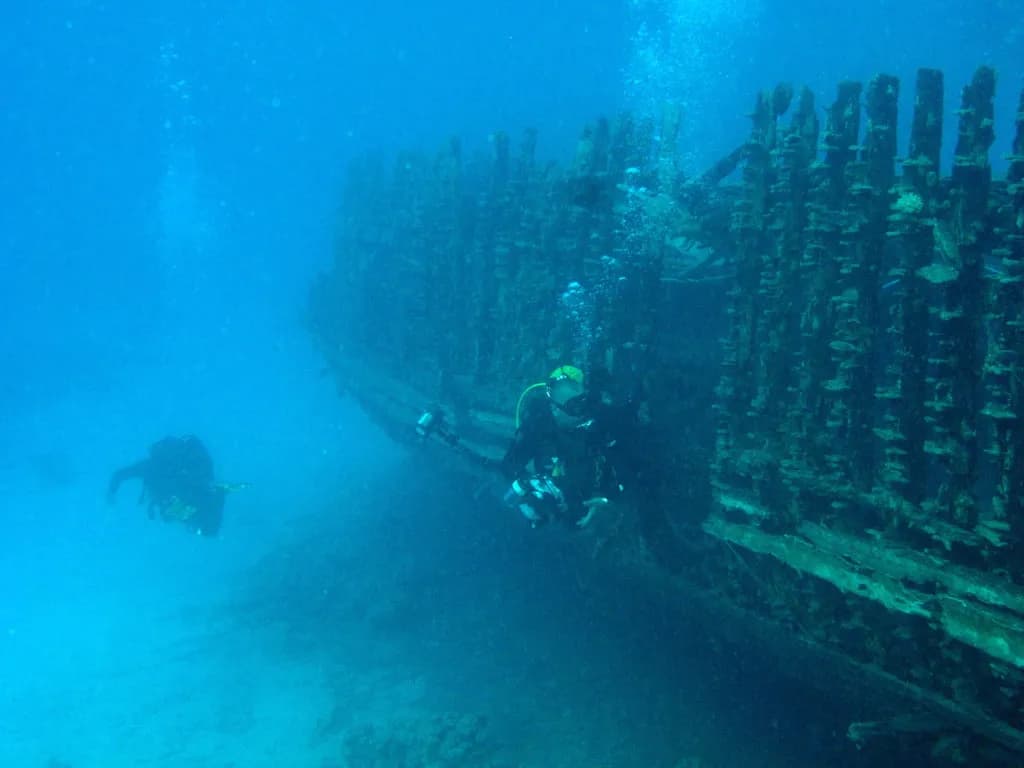
Most wreck dives ask you to imagine the ship. The Thistlegorm does not. The motorcycles are still stacked in the hold, the Bedford trucks still parked in rows, the rifles still in their crates. It is less a wreck than an interrupted delivery.
The SS Thistlegorm was a British armed freighter, 125 metres long, sunk by German aircraft on the night of 5 to 6 October 1941 while carrying supplies intended for Allied forces in North Africa. She had been in service for barely eighteen months.
She lies about 40 km from Sharm El Sheikh off the west coast of the Sinai Peninsula, upright on sand at around 30 metres, with the stern section separated from the main body. That combination of depth, cargo and preservation is why she is regularly described as the best known wreck dive in the Red Sea.
What happened that night
The ship was at anchor when she was found by German bombers. She sank in under ten minutes, which for a vessel of that size is close to instantaneous.
The detail that changed the outcome is almost incidental: the night was warm, and most of the crew were sleeping on deck rather than below. All but nine men were rescued by HMS Carlisle, which was moored nearby, according to the published history of the wreck.
Nine men died. It is worth holding that in mind on a site that is now visited for pleasure, because the wreck is also a grave, and the atmosphere among divers who understand that is noticeably different from the atmosphere among those who do not.
Cousteau, and then everyone
The wreck was located by Jacques Cousteau in 1956. For decades afterwards it stayed relatively obscure, then became one of the most visited dive sites in the world.
That popularity is now part of the site's condition. Heavy traffic, mooring lines and the sheer number of divers passing through the holds have all left marks on a structure that has been submerged for more than eighty years.
What the dive actually demands
This is not a beginner site, and the reasons are specific rather than atmospheric.
The wreck sits at around 30 metres. Time spent at that depth accumulates nitrogen quickly, and a dive plan that includes moving through the holds needs to account for a slow ascent and a proper safety stop in open water afterwards. Most operators restrict it to divers with an advanced certification for exactly this reason.
Current is the second factor. The site sits in open water in the Straits of Gubal, and conditions range from still to genuinely strong. A negative entry and a descent down a line are standard practice, not caution.
The third is the cargo holds themselves. Swimming inside a wreck is overhead environment diving, whatever the certification card says. There is a real difference between a swim through with visible daylight at both ends and a penetration into a dark, silted space, and the second requires training, a reel and a light that most recreational divers do not carry.
Why it stays worth doing
Because the cargo makes the history physical in a way a museum cannot. Motorcycles corroded into the deck, a locomotive blown clear of the ship by the explosion, boots and rifles and tyres arranged as they were stowed.
Accounts from operators such as ZuBlu emphasise the same thing: it is the inventory rather than the structure that people remember.
Going, and going responsibly
Day boats run from Sharm El Sheikh, and liveaboards on northern Red Sea itineraries include it as a matter of course. The liveaboard option usually means diving it early, before the day boats arrive, which changes the experience considerably.
The site rewards two dives rather than one: an orientation circuit outside, then a second dive into the holds with a clearer sense of the layout. Trying to do everything on a single tank at 30 metres is how people end up rushing an ascent.
Handle the artefacts with restraint, or rather do not handle them. The site has been visibly degraded by decades of souvenir taking, and the difference between a wreck that keeps its cargo and one that has been picked clean is a few thousand individual decisions.
What a wreck becomes after eighty years
A ship on the seabed stops being a ship fairly quickly and becomes a structure with a predictable decay curve.
Steel corrodes, decking weakens, and the spaces that were solid when the wreck was found become unreliable. On a site as heavily visited as this one, that process is accelerated by contact: fins striking surfaces, hands on railings, and the constant disturbance of silt that abrades as it settles.
The practical consequence for divers is that a route through the holds that a guide swam safely ten years ago is not automatically safe now. Local briefings exist for that reason and are not a formality.
Why it also functions as an artificial reef
The Thistlegorm is a war grave, a museum and, incidentally, a substantial artificial reef.
Eighty five years of submersion have colonised the structure thoroughly, and the wreck now supports a resident marine community that would not exist on the surrounding sand. That is the same principle behind deliberate reef sinkings, achieved accidentally by a bombing raid.
It complicates the conservation argument in a useful way. Preserving the wreck is not only about protecting the artefacts, it is about protecting a habitat that took decades to establish. Operator accounts such as ZuBlu's increasingly note the marine life alongside the cargo.
What to watch next
The pressure question for the Thistlegorm is management rather than discovery. Mooring practice, diver numbers and whether any formal protection status arrives will determine what is left of the cargo in another twenty years.
It survived a bombing, eighty five years of seawater and rediscovery. What it may not survive is being loved carelessly.
Published in The Outspoken Digest
Editorial desk
Outspoken Digest Diving DeskCovers freediving, recreational and technical diving, dive medicine and the incidents the sport learns from.
Newsletter
The Digest, in your inbox
One edition, sent when it is ready. No noise, and your address is never passed on.
Read Next
More Diving →
Breathless and Coughing Pink Froth After a Dive: Immersion Pulmonary Edema Explained
Oct 17, 2026/3 min read
Your Gas Consumption Is Not One Number: Why Depth, Cold and Nerves Change It
Oct 16, 2026/3 min read
SS United States Reef Sinking Targeted for November: What Divers Should Know
Oct 16, 2026/2 min read
Divers Excavating Off Kekova Find a Wreck Believed to Be the World's Oldest, Turkey Says
Oct 15, 2026/2 min read