Giant Canyon on Mars Is Still Tectonically Active, Study of a 2021 Marsquake Finds
Re-reading a quake NASA's InSight lander recorded in 2021, researchers place it in an ancient fault under Valles Marineris and say the planet's crust still breaks along old scars.
Thursday, October 22, 2026/2 min read
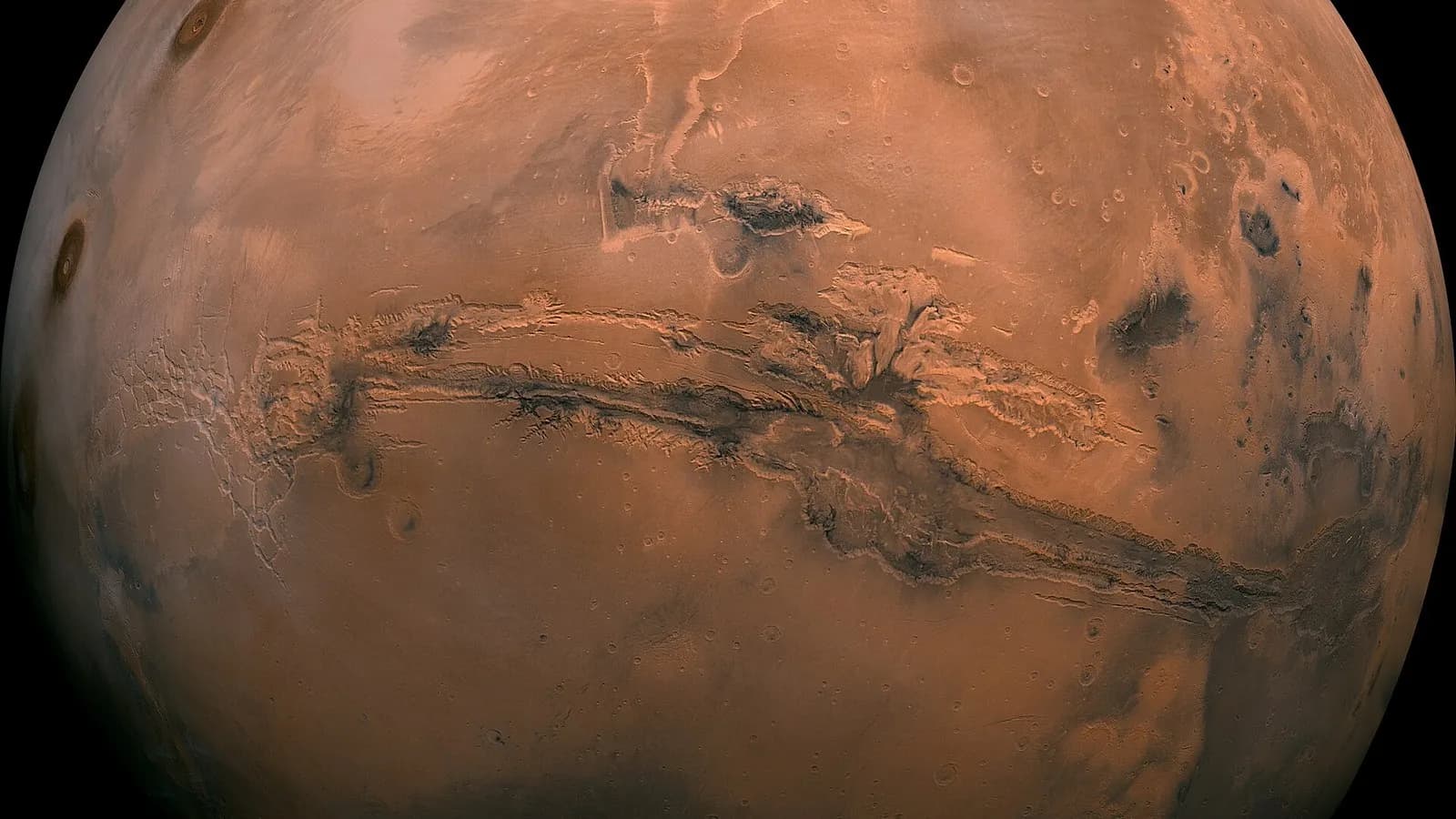
Mars is often described as a dead world, its great landscapes frozen billions of years ago. A new analysis of one marsquake suggests the largest canyon in the solar system did not get the message.
Researchers at Imperial College London and Columbia University report that Valles Marineris is still tectonically active, according to Phys.org. The work appeared in Nature Communications, and Imperial College London published its announcement on 15 October.
What did the marsquake show?
The quake, catalogued as S0976a, was recorded by NASA's InSight lander on 25 August 2021. It was the only InSight-detected marsquake that could be located in the planet's western hemisphere, Imperial says.
The team, led by Jung-Hun Song with Folarin Kolawole and Doyeon Kim, studied the amplitudes and directions of the seismic waves to work out how the rock moved. The best fit was a strike-slip event, where blocks of crust slide sideways past each other along a steep fault. The rupture lay roughly 20 to 40 kilometres below western Valles Marineris.
Could it have been something else?
The researchers tested alternatives, including meteoroid impacts, landslides and other mass movements. None reproduced the observed waves. Satellite images taken after the event showed no fresh crater and no large new landslide, Phys.org reports.
The faults date from the canyon's formation billions of years ago, yet they remain weak enough to slip under today's stresses. The authors attribute those to the planet's long cooling, the nearby Tharsis volcanic region and effects local to the canyon.
How big is Valles Marineris?
The canyon system is about 3,900 kilometres long, up to 600 kilometres wide and more than 9 kilometres deep, Phys.org says. At its largest it is roughly nine times longer and five times deeper than the Grand Canyon.
Song said the canyon is "not just a 'dead' fossil landscape." Kolawole said that on a planet without plate tectonics, ancient structures can still control where the crust breaks. Song added that several independent lines of evidence point the same way.
How firm is the conclusion?
It rests on one event. Imperial describes the mechanism as the best explanation from the wave analysis, not a rupture anyone watched, and the epicentre and depth are model-based estimates. InSight's mission ended in 2022, so no new data can test it directly.
Other InSight data point to active faulting at Cerberus Fossae and southern Elysium Planitia, which suggests stress varies across Mars. Mapping where else old faults are slipping now depends on future seismometers on the surface.
Published in The Outspoken Digest
Editorial desk
Outspoken Digest Science DeskReports for The Outspoken Digest across Technology, Latest Trends, Health.
Newsletter
The Digest, in your inbox
One edition, sent when it is ready. No noise, and your address is never passed on.
Read Next
More Technology →
What PHP2Shell Reveals About Maintaining the Code Behind Most of the Web
Oct 22, 2026/3 min read

PHP2Shell for Hosts, Developers and Security Teams: Backports, WAF Rules and Incident Response
Oct 22, 2026/3 min read
PHP2Shell: What Website Owners and Small Businesses Should Do Right Now
Oct 22, 2026/3 min read

PHP2Shell Timeline: From a Quiet August Report to a Leak, Early Attacks and a Day-Early Patch
Oct 22, 2026/3 min read