Von der Leyen Offered Canada a Seat That Does Not Exist Yet: the EU's First Associate Member, With Carney in the Gallery
A 73-minute State of the Union in Strasbourg proposed a European Security Council with Ukraine, Britain, Norway and Canada, a migration emergency framework, a social media ban under thirteen and a two trillion euro budget. The treaties know no such seat.
Thursday, September 17, 2026/3 min read
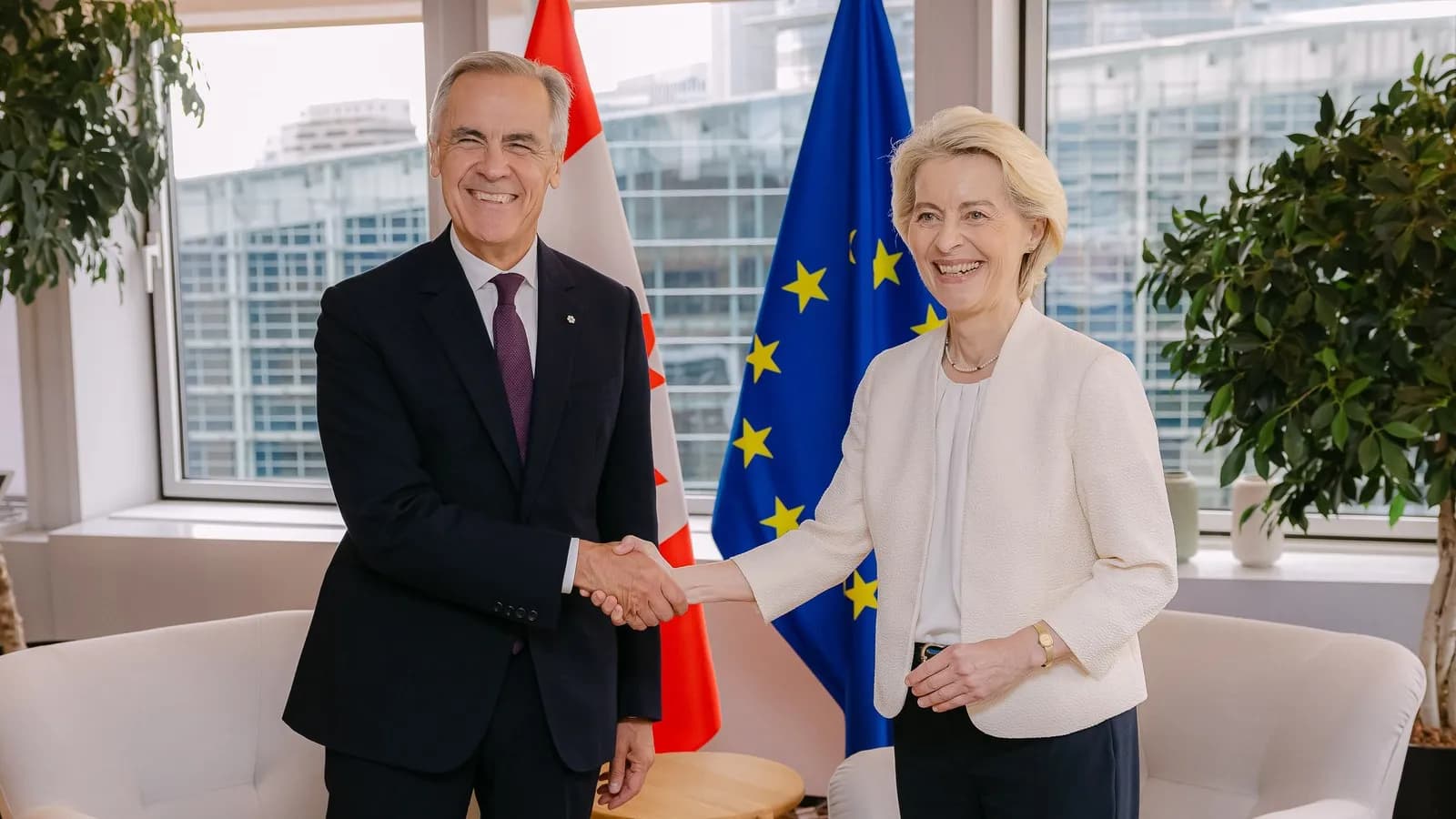
Ursula von der Leyen's sixth State of the Union address ran 73 minutes on Wednesday morning and the line that travelled was addressed to a guest. "I would like to work with you on opening the door for Canada to be the first associate member of the EU," she told Mark Carney, who had flown to Strasbourg to hear it. The category does not exist. There is no associate membership in the treaties and no legal framework for one; the 27 governments would have to invent it and then agree to admit Canada to it. What von der Leyen described was a step up from the CETA trade agreement to what she called an "alliance for the future": a technology alliance, a shared defence industrial base, Arctic projects, energy and cooperation on artificial intelligence, including joint evaluation of frontier models with Canada and Britain. "We must urgently reimagine our partnerships," she said, in "an openly hostile world". The ABC and Al Jazeera both note the timing: a trade war with Washington that has not eased, and Carney's own search for partners who are not the United States.
Security
The second proposal was a European Security Council bringing in Ukraine, the United Kingdom, Norway and Canada, alongside an EU equivalent of NATO's Article 4 for hybrid attacks; she cited the drone attack on Leipzig. Defence spending across the bloc is up eighty per cent in five years. For Ukraine she announced, for the first time, EU-approved purchase of Patriot missiles, a European modular missile-defence programme called Freyja, and the redirection of ten to fifteen billion euros of unspent SAFE loans to joint EU-Ukrainian projects. Russia's daily strikes she called "a deliberate strategy of terror". On Gaza she conceded what everyone in the chamber knew, that the Union had been unable to build a consensus. She said the funeral of Ratko Mladić had "horrified" her.
Heat, migration, children
Euronews' running account lists the rest. A European heatwave plan with early-warning systems, after a summer in which the Greens' Terry Reintke reminded her 650,000 hectares burned and 35,000 Europeans died of heat. A climate insurance alliance, since only a quarter of catastrophe losses in Europe are insured, and a hundred vulnerable territories to be assessed. An emergency response framework for mass irregular arrivals, prompted by Ceuta, allowing temporary departures from standard procedure and a stronger Frontex for returns. And an EU Kids Act that would bar social media to children under thirteen, restrict it under fifteen, and reverse the burden of proof so that platforms must show a service is safe. On AI she chose industry over models: health, transport, food, manufacturing, defence and space, with a nod to "pacing" frontier development that echoes the argument running in California this week.
The money
Underneath it sits a proposed budget of two trillion euros for 2028 to 2034 and five new "own resources", which is Brussels for EU-wide taxes, along with the Draghi and Letta recommendations on the single market. The reactions were the usual map. Manfred Weber of her own EPP used the moment to oppose the combustion-engine ban: "innovation, not bans". Iratxe García Pérez for the Socialists and Manon Aubry for the Left demanded windfall taxes on energy companies, whose profits at 108-dollar oil are the season's easiest target. Nicola Procaccini of the ECR asked why Canada came before Britain. Jordan Bardella of the Patriots wanted "European money, European jobs" in procurement. Aubry asked what democratic mandate existed for associate membership, which is the right question, and one the 27 will now have to answer.
Why it matters
The Union has spent seventy years defining membership as a binary. Von der Leyen has proposed a third state, for a G7 country that shares a language, a legal tradition and a neighbour with the bloc's largest trading partner, at a moment when that neighbour is imposing tariffs on both. Whether it is a real offer or a speech will be decided in national capitals, several of which noticed they were not consulted. Carney, at least, had a good morning.
Published in The Outspoken Digest
Editorial desk
Outspoken Digest News DeskReports for The Outspoken Digest across Latest Trends, Sports, Nutrition, Crypto.
Newsletter
The Digest, in your inbox
One edition, sent when it is ready. No noise, and your address is never passed on.
Read Next
More Latest Trends →
Trump Rallies in Port Huron Against El-Sayed as Michigan's Senate Race Enters Its Final Eleven Days
Oct 26, 2026/2 min read

Trump Rules Out a Sunday Strike on Iran as Qatari Mediators Reach Tehran and Houthi Missiles Hit Saudi Arabia
Oct 26, 2026/3 min read

Zelenskyy Confirms Trilateral Peace Talks With Russia and the US Will Take Place in November
Oct 26, 2026/2 min read
Serbia's Student List Wins the Election as Vucic Concedes, Ending 14 Years of Progressive Party Rule
Oct 26, 2026/2 min read