What Freediving Actually Is: Every Discipline Explained
CWT, CNF, FIM, STA, DYN: a plain guide to how competitive freediving is actually judged, discipline by discipline, and why the letters matter more than the depth alone.
Wednesday, February 14, 2024/5 min read
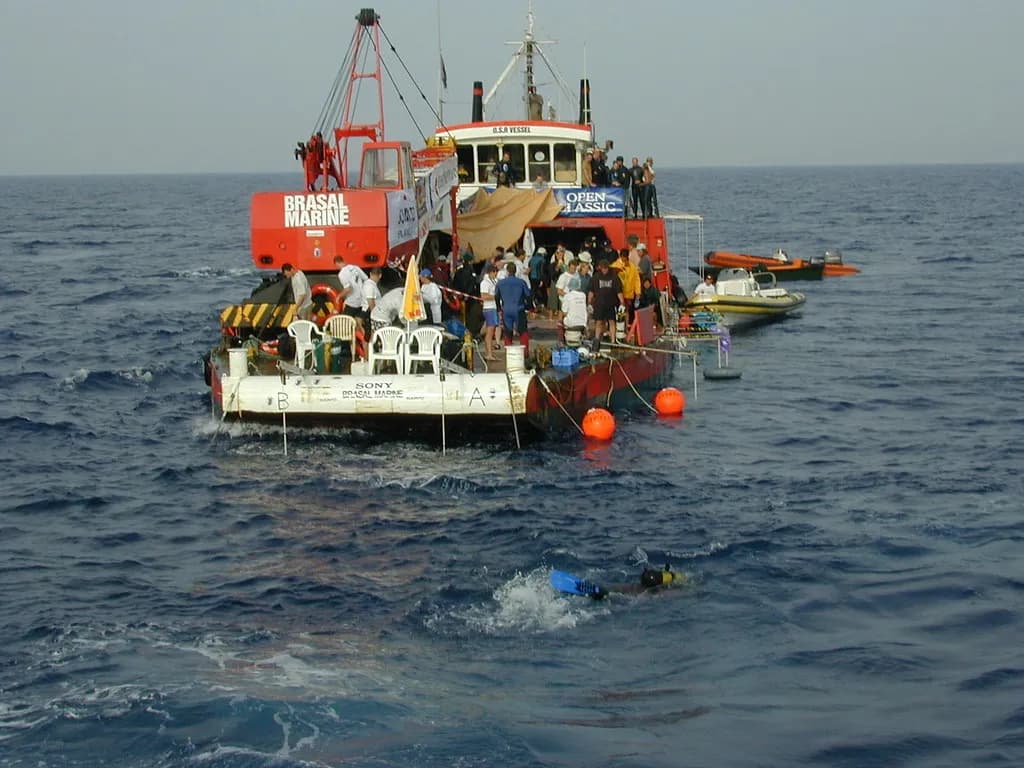
Ask someone who has never watched competitive freediving what the sport involves and they will usually say some version of "holding your breath and going deep." That is true in the way that saying running is "moving your legs fast" is true. The sport actually splits into a handful of distinct disciplines, each with its own technique, its own record book, and its own particular way of testing the human body.
Two federations govern almost all of it: AIDA International and CMAS, the older umbrella body for underwater sports. Their rulebooks differ in small ways, but the disciplines themselves are recognisable across both, and athletes routinely compete under either banner. Understanding the letters, CWT, CNF, FIM, STA, DYN, is the fastest way into the sport as a spectator.
What is CWT, the depth discipline everyone pictures?
Constant Weight, CWT, is the one people mean when they picture freediving: a diver descends along a vertical line using a monofin or bifins for propulsion, and returns to the surface under their own power, without pulling on the rope and without dropping any weight along the way. It is the most widely contested depth discipline and the one that produces the sport's headline numbers, according to the Freediving Association of India's discipline guide.
The monofin, a single blade that binds both feet together, turns the kick into something closer to a dolphin's tail stroke than a swimmer's flutter kick. It is efficient, but it demands technique that takes years to build cleanly.
What makes CNF the hardest discipline in the sport?
Constant Weight Without Fins, CNF, strips away the fin entirely. The diver swims breaststroke-style, using only their arms and legs, unaided by any propulsion equipment, on the way down and the way back up. Freedivers who compete in it consistently describe it as the most physically demanding depth discipline that exists, because there is no equipment to compensate for a tired stroke, according to DIPNDIVE's overview of freediving disciplines. Depths in CNF sit well below CWT depths for the same athlete, simply because the body cannot generate as much thrust as a monofin can. A CNF diver has to manage every stroke's efficiency manually, and the smallest wasted movement costs oxygen that cannot be recovered mid dive.
How is Free Immersion, FIM, different from a pull-down descent?
In Free Immersion, FIM, there is no kicking at all. The diver pulls themselves down the rope hand over hand, and pulls themselves back up the same way, according to Wikipedia's entry on free immersion apnea. Coaches often use FIM as a teaching tool precisely because the slower pace gives a diver time to practise equalisation technique without the added workload of finning, which is why many freedivers first learn to manage pressure changes in this discipline before they ever pick up a monofin.
Because both hands stay busy pulling rope rather than finning, FIM also forces a diver to keep their body streamlined using core tension alone, a skill that transfers directly into cleaner technique once they move on to CWT.
Why does STA measure time instead of distance?
Static Apnea, STA, is the outlier. There is no depth and no distance, only time. The diver floats face down in a pool, motionless, and the clock runs until they lift their head to breathe. It looks like the least dramatic event in the sport and it is, in some ways, the most purely physiological one: no technique variable, no current, no equalisation, just the body's tolerance for rising carbon dioxide and falling oxygen under controlled, supervised conditions.
Elite STA times now run past ten minutes for some competitors, a duration that sounds implausible until you remember that a motionless body submerged face down, heart rate slowed by the dive reflex, burns oxygen at a fraction of the rate an active swimmer does.
What separates DYN from the depth disciplines entirely?
Dynamic Apnea With Fins, DYN, moves the sport horizontal. Competitors swim underwater in a pool, monofin or bifins, chasing distance rather than depth, according to the same DIPNDIVE breakdown cited above. A no-fins variant, DNF, exists as its breaststroke-only counterpart, mirroring the CWT to CNF relationship in the depth disciplines.
Pool disciplines like DYN and STA also serve a quieter purpose in the sport: they let a diver train and compete without ever needing open water access, which is why so many national federations run their domestic championships in a standard pool while reserving depth events for coastal or lake venues later in the season.
Why the letters matter beyond trivia
The alphabet soup is not bureaucratic clutter. Each discipline isolates a different variable, propulsion, equalisation load, pure time, and a diver's personal best in one tells you almost nothing about their capability in another. A world class STA athlete with an eight minute static hold might be a modest CNF performer, because raw breath hold time and depth technique are not the same skill. The official rulebooks, published and updated by AIDA International, define the exact judging criteria for each, down to the surface protocol a diver must complete within fifteen seconds of returning to the surface for the dive to count.
None of this happens casually. Every discipline described here is contested under direct supervision, with safety divers stationed on the line and strict medical protocols in place, because breath hold diving carries real risk even for trained athletes. Shallow water blackout, a loss of consciousness from oxygen deprivation, is the mechanism that ends dives and lives, and it is precisely why competitive freediving is never a solo pursuit and never should be attempted as one.
This article is journalism, not instruction. Anyone drawn to try any of these disciplines should start with a certified freediving agency and a qualified instructor, not a video and a swimming pool.
As more national federations professionalise their competition calendars, expect the entry point for spectators to keep getting clearer, even as the sport at its deepest end keeps pushing further than most people would guess a human body could go on a single breath.
Published in The Outspoken Digest
Editorial desk
Outspoken Digest Diving DeskCovers freediving, recreational and technical diving, dive medicine and the incidents the sport learns from.
Newsletter
The Digest, in your inbox
One edition, sent when it is ready. No noise, and your address is never passed on.
Read Next
More Diving →
Playing Recordings of a Healthy Reef Drew More Coral and Fish Larvae to Artificial Structures Off Hawaii
Oct 9, 2026/3 min read
Blacktip Sharks Can Hear a Sound From Nearly 250 Feet Away and Swim Straight Toward or Away From It
Oct 1, 2026/2 min read
A Sea Turtle Species Never Recorded Nesting in the United States Laid Eggs on a Southern California Beach
Oct 1, 2026/2 min read
Marine Surveyors Confirmed Living Coral Off Benin, More Than Sixty Years After the Reef Was Presumed Dead
Sep 29, 2026/2 min read