Andromeda Is Slowly Winding Down Its Star-Making Era
Hubble observations show star formation across Andromeda has declined for roughly 500 million years, offering a detailed preview of how a large spiral galaxy changes with age.
Saturday, August 1, 2026/2 min read
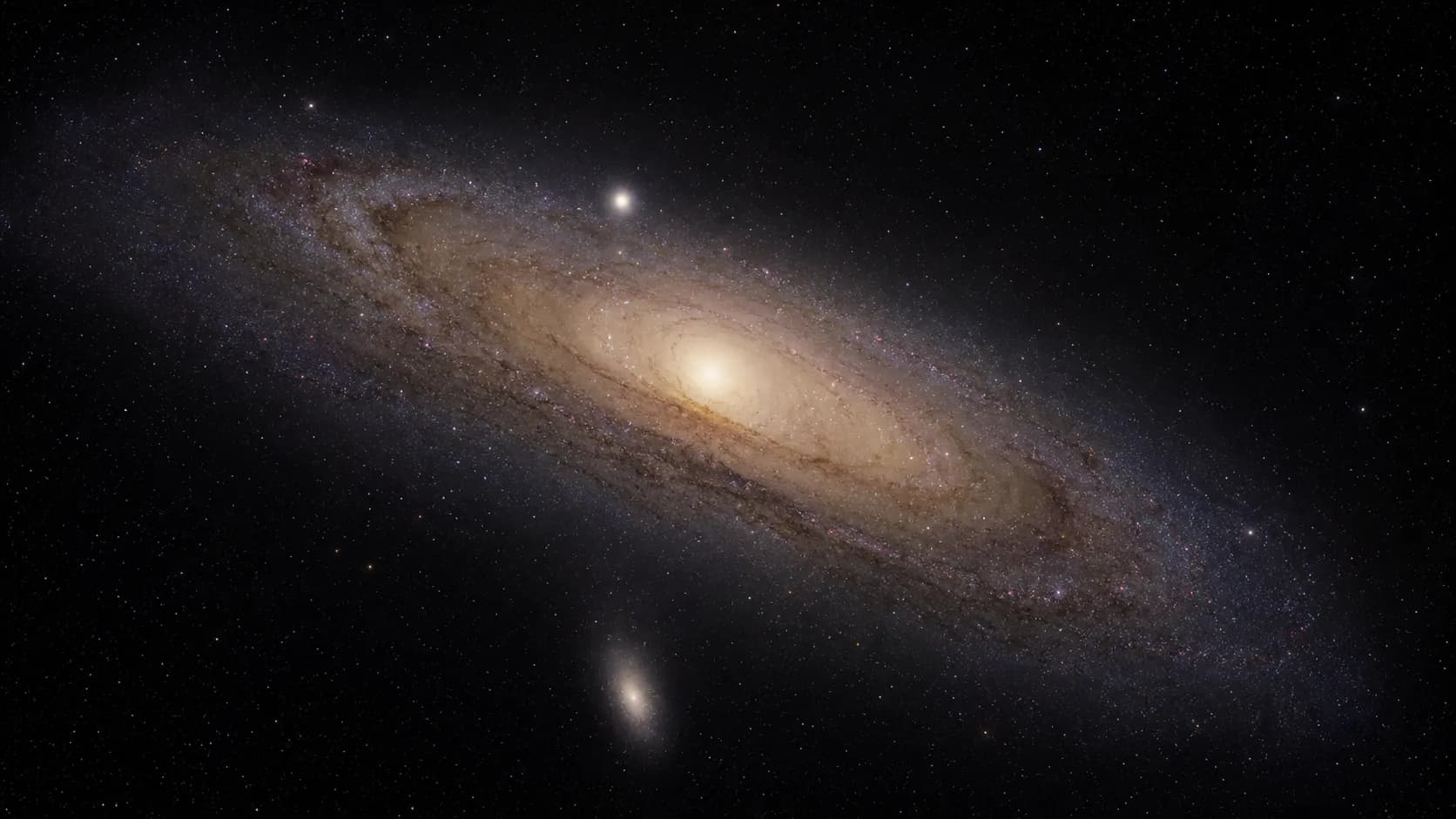
Our nearest large galactic neighbor is not running out of stars. It is producing new ones more slowly. A detailed Hubble analysis finds that star formation across the Andromeda Galaxy has declined over about 500 million years, revealing a large spiral system in the late stage of a much longer wind-down.
The NASA Hubble release draws on the Panchromatic Hubble Andromeda Southern Treasury, or PHAST. By resolving millions of individual stars, researchers reconstructed when different regions formed their stellar populations.
How scientists read a galaxy's history
A galaxy does not keep a written archive, but its stars preserve evidence. Their brightness and color depend on mass, age and composition. Astronomers compare observed populations with models of stellar evolution to estimate how actively stars formed at different times.
Hubble's sharp imaging is crucial because Andromeda contains a dense mix of stars. At about 2.5 million light-years away, it is close enough for the telescope to separate enormous numbers of them rather than seeing only a smooth glow.
A decline is not a shutdown
Andromeda still contains gas, dust and regions where stars are forming. The result describes a broad decline in rate, not a switch from active to dead. Galaxies evolve over hundreds of millions or billions of years, so a slowdown can be both significant and almost imperceptible on a human timeline.
The underlying PHAST analysis maps recent star formation across the southern disk. Different areas do not behave identically. Spiral structure, gas density, past interactions and feedback from young stars can shape local activity.
Why galaxies stop making stars
Stars form when cold gas collapses into dense clouds. A galaxy's rate can fall when it uses up or loses that gas, when fresh material stops arriving or when energetic events heat gas so it cannot collapse efficiently. Interactions can either trigger bursts or strip and disturb the supply.
Understanding which mechanism dominates requires more than counting young stars. Radio observations trace cold gas, infrared data reveal dust-obscured regions and spectroscopy measures motion and chemistry. Hubble supplies an unusually detailed stellar timeline that other observatories can connect to the remaining fuel.
What Andromeda teaches us about the Milky Way
Andromeda and the Milky Way are both large spirals in the Local Group. They are not twins, but their proximity makes comparison valuable. Researchers can test whether features seen as blended light in distant galaxies also appear in the resolved history of a nearby one.
The galaxies may interact dramatically in the far future, though current research continues to refine the exact probability and path. That distant possibility is separate from today's finding. The star-formation decline is already underway because of Andromeda's internal history and environment.
A quiet discovery with a long view
Astronomy often emphasizes explosions, collisions and record-breaking objects. A 500-million-year decline is quieter but just as fundamental. It shows how galaxies mature and how the bright, blue light of young stars gradually gives way to older populations.
Andromeda remains a spectacular spiral filled with hundreds of billions of stars. Hubble has simply revealed that its great stellar factory has passed a busier chapter, and that a galaxy can change profoundly without changing quickly.
Published in The Outspoken Digest
Editorial desk
Outspoken Digest Science DeskReports for The Outspoken Digest across Technology, Latest Trends, Health.
Newsletter
The Digest, in your inbox
One edition, sent when it is ready. No noise, and your address is never passed on.
Read Next
More Technology →
Webb Caught a Probable Supernova From the Early Universe Only Days After It Exploded
Oct 18, 2026/2 min read

Webb Maps an Exoplanet's Atmosphere as Egg-Shaped, With a Puffed-Up Evening Side Hotter Than Its Morning Edge
Oct 18, 2026/2 min read
A Hole in a 75,000-Year-Old Shoulder Blade Points to a Wooden Spear, and Perhaps to Neanderthal Care
Oct 18, 2026/2 min read

Anthropic's Own Staff Data: Junior Technical Hires Fell From 27 to 9 Percent as Its AI Agents Outworked Humans
Oct 18, 2026/2 min read