Astronauts Install the Space Station's Eighth and Final Roll-Out Solar Array in a 7-Hour Spacewalk
Anil Menon and Joshua Kutryk finished a power upgrade that took 18 spacewalks, and NASA says the orbiting laboratory's capacity will rise from about 160 kilowatts to roughly 215.
Friday, November 6, 2026/2 min read
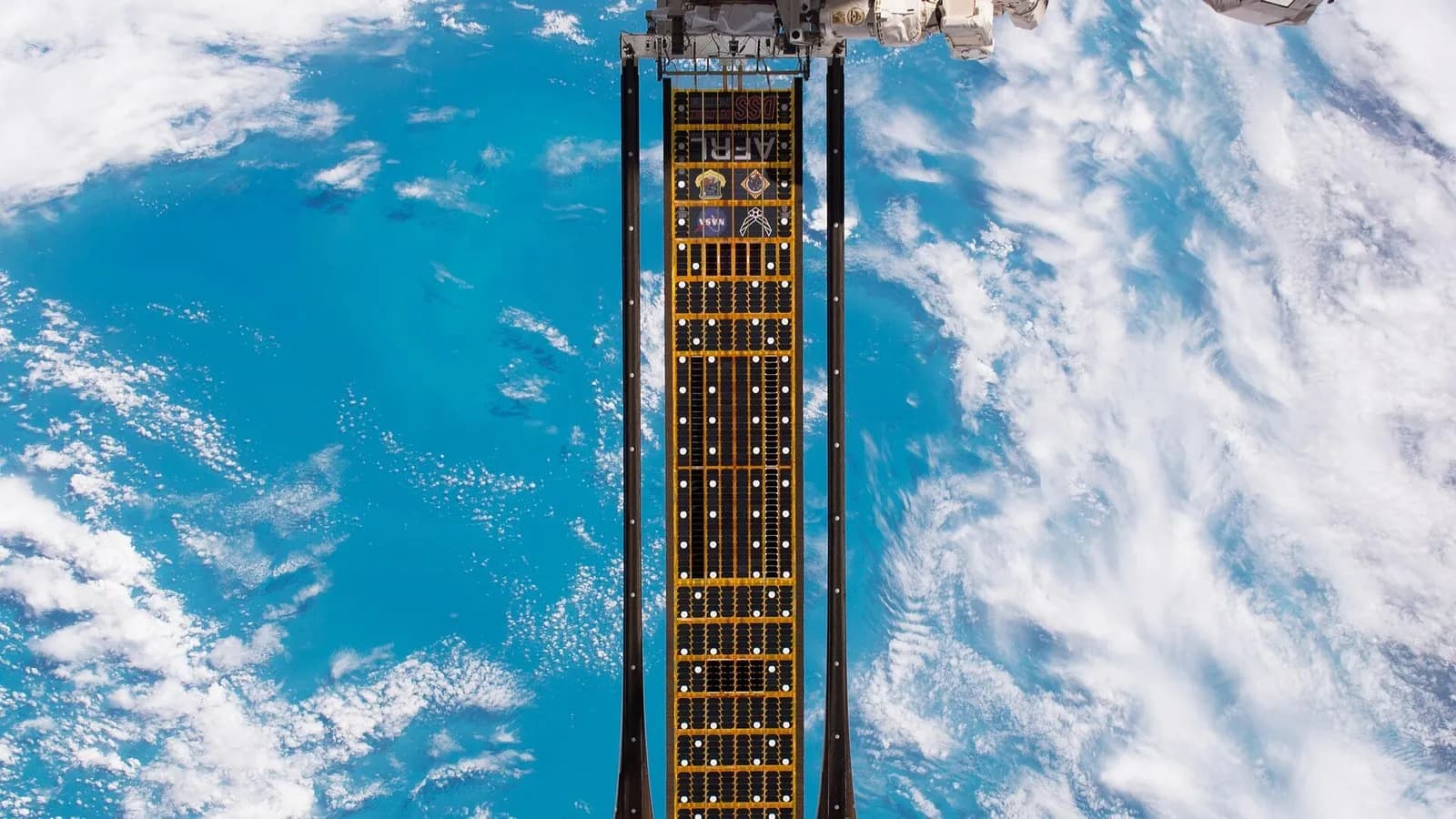
The last of the International Space Station's new solar arrays is in place. NASA astronaut Anil Menon and Canadian Space Agency astronaut Joshua Kutryk spent six hours and 59 minutes outside the station on Thursday, installing and deploying the eighth and final ISS Roll-Out Solar Array on the 3B power channel, NASA reported. The spacewalk ended at 3.35pm US Eastern time.
It completes a programme of power augmentation that NASA says took 18 spacewalks and eight arrays in total, and that raises the station's power generation from 160 kilowatts to approximately 215 kilowatts.
What did the spacewalkers do?
The job repeated the steps of a spacewalk a week earlier, mirrored on the opposite side of the truss. According to NASA's preview on Wednesday, the plan was to install the array at the far end of the starboard truss. Menon, attached to the Canadarm2 robotic arm, carried the array to the site and handed it to Kutryk, who passed it back to Menon for installation. Inside the station, NASA flight engineers Jessica Watkins and Luke Delaney supported the pair.
NASA numbers it as US spacewalk 101 and the 286th in support of station assembly, maintenance and upgrades. It was Menon's fifth and Kutryk's second. The preview had it starting at 8.30am Eastern and lasting about seven hours, so it finished almost exactly on schedule.
The pair also came in a little faster than a week earlier: 6 hours 59 minutes against 7 hours 11 minutes for the 2A channel array. NASA live-streamed the work on NASA+ and other platforms from 7am Eastern, an hour and a half before the spacewalk began. In its account of the day NASA describes the work as completing the station's power augmentation upgrades, with no further arrays planned.
Why does the space station need more power?
The arrays add power for the station's critical operations, including, NASA says, a safe and controlled deorbit at the end of its life. The agency expects the full set to lift output by up to 30%, from 160 kilowatts to about 215.
The previous array, the seventh, went onto the 2A power channel on 29 October in a spacewalk that lasted 7 hours and 11 minutes and was US spacewalk 100, according to NASA's account of that day. It was Menon's fourth outing and Kutryk's first, so the same two men have now done the job twice in seven days.
What happens on the space station next?
With the upgrade finished, the crew returns to routine research. NASA's preview described the days before the spacewalk as spent on tools, suits and procedures, alongside microbiology and biotechnology experiments, with Expedition 75 commander Pyotr Dubrov and cosmonauts Anna Kikina and Sergey Teteryatnikov also aboard. NASA's blog does not set out what comes next for spacewalks, and no date for the next one has been given. For now, the station has more generating capacity than at any point in its upgrade programme.
Published in The Outspoken Digest
Editorial desk
Outspoken Digest Science DeskReports for The Outspoken Digest across Technology, Latest Trends, Health.
Newsletter
The Digest, in your inbox
One edition, sent when it is ready. No noise, and your address is never passed on.
Read Next
More Technology →
Zipline Raises $1.5 Billion at a $21.5 Billion Valuation as Walmart Commits to 300 More Drone Delivery Sites
Nov 6, 2026/2 min read

After the Ballot Rebuke, OpenAI Promises to Pay Full Power Costs and Drop NDAs, and Meta Admits Building Will Get Harder
Nov 6, 2026/2 min read
A Digital Twin of the Webb Telescope Pulls a Hidden Planet Out of Old Data and Makes JWST Up to 15 Times Sharper
Nov 5, 2026/3 min read

Voters Said No to Data Centres in 40 of 41 Local Ballot Measures, From Ohio Towns to Alhambra
Nov 5, 2026/3 min read