Duke Physicists Used a 13-Ion Quantum Computer to Recreate How the Early Universe Made Matter
Christopher Monroe's team encoded string breaking, the process by which a stretching bond between particles conjures new matter into existence, onto a chain of trapped ions, a phenomenon last seen naturally moments after the Big Bang.
Sunday, September 27, 2026/3 min read
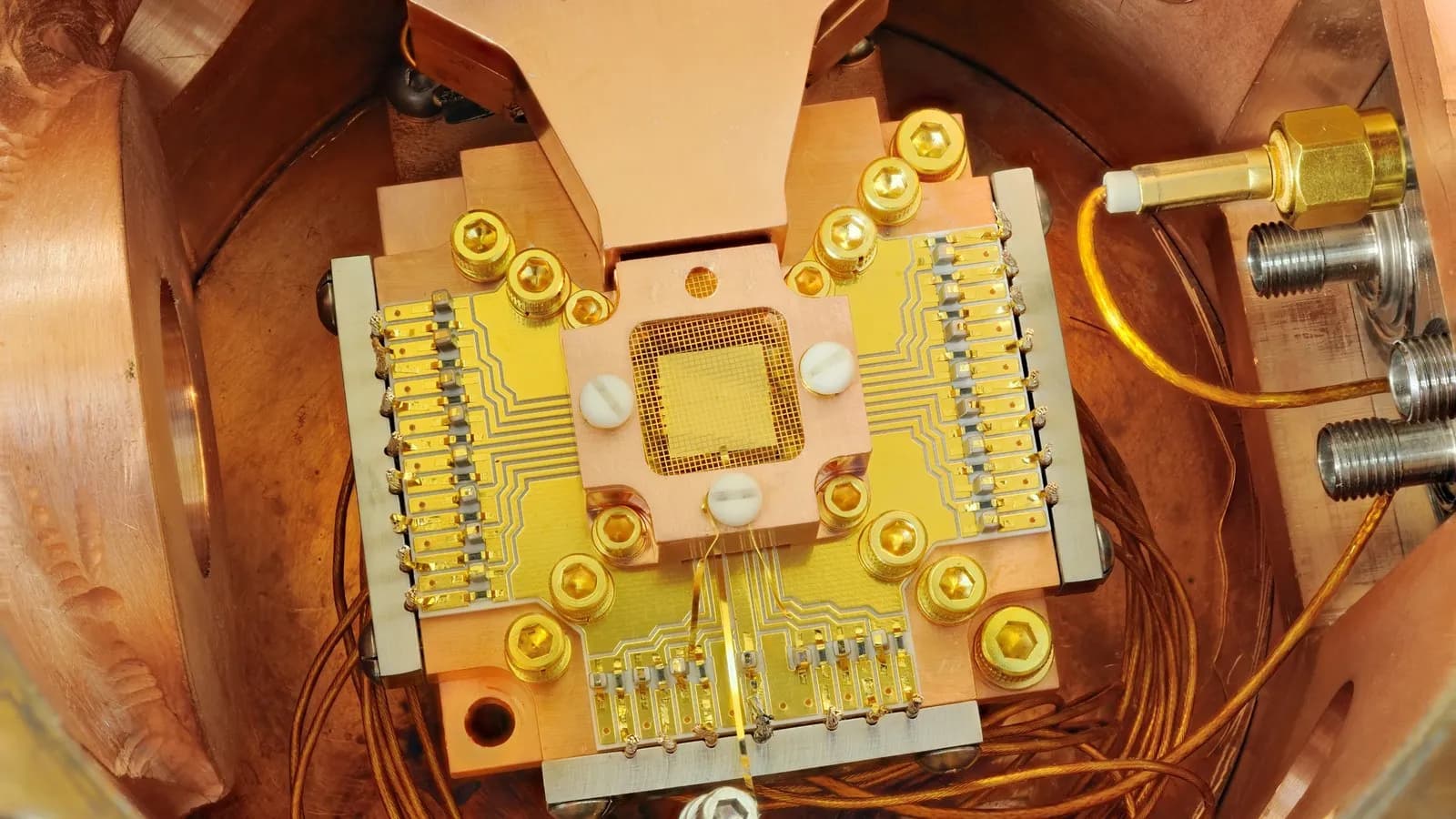
Physicists at Duke University have used a chain of just 13 trapped ions to recreate string breaking, the process by which stretching the bond between two fundamental particles builds up so much energy that a new particle pair simply appears out of it, a phenomenon that last occurred naturally in the fractions of a second after the Big Bang. The work, led by Christopher Monroe and first-authored by Arinjoy De, appeared in Nature Physics on 23 September, with a university account of the result carried by ScienceDaily.
What string breaking actually is
In quantum field theory, two connected particles such as a quark and its antiquark behave, in a rough analogy, like the ends of an elastic string. Pull them apart and the string stretches, storing more and more energy, until the tension becomes so great that the string itself snaps and that stored energy condenses into an entirely new pair of particles at the break point. This is thought to be one of the basic mechanisms by which matter was generated as the infant universe expanded and cooled after the Big Bang, and it is also relevant to conditions recreated fleetingly inside colliders such as the Large Hadron Collider. Directly observing the process as it unfolds has been extremely difficult, because it happens over timescales and energy regimes that are hard to isolate and measure in a real particle accelerator.
Why a quantum computer, not a bigger collider
Monroe's team sidestepped that problem by building a synthetic analogue of the phenomenon rather than chasing it inside a beam of colliding protons. Using precisely controlled laser beams, the researchers encoded a string-breaking model directly onto a chain of 13 trapped ytterbium ions, each ion's internal quantum state standing in for a small segment of the stretching string. By tuning the lasers, the team could watch, step by step, how the simulated string evolved and eventually broke, producing the quantum-mechanical signature of new particle pairs appearing, all inside a benchtop apparatus rather than a 27-kilometre accelerator ring.
Checking the result against a classical computer
Because a genuinely new experimental method invites scepticism, the team cross-checked its quantum simulation against results obtained independently using classical computer simulations of the same string-breaking model. The two approaches agreed, giving the researchers confidence that the trapped-ion system was faithfully reproducing the underlying physics rather than some artefact specific to the quantum hardware. Monroe described the result as marking a development in quantum science that opens new avenues for understanding string-breaking dynamics, while De said the work opens pathways for experimental investigations into the behaviour of matter at its most fundamental level.
What thirteen ions can and cannot tell you
A 13-ion chain is a small system by the standards of the phenomena it is meant to illuminate, and nobody on the Duke team is suggesting it replaces the Large Hadron Collider or settles open questions in high-energy physics on its own. Its value is as a controllable laboratory stand-in, letting physicists dial through conditions, repeat runs cheaply and watch the string-breaking process unfold in real time in a way that a single, fleeting high-energy collision event does not allow. Scaling such simulators to larger ion chains is the obvious next step, and would let researchers probe string-breaking dynamics in more complex field theories that are currently only tractable on paper or in supercomputer approximations.
Where this fits in the bigger picture
Trapped-ion quantum simulators have already demonstrated an ability to model magnetism and certain chemistry problems that are difficult for classical computers, and this result extends that track record into fundamental particle physics and early-universe cosmology, two fields not normally associated with tabletop apparatus. Whether the approach eventually helps resolve specific open questions, such as the precise dynamics of quark confinement, will depend on scaling the ion count up substantially from 13, but the Duke result establishes that the basic method works and produces physics that agrees with independent classical checks.
Published in The Outspoken Digest
Editorial desk
Outspoken Digest Science DeskReports for The Outspoken Digest across Technology, Latest Trends, Health.
Newsletter
The Digest, in your inbox
One edition, sent when it is ready. No noise, and your address is never passed on.
Read Next
More Technology →
For the First Time, Saudi Team Lynx Takes the Top Spot at the Aramco STEM Racing World Finals in Singapore
Oct 17, 2026/3 min read
Some White Dwarfs Would Look Green, Pink or Purple, Warwick Astronomers Calculate
Oct 15, 2026/2 min read

Oxford Physicists Reproduce the Aharonov-Bohm Effect on a Hybrid Quantum Computer
Oct 15, 2026/2 min read

Japan Will Fund Up to $21 Billion for Two GlobalFoundries Chip Plants in New York
Oct 15, 2026/2 min read