Freediving Breathing: What Helps, What Does Nothing, and What Can Kill You
Breathe-up, diaphragmatic breathing and the recovery breath are the three that matter. Hyperventilation is the one that removes your warning that you are about to black out.
Monday, August 10, 2026/3 min read
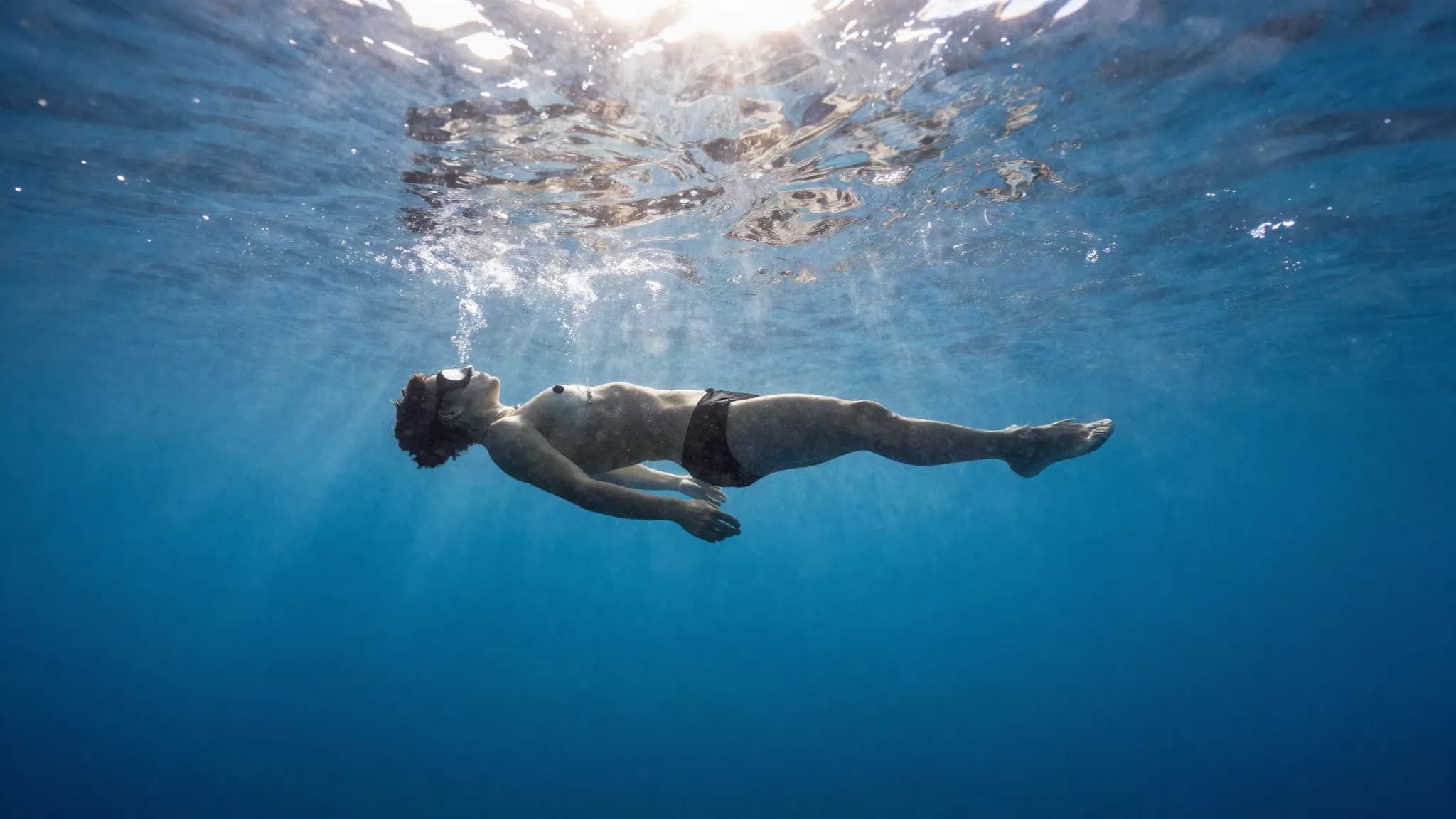
Almost everything a freediver does with their lungs happens before and after the dive, not during it. Which is why breathing gets more attention in training than finning does, and why the most dangerous mistake in the sport is a breathing mistake.
Start with the physiology, because the rest follows from it.
The urge to breathe is not about oxygen
This is the fact that reorganises everything.
The overwhelming drive to breathe comes from rising carbon dioxide, not falling oxygen. Chemoreceptors monitor CO2 with great sensitivity. They monitor oxygen poorly and late.
So the discomfort you feel, the contractions in your diaphragm, the growing insistence: that is CO2 talking. It is your alarm clock, and it normally goes off with oxygen to spare.
Why hyperventilation is the thing that kills people
Now the consequence. Rapid deep breathing before a dive does almost nothing to raise your oxygen stores, because haemoglobin is already close to saturated at rest. What it does is blow off CO2.
Lower starting CO2 means the alarm goes off later. The diver feels fantastic, holds longer, and interprets that as improved performance.
What has actually happened is that the warning system has been disabled while oxygen continues to fall on the same schedule. If oxygen reaches the point of hypoxic blackout before CO2 reaches the point of triggering the urge to breathe, the diver loses consciousness with no warning at all.
This is the mechanism behind a large share of shallow water blackout deaths, including in swimming pools among people who were not freedivers and were simply competing to hold their breath.
The rule is not negotiable: never hyperventilate before breath-holding, and never breath-hold alone. Blackout is survivable when someone is watching and fatal when nobody is.
Breathe-up, done properly
The correct preparation is the opposite of hyperventilation: slow, calm, unremarkable breathing that lowers heart rate and relaxes the body without stripping CO2.
Breathe through the diaphragm rather than the chest. Lying face down in the water, the belly should press outward on the inhale and the shoulders should barely move. A useful ratio is an inhale of roughly four seconds and an exhale of roughly eight, because a long exhale is what activates the parasympathetic response.
Keep it going for two to three minutes. Longer is not better, and a breathe-up that turns into fifteen minutes of anxious preparation usually makes the dive worse.
Then a final breath: fill from the bottom up, belly then ribs then upper chest, to roughly 85 to 90 percent of capacity. A completely packed inhale creates tension and, at depth, makes equalisation harder.
The recovery breath, which is not optional
What you do in the first seconds at the surface matters more than most beginners realise, because blackout most often happens at or just after surfacing, when pressure drops and the partial pressure of oxygen in the lungs falls sharply.
The hook breath is the standard technique. On surfacing, take a sharp quick inhale, close the airway and press gently against it for one to two seconds to raise pressure in the chest and push oxygen into the blood, then release and repeat two or three times.
Keep your airway clear of the water throughout, hold the line or your buddy, remove nothing from your face until you have completed the sequence, and give the OK signal only after it. A diver who takes their mask off and says they are fine before breathing properly is doing it in the wrong order.
Dry training, and its limits
CO2 and O2 tables build tolerance and are done on land, never in water. They are useful and boring in equal measure, and we have covered how to structure them and how often.
Stretching the diaphragm and intercostals improves comfort at depth. Cardiovascular fitness helps by lowering resting heart rate.
What none of it does is substitute for water time, and none of it should be practised in a bath or pool alone. Every year people drown doing dry training wet.
The short version
Slow relaxed breathing before. Never hyperventilate. Never alone. Hook breaths after, before anything else.
The rest of technique, including equalisation, which is what actually limits most people's depth, can be learned progressively. These four are the ones that decide whether you get the chance to learn them.
This article is general information, not a substitute for a certified course with a qualified instructor and a trained buddy.
Published in The Outspoken Digest
Editorial desk
Outspoken Digest Diving DeskCovers freediving, recreational and technical diving, dive medicine and the incidents the sport learns from.
Newsletter
The Digest, in your inbox
One edition, sent when it is ready. No noise, and your address is never passed on.
Read Next
More Diving →
Black Swallower Filmed With a Hugely Swollen Belly 1,259 Metres Down Off Trinidad and Tobago
Oct 13, 2026/2 min read

Playing Recordings of a Healthy Reef Drew More Coral and Fish Larvae to Artificial Structures Off Hawaii
Oct 9, 2026/3 min read
Blacktip Sharks Can Hear a Sound From Nearly 250 Feet Away and Swim Straight Toward or Away From It
Oct 1, 2026/2 min read
A Sea Turtle Species Never Recorded Nesting in the United States Laid Eggs on a Southern California Beach
Oct 1, 2026/2 min read