Gold Is Up Fourteen Per Cent in a Month, and the Banks Cut Their Targets Three Weeks Before It Ran
The metal reached about 4,607 dollars an ounce on Friday, its strongest week in months, on the same US debt news that moved bonds and bitcoin. It is still below January's record, and it has just overtaken forecasts that were revised down in early August.
Saturday, August 22, 2026/4 min read
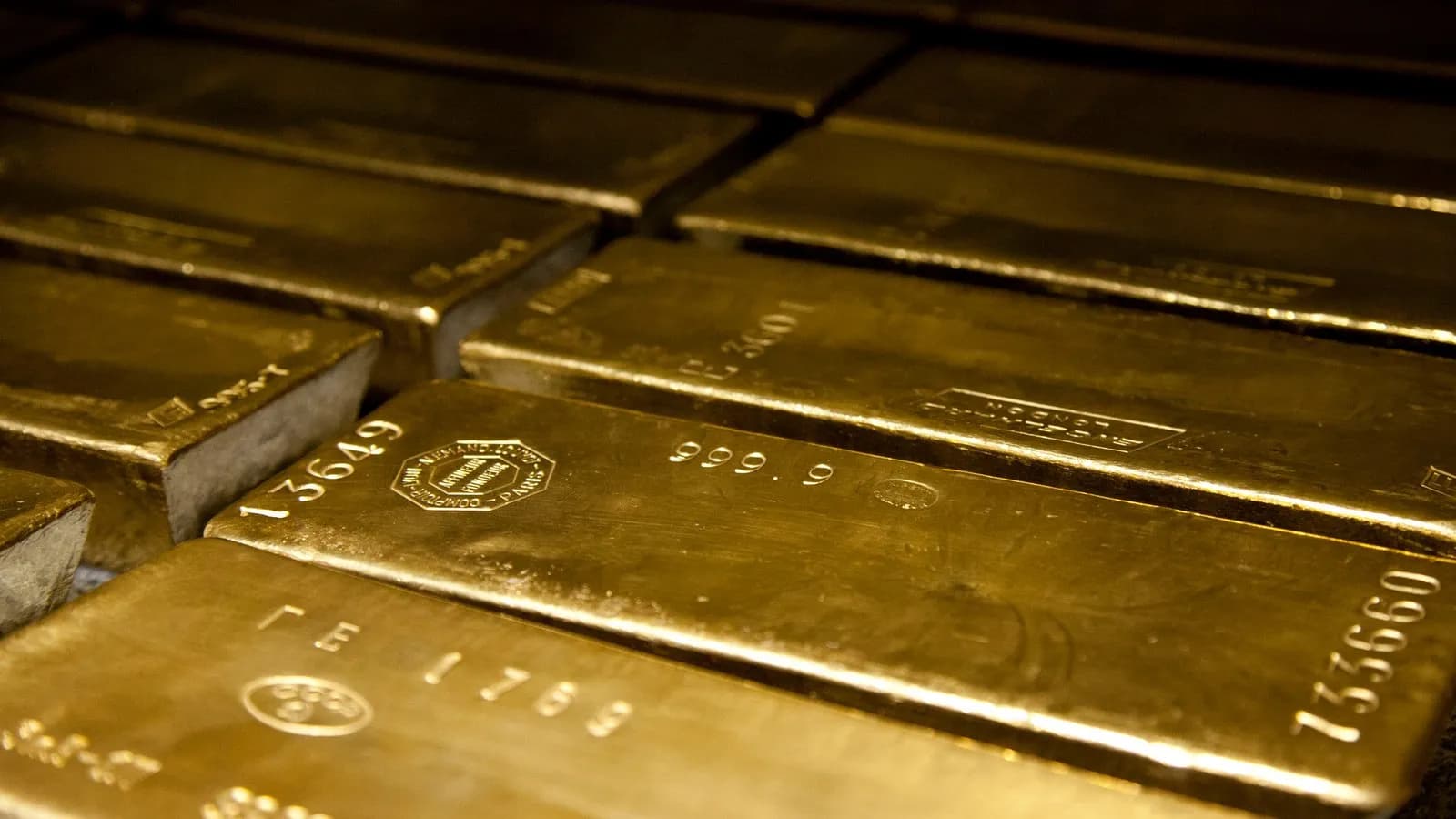
Gold rose to roughly 4,607 dollars a troy ounce on Friday 21 August, a gain of about two per cent on the day. December futures opened at 4,577 dollars and were trading near 4,634 by mid-morning in New York.
Stack the periods up and the shape is clearer than any single session. The metal is up about 5.9 per cent over the week, 14.4 per cent over the month, and 36.7 per cent over the year.
Why is it climbing now?
Because of a number published by the United States Treasury and a decision taken two days later.
Gross American federal debt crossed forty trillion dollars during the week, reaching 40,047,425,768,420 dollars on 18 August. Interest costs on that debt now exceed what the country spends on defence. On the Wednesday the Treasury said it would more than double its repurchases of long-dated bonds, and long yields and the dollar both fell.
Gold has no yield. That is usually its disadvantage, because holding it earns nothing while holding a government bond pays a coupon. When the yield on the bond falls, the disadvantage narrows, and when the reason the yield fell is anxiety about the currency the bond is denominated in, the case for the metal strengthens twice over. Both happened in the same afternoon, which is why one Treasury announcement moved bullion, bonds and cryptocurrency together.
Underneath the week, two slower forces continue. Central banks have kept buying, with Chinese purchases repeatedly singled out. And investment demand through funds has stayed robust rather than spiking, which is the kind of demand that tends to persist.
Is this a record?
No, and the gap matters.
Gold's all-time high was 5,595 dollars an ounce, set on 29 January 2026. At 4,607 the metal is still roughly eighteen per cent below that peak. Earlier this year it traded near 4,020 dollars, about twenty eight per cent below the record, so the move being described as a rally is more accurately a recovery of ground lost after January.
This is worth stating plainly because a chart of the last month and a chart of the last eight months tell opposite stories. Anyone selling on the strength of the first without showing the second is not describing the market.
What are the forecasters saying?
Less than they were, which is the most interesting thing about this week.
- Goldman Sachs lowered its year-end target to 4,900 dollars in June, down from 5,400.
- JPMorgan moved to a third quarter average of 4,300 dollars and a fourth quarter target of 4,500, down from a path that had pointed at 6,000.
- Bank of America cut its 2026 average forecast by fourteen per cent, to 4,360 dollars, in early August.
Set those against Friday's price. Gold is now trading above Bank of America's revised average for the whole year, above JPMorgan's fourth quarter target, and within about six per cent of Goldman's year-end number. The cuts were published within the last ten weeks.
None of that makes the analysts foolish. Forecasts are conditional, they are revised for good reasons, and a bank that adjusts to new information is doing its job. But it is a clean demonstration of something we have argued before about what a price target is actually worth. A target is a description of a house view at a moment, not a schedule.
What is the speculation actually about?
Three distinct arguments are being run together, and they deserve separating.
The debt argument. Rising government borrowing erodes confidence in the currency, so hold the asset that no government issues. This is the argument driving the current move, and it is the most durable of the three, because forty trillion does not reverse.
The rates argument. If the Federal Reserve cuts, the opportunity cost of holding a non-yielding metal falls further. This is a genuine mechanism and a fragile one, because it depends on a decision that has not been taken.
The momentum argument. It has gone up fourteen per cent in a month, therefore it will keep going up. This is not an argument. It is the observation that a price moved, restated as a prediction.
Most retail commentary blends all three and presents the mixture as a single case. A reader can usually tell which one is really being made by asking what would have to happen for the writer to change their mind.
What would change the picture?
The same things that made it, running the other way.
If long-dated Treasury yields resume their climb despite the buyback programme, which analysts have been careful to describe as limited relief rather than a fix, the opportunity cost of holding gold rises again. If inflation data comes in soft enough to strengthen the dollar, the metal gives ground. And central bank buying is policy rather than trading, so it can pause without warning and without explanation.
The range and the risks around it were mapped out in our second half outlook, and this week sits inside that map rather than outside it. What it does not do is settle anything. A metal that is up more than a third in a year and still nearly a fifth below its own high is telling you the argument is live, not that it has been won.
Published in The Outspoken Digest
Editorial desk
Outspoken Digest Markets DeskReports for The Outspoken Digest across Business, Crypto.
Newsletter
The Digest, in your inbox
One edition, sent when it is ready. No noise, and your address is never passed on.
Read Next
More Business →
Jio Platforms Raises Rs 8,110 Crore From Anchors at the Top of Its Range as India's Biggest IPO Opens
Oct 21, 2026/2 min read
Netflix Beats on Profit, Then Slides After Hours as It Trims Its Ad Forecast and Guides Lower
Oct 21, 2026/2 min read
Wall Street Rebounds as AI Stocks Recover, With the Nasdaq Up 1.1% and the 10-Year Yield Above 5.15%
Oct 20, 2026/2 min read

CoreWeave Shares Fall 25 Percent in a Week as Its Bonds Flash Warning Signs for AI's Borrowers
Oct 18, 2026/2 min read