Physicists in Japan Cracked a 25-Year Puzzle in Measuring One of the Hardest Forms of Quantum Entanglement
A Kyoto University and Hiroshima University team demonstrated the first method for identifying W state entanglement among three photons, closing a gap that had resisted physicists since the state was first described in the late 1990s.
Thursday, October 1, 2026/2 min read
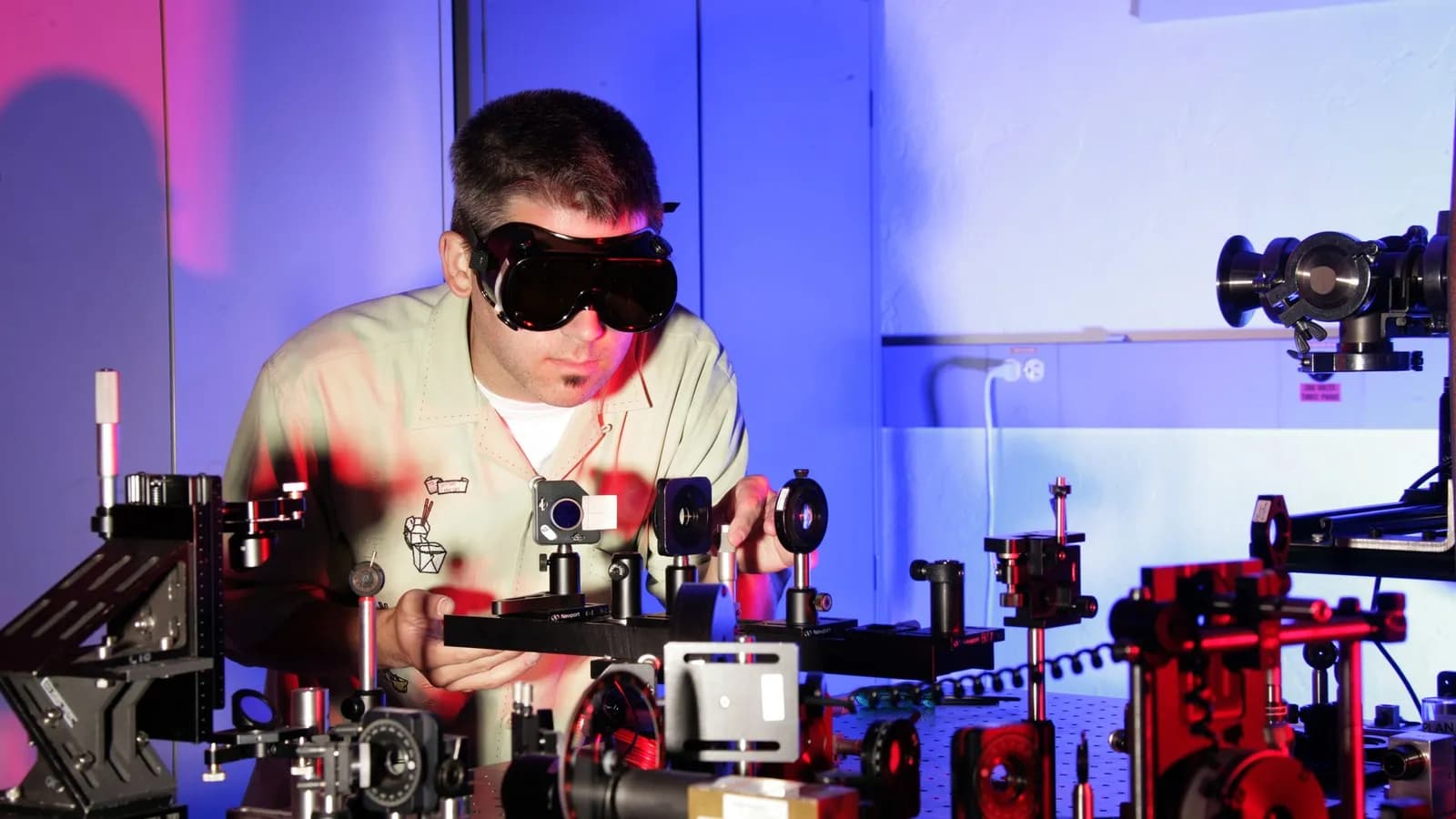
Researchers at Kyoto University and Hiroshima University have demonstrated a method for identifying a form of multi-photon quantum entanglement called a W state, solving a measurement problem that had stood open for more than two and a half decades. The summary of the work, published on 29 September, said the team built a photonic quantum circuit and confirmed the technique experimentally using three photons.
Two families of entanglement
When three or more quantum particles become entangled, the resulting state generally falls into one of two broad families named after the researchers who first classified them: the Greenberger Horne Zeilinger, or GHZ, state and the W state. Physicists had already worked out how to perform an entangled measurement that identifies a GHZ state directly, but no one had managed to do the same for a W state, despite it being just as fundamental to how multi-particle entanglement behaves.
The trick was symmetry
The Kyoto and Hiroshima team found their way in by focusing on a property called cyclic shift symmetry, a mathematical feature specific to W states in which swapping the particles around in a particular rotating order leaves the state unchanged. Using that symmetry, the researchers designed a photonic circuit that performs what is known as a quantum Fourier transformation tailored to W states, and the approach scales in principle to any number of photons rather than being limited to the three used in the demonstration.
Why entangled measurement matters
Being able to directly measure and confirm a specific entangled state, rather than having to reconstruct it indirectly through repeated runs, is a basic requirement for several of the most promising applications of quantum technology, including quantum teleportation protocols, secure quantum communication networks, and error correction schemes in quantum computers. A technique that had only worked for one of the two major entanglement families left a persistent blind spot in experimental quantum optics, one the new circuit design is intended to close.
Early stage but scalable in principle
The demonstration so far involves only three photons, a small scale compared with the hundreds or thousands of qubits that practical quantum computers are expected to eventually require, and turning the laboratory circuit into something usable in larger quantum networks will take further engineering work. Even so, the researchers' description of the method as scaling to W states with any number of photons suggests the underlying idea, rather than just this specific experiment, is what is likely to matter most as quantum hardware continues to grow in scale over the coming years.
Part of a wider push on quantum measurement
The result lands amid a broader international effort to solve the practical bottlenecks standing between today's small scale quantum demonstrations and genuinely useful quantum computers and networks, with groups across Japan, the United States, Europe and China racing to improve how reliably entangled states can be created, verified and manipulated. A separate account of the advance noted that closing a 25 year old gap in measuring one of the two fundamental entanglement families gives experimentalists a tool they have lacked since the W state was first formally described, and researchers in the field are likely to test the Kyoto group's approach against larger photon counts in the months ahead.
Published in The Outspoken Digest
Editorial desk
Outspoken Digest Science DeskReports for The Outspoken Digest across Technology, Latest Trends, Health.
Newsletter
The Digest, in your inbox
One edition, sent when it is ready. No noise, and your address is never passed on.
Read Next
More Technology →
Astronomers Say a Pulsar's Odd Slowdown Is Explained by a Hidden Sunlike Star, Making It a Rare Stellar Trio
Oct 21, 2026/2 min read

Interstellar Comet 3I/ATLAS May Have Lost Metres of Its Surface to the Sun, a New Estimate Finds
Oct 21, 2026/2 min read

A Power Event in Google Cloud's London Region Knocked Out Banking Apps and Delivery Services for Hours
Oct 21, 2026/2 min read

An Indian Certificate Authority's Private Keys Were Trivially Guessable, and Browsers Have Revoked Them
Oct 21, 2026/2 min read