Two Days After the Nobel for Optogenetics, a Small NEJM Trial Shows It Helped Some Blind Patients Detect Objects
Ten people with advanced retinitis pigmentosa got a light-sensing gene and wore camera goggles. Light sensitivity improved in seven, but sight was not restored and the trial was built for safety.
Friday, October 9, 2026/3 min read
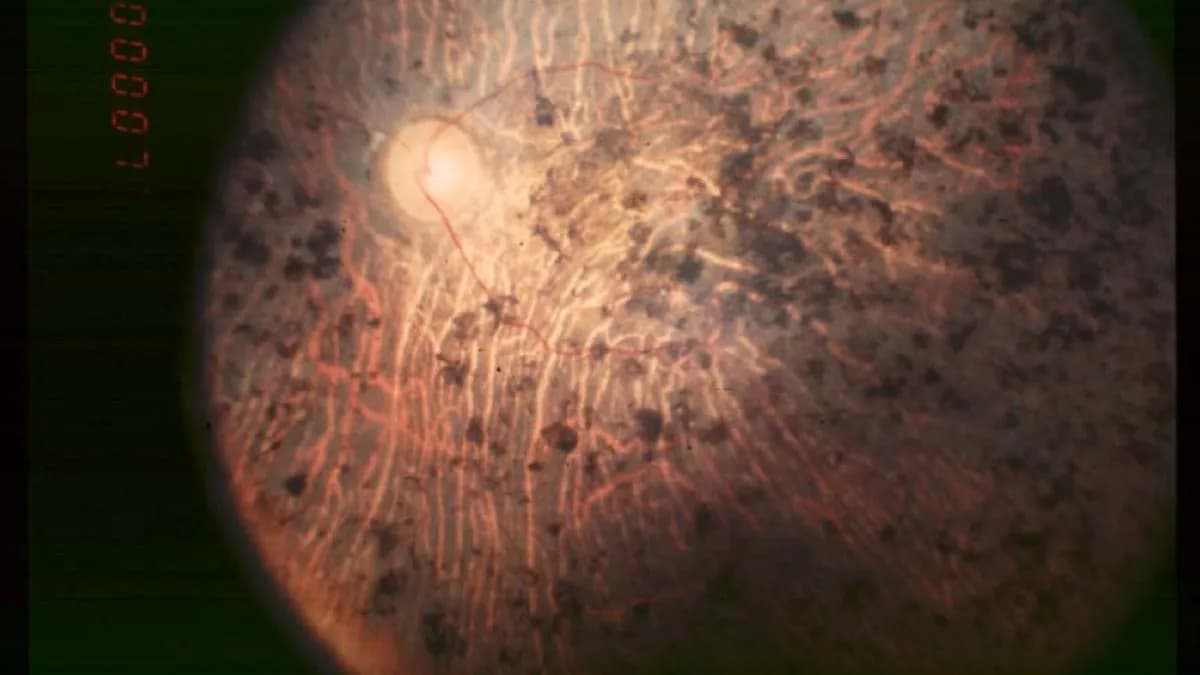
Optogenetics had its Nobel moment on Monday, when Karl Deisseroth, Peter Hegemann and Georg Nagel were named winners of the 2026 prize in physiology or medicine for their work on light-gated ion channels, the Associated Press reported via Georgia Public Broadcasting. Two days later the New England Journal of Medicine published a small clinical trial of the technique in people with advanced retinitis pigmentosa, a genetic disease that destroys the eye's light-sensing cells.
The result is early and partial. Of ten people treated, seven became more sensitive to light and some could detect and reach for objects while wearing special goggles. Nobody got normal sight back, and reading did not return, according to the University of Pittsburgh's release.
What did the trial test?
The PIONEER trial is a first-in-human, open-label, dose-escalation phase 1/2 study of a therapy called GS030 in late-stage retinitis pigmentosa, according to the company's release. Participants had little or no light perception. A single injection into the worse-seeing eye delivers the gene for ChrimsonR, a light-sensing protein, to retinal ganglion cells that survive after the photoreceptors are lost.
Physics World explains the rest of the system. Patients wear goggles with a camera, and a processor converts changes in the scene into pulses of amber light that the goggles project into the eye to switch on the modified cells. Three groups of three people received three doses, and an extension patient received the highest, giving ten in all, at centres in Britain, France and the United States. Follow-up runs for up to five years.
What did patients gain, and what did they not?
Light sensitivity improved in seven of the ten, and six of those gains were judged clinically meaningful. On behavioural tests, four or five of the eight participants who completed them did better with the goggles on, depending on the task, whether that was detecting an object, locating it, reaching for it or judging the orientation of a bar. Brain recordings in some participants showed signals reaching the visual cortex when the goggles were worn. Four people showed consistent gains across several real-world tasks over months to years.
The limits are as important as the gains. The study was not designed to prove that the therapy works, and Sahel says the results are exploratory and need confirming. There was no control group, and ten people is a very small sample. The first author, José-Alain Sahel of the University of Pittsburgh, is also a co-founder of GenSight Biologics, the company that supported the trial, according to the company's release.
How safe was it?
Safety was the main aim. Physics World reports 33 mild or moderate eye-related events in nine participants, such as temporary inflammation and brief rises in eye pressure. One severe event resolved within minutes after eye drops, and the company says no systemic side effect was related to the drug or the injection.
Who is it for, and what happens next?
Retinitis pigmentosa affects more than 1.5 million people worldwide and can be caused by mutations in more than 100 genes, the Pittsburgh release says. That diversity is the argument for optogenetics. Sahel says the aim is to restore visual function "regardless of which gene caused the disease." GS030 has no marketing authorisation anywhere, and the company's release gives no timetable for the next trial, though Physics World reports that Sahel is optimistic about moving towards future ones.
This is reporting, not medical advice. Anyone living with retinitis pigmentosa or another cause of vision loss should discuss treatment options, including clinical trials, with an ophthalmologist who knows their history, because decisions about gene therapy belong with a clinician.
A Nobel recognises a method, not a cure. The test that matters now is a larger, controlled trial that shows whether the gains seen in these ten people hold up.
Published in The Outspoken Digest
Editorial desk
Outspoken Digest Health DeskMedicine, public health and the research behind the headlines, read carefully.
Newsletter
The Digest, in your inbox
One edition, sent when it is ready. No noise, and your address is never passed on.
Read Next
More Health →
WHO Launches a Global Roadmap on Pre-Eclampsia and Pregnancy Hypertension, Tied to 42,000 Maternal Deaths a Year
Oct 8, 2026/3 min read

WHO Says Diet and Exercise Come First and Children Under 10 Should Not Get Weight-Loss Drugs or Surgery
Oct 7, 2026/3 min read

Kenya Confirms Its First Ebola Case, a Man Who Flew In From Uganda After Years in Congo and Died in Nairobi
Oct 6, 2026/3 min read