Physicists Made Entangled Photons Out of Ordinary Sunlight, Which Was Supposed to Require a Laser
A team in Ottawa and Erlangen put a window sized lens in the sun, funnelled the light down a glass cone into a fibre the width of a hair, and got entangled photons at ninety four per cent fidelity. The Sun is not supposed to be able to do this.
Outspoken Digest Technology Desk
Tuesday, August 25, 2026/4 min read
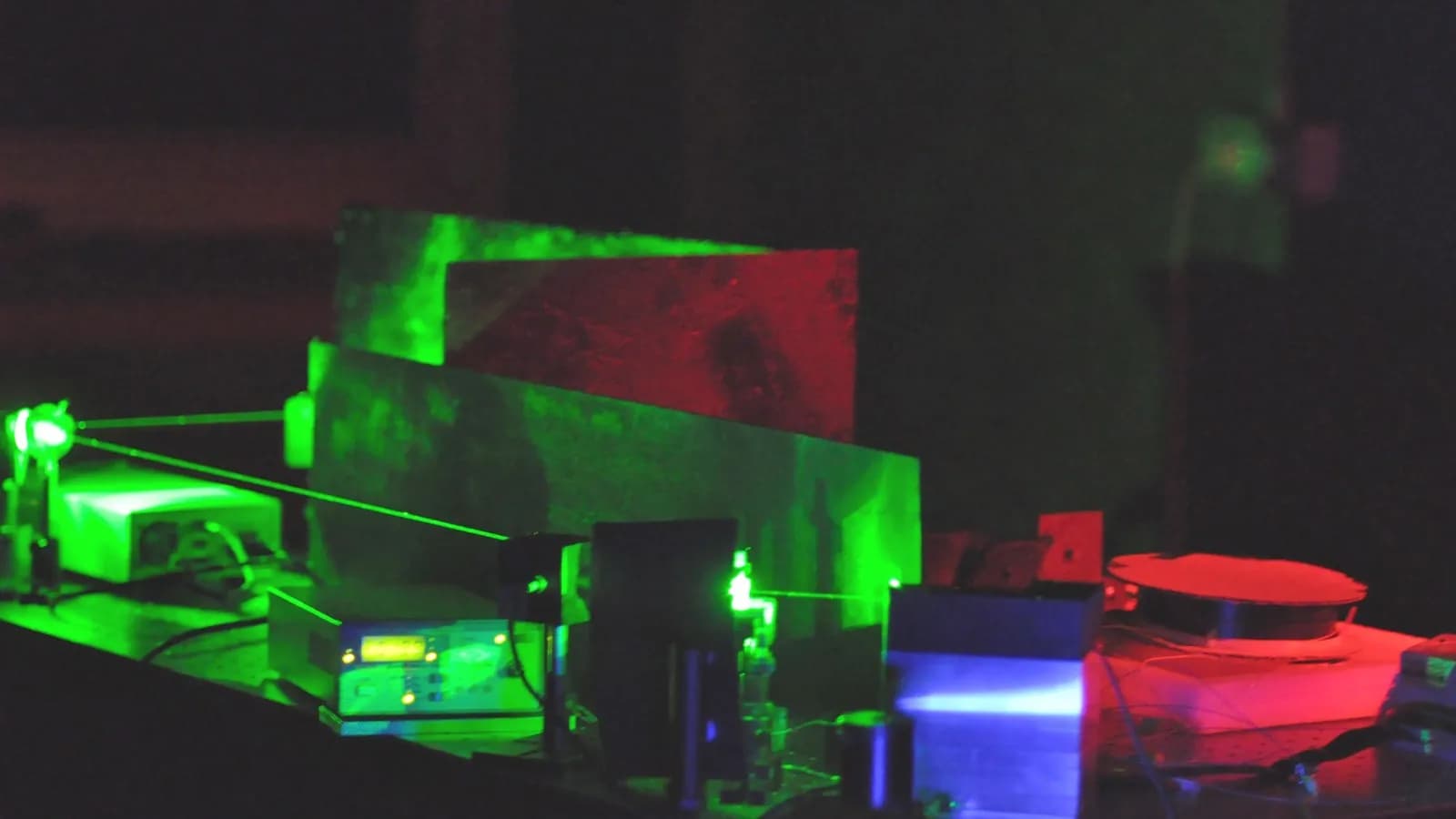
Entangled photons are the raw material of quantum communication, quantum sensing and a good deal of quantum computing. Making them has always started the same way: with a laser.
A team led by the University of Ottawa and the Max Planck Institute for the Science of Light has now made them out of sunlight. The paper appeared in Optica on 6 August.
Why was sunlight supposed to be impossible?
Because on every axis that matters for this, sunlight is the opposite of a laser.
A laser is coherent, narrow in wavelength and pointed in one direction. Sunlight is incoherent, spans the spectrum and arrives from a spread of angles after eight minutes of travel and a pass through the atmosphere. The process that makes entangled pairs, spontaneous parametric down conversion, splits one high energy photon into two lower energy ones inside a nonlinear crystal, and it has always been run with the tidiest light available because the untidiness of ordinary light was assumed to destroy the delicate correlation you are trying to create.
That assumption was reasonable and, it turns out, wrong in an interesting way. The colour variations and the spread of propagation angles do disturb some properties of the emitted photons. They do not have to disturb polarisation, which is the property this experiment set out to entangle.
What the apparatus actually is
A chain of four things, each doing one job.
A Fresnel lens about the size of a household window collects the sunlight, roughly 1.4 square metres of it. A cone shaped concentrator, made entirely of glass and developed by Hanieh Fattahi's group in Erlangen, squeezes that down. The light goes into an optical fibre no wider than a human hair. At the end of the fibre sits a nonlinear crystal a millimetre across, where the down conversion happens.
The engineering that matters is the optical configuration between those stages, designed so that the messy properties of sunlight pass through without contaminating the polarisation states. Cheng Li at Ottawa is the first author; Robert Boyd, whose group did the theoretical work, has spent a career on exactly this class of problem.
How good was the result?
Better than a demonstration usually is on the first attempt.
The entanglement was about ninety four per cent similar to a perfectly entangled state. The photon pairs violated Bell's inequality, which is the standard test that separates genuine quantum entanglement from correlations a classical explanation could account for. Once you adjust for the difference in bandwidth between sunlight and laser light, the quality is comparable to laser driven sources.
Ninety four per cent is not a rounding error away from perfect, and the bandwidth adjustment is doing real work in that comparison. But this is a first demonstration of a thing widely assumed not to be available, and first demonstrations are not usually within a few points of the established method.
What would you use it for?
The honest answer is nothing yet, and the interesting answer is anywhere power is the constraint.
The authors are working towards a field deployable device and say the remaining work is brightness and entanglement quality. Brightness is the real limit: a laser puts a great many photons through the crystal per second, and a lens full of sunlight does not.
Where that trade might make sense is in orbit. A satellite carrying a quantum light source has to carry the laser, the power supply to run it and the thermal design to survive it. In orbit, sunlight is the one resource that is free, constant and already arriving. The same logic applies to deep space missions and to any sensing installation far from a power grid. On the ground, in a building with mains electricity, a laser will remain the obvious choice for a long time.
The part that is not about engineering
Quantum light sources are usually described as exotic. This result says something quieter: the Sun has been producing the raw ingredients for entanglement continuously for four and a half billion years, and the reason nobody had made entangled photons from it is that nobody had built the right cone.
That is worth sitting with, because most of the public conversation about quantum technology is about scarcity, difficulty and cost. Sunlight is the least scarce thing there is.
The practical stakes are not small either. Entanglement underwrites quantum key distribution, the encryption scheme that becomes interesting precisely when quantum computers become capable enough to threaten current cryptography, a problem the digital asset world has been circling for years and which we covered in Ethereum's account upgrades and the quantum question. And energy is the binding constraint on the whole computing industry now, as the economics in the AI hardware gold rush make clear. A light source that runs on the thing already falling on the roof is not a trivial idea.
Published in The Outspoken Digest
Editorial desk
Outspoken Digest Technology DeskSoftware, hardware, artificial intelligence and what they change for everyone else.
Newsletter
The Digest, in your inbox
One edition, sent when it is ready. No noise, and your address is never passed on.
Read Next
More Technology →
What PHP2Shell Reveals About Maintaining the Code Behind Most of the Web
Oct 22, 2026/3 min read

PHP2Shell for Hosts, Developers and Security Teams: Backports, WAF Rules and Incident Response
Oct 22, 2026/3 min read
PHP2Shell: What Website Owners and Small Businesses Should Do Right Now
Oct 22, 2026/3 min read

PHP2Shell Timeline: From a Quiet August Report to a Leak, Early Attacks and a Day-Early Patch
Oct 22, 2026/3 min read