How the Red Sea Crisis Is Reshaping Gulf Supply Chains
Houthi attacks on shipping have rerouted global trade around Africa, and Gulf importers are absorbing the fallout in freight rates and delivery times.
Outspoken Digest Business Desk
Monday, February 5, 2024/5 min read
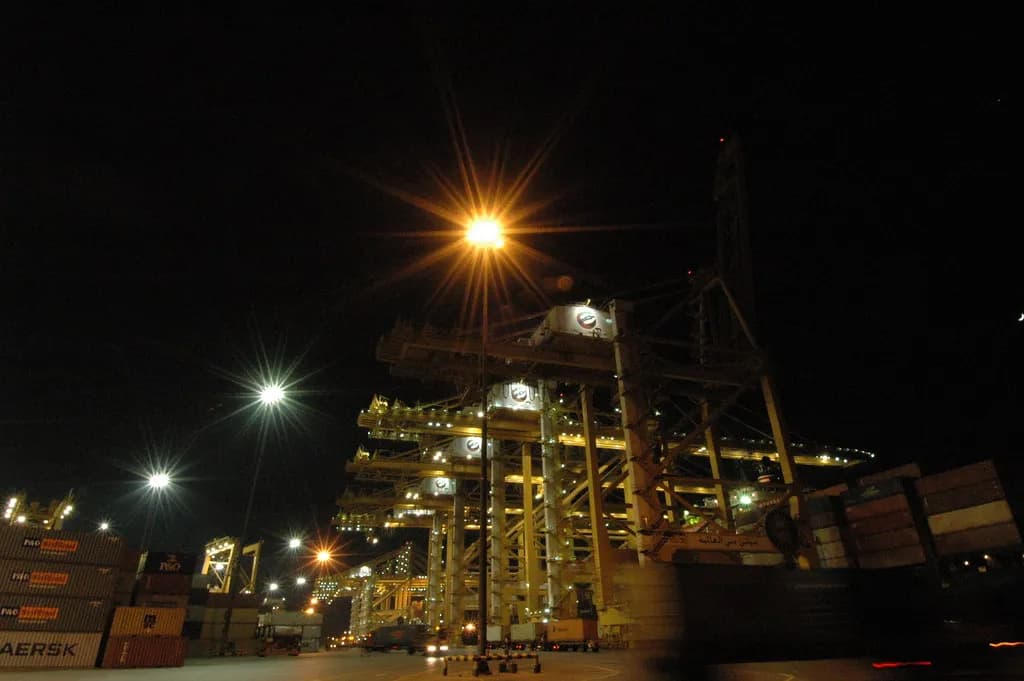
For three months now, cargo captains in the Bab el-Mandeb strait have been making a choice no shipping line wants to write into a policy manual: run the gauntlet, or add ten days and a few thousand nautical miles to the voyage. Since November, Houthi forces in Yemen have fired on merchant vessels transiting the southern Red Sea, and the world's biggest carriers, Maersk, MSC, CMA CGM among them, have mostly chosen the long way round, down past the Cape of Good Hope.
The headlines have been about Europe, about a Suez Canal that suddenly looks optional. But the Gulf is not a bystander in this story. It sits right next to the trouble, and its ports are quietly absorbing a version of the crisis that looks different from the one hitting Rotterdam or Southampton.
The Platts Container Index touched $5,272.50 per forty-foot container in early January, according to Procurement Magazine, the highest reading since the tail end of the 2022 freight boom. That is a global number. Locally, the picture is more textured, and more interesting for anyone actually moving goods into Dubai, Riyadh or Manama this quarter.
Why Gulf ports were never fully insulated
The comforting version of this story, repeated in trading offices from Jebel Ali to Khalifa Port in the first weeks of the crisis, was that container traffic from Asia to the Gulf does not need the Red Sea at all. Ships coming from China or India sail straight through the Indian Ocean and into the Arabian Gulf via the Strait of Hormuz, nowhere near the Bab el-Mandeb chokepoint.
That is true, and it is also incomplete. It describes cargo arriving in the Gulf. It says nothing about cargo leaving the Gulf, or transiting through it toward the Red Sea's own coastline, which includes Saudi Arabia's western ports.
Sea freight from Jebel Ali to Jeddah, a route that barely registered as a cost line a year ago, has jumped from roughly $450 to $500 a container up to around $2,500, according to Gulf News, because Jeddah sits directly on the contested coastline. Suppliers who used to route goods from the UAE straight to Jeddah are now diverting through Dammam on the eastern Saudi coast instead, then trucking the load overland, a workaround that adds days but avoids the surcharge entirely.
What it means for freight and delivery times across the GCC
Demand for road freight between UAE hubs and the rest of the Gulf has climbed sharply as businesses look for alternatives to the pricier sea legs, tightening capacity on container trucks running the Dubai to Dammam and Dubai to Riyadh corridors. Insurance premiums for vessels that do still risk the Red Sea route have also spiked, a cost that inevitably lands somewhere in a landed price further down the chain, as detailed in analysis from the Atlas Institute for International Affairs.
Over 190 attacks or attempted attacks on shipping have now been recorded since the campaign began, a scale that has kept the big alliances committed to the Cape of Good Hope diversion for the immediate future rather than betting on a quick resolution.
Who feels it first: importers, retailers, restaurants
The businesses noticing this fastest are the ones running lean inventories, restaurants, grocery retailers, anyone dependent on perishables or just-in-time restocking. A ten to fourteen day delay on a container that used to arrive on schedule forces difficult choices: air freight a portion of the order at a steep premium, hold safety stock that ties up cash, or simply accept gaps on shelves and menus.
- Freight rates on Red Sea-adjacent routes have risen roughly fivefold since the disruption began.
- Transit times on diverted Asia-Europe and Asia-Gulf-fringe routes have lengthened by one to two weeks.
- UAE re-export hubs serving Jeddah and the wider Saudi west coast are seeing the sharpest local cost increases.
Is there a Gulf-specific fix
Analysis circulated by the J.P. Morgan research team frames the crisis as a capacity problem as much as a cost problem: the same number of ships now doing more miles per voyage effectively shrinks global shipping capacity, and that scarcity is what is really pushing rates up, in the Gulf and everywhere else.
For now, Gulf logistics operators are leaning on the region's other advantage, its position outside the main danger zone for eastbound cargo, and using road and rail links between the Emirates and Saudi Arabia to smooth over the gaps that the Red Sea has opened on the map.
The insurance market is repricing the whole region
Marine war-risk insurance, a line most shipping clients never had to think about before November, has become one of the fastest-moving costs in the crisis. Underwriters are pricing individual Red Sea transits case by case now, and premiums swing with the news cycle: a quiet week brings rates down, a fresh attack sends them straight back up. For carriers still willing to risk the direct route, that volatility is itself a planning problem, one that pushes many toward the predictability of the longer Cape of Good Hope diversion even at a higher fixed cost.
That repricing does not stay contained to the ships themselves. Cargo insurance, port handling fees and even warehousing contracts across the Gulf are being renegotiated with war-risk clauses that barely existed in standard agreements a year ago, according to the same body of analysis compiled by the Atlas Institute for International Affairs. Small and mid-size importers, who lack the negotiating leverage of the big retail and hospitality groups, are the ones least able to absorb these new line items quietly.
What Gulf logistics firms are betting on next
Freight forwarders in Dubai describe a market in which nobody wants to commit to long-term contracts at current rates, betting instead that the crisis eases before the next renewal cycle. That bet has not paid off yet. The ITF-OECD assessment of the crisis notes that shipping alliances have shown no urgency to return to the Suez route while the security picture in the southern Red Sea remains this unpredictable, which means Gulf importers should plan for these costs as a feature of the year rather than a passing spike.
Whether the diversion holds through the spring depends entirely on what happens next in a strait that, until recently, most shoppers in Dubai or Riyadh had never had reason to think about. For now, the Gulf's own workaround, splitting cargo between sea, road and the occasional air freight top-up, is holding the region's shelves stocked, at a cost that is only now starting to show up on receipts.
Published in The Outspoken Digest
Editorial desk
Outspoken Digest Business DeskCompanies, markets and the money moving through the region.
Newsletter
The Digest, in your inbox
One edition, sent when it is ready. No noise, and your address is never passed on.
Read Next
More Business →
Nasdaq Falls 1.25% as the FT Puts OpenAI's Annualized Revenue Near $50 Billion, Not $70 Billion
Oct 9, 2026/2 min read

Treasury Yields Hit a 24-Year High, Waller Says More Fed Rises Are Coming, and the 30-Year Auction Clears at 5.618%
Oct 9, 2026/2 min read

Samsung's 107 Trillion Won Quarter Outearned Nvidia, and Its Shares Fell 2.4 Per Cent Anyway
Oct 8, 2026/3 min read

McKesson and CD&R Agree to Take Option Care Health Private in a $5.8 Billion Home Infusion Deal
Oct 7, 2026/2 min read