Your Gas Consumption Is Not One Number: Why Depth, Cold and Nerves Change It
A diver's surface air consumption rate looks like a fixed fact. It is a moving average that depth multiplies and stress inflates, which is why reserves exist at all.
Friday, October 16, 2026/3 min read
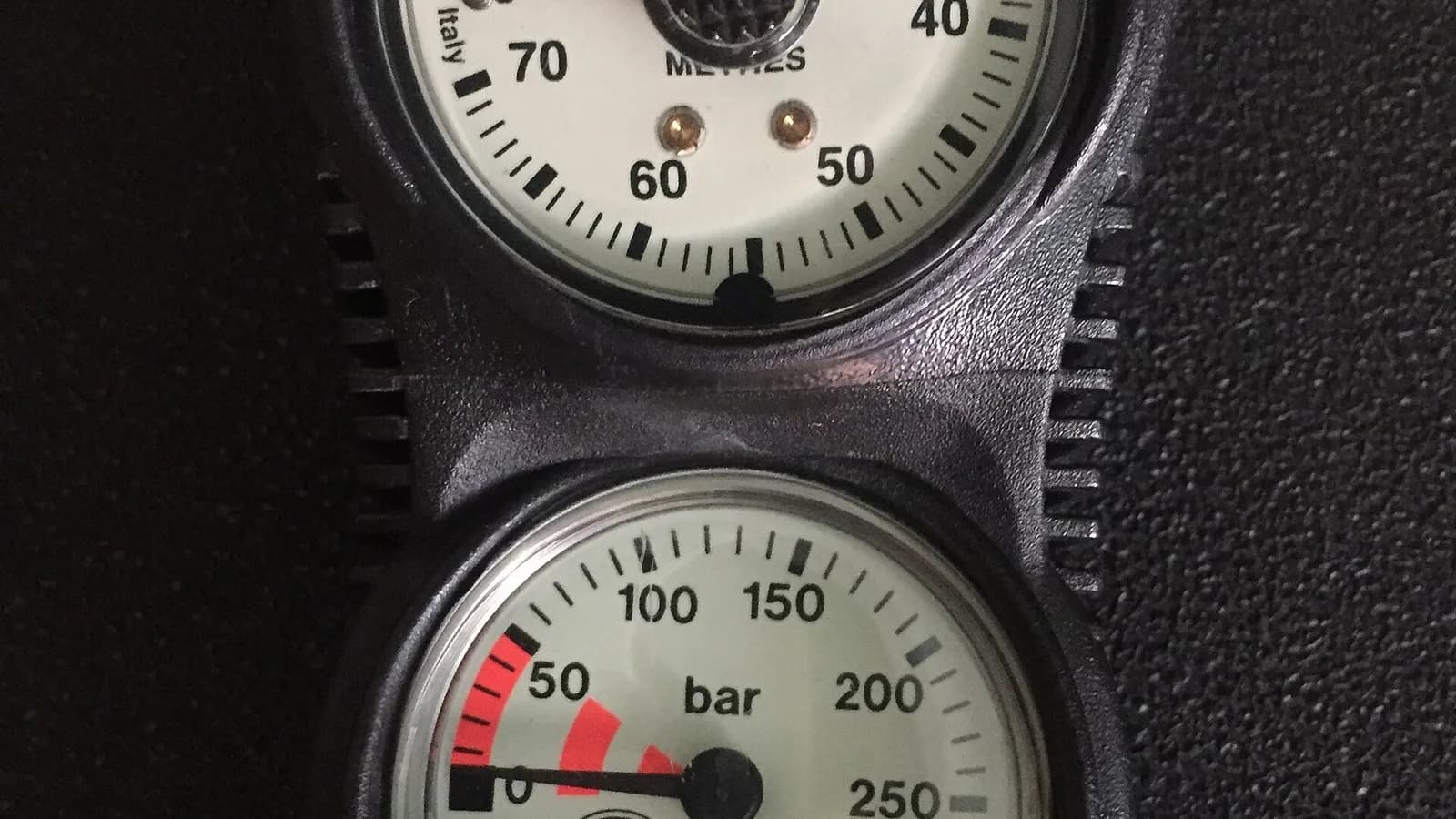
Ask a group of divers how long a cylinder lasts and you will get as many answers as people. Someone with a calm, trimmed-out style will make it last far longer than a diver fighting a current with a floating fin, and the same diver will use gas faster at 30 metres than at ten. The measure that captures this is the surface air consumption rate, usually called SAC, and understanding what it does and does not say is one of the quieter pieces of diving safety.
What is a SAC rate, and how is it worked out?
SAC is the volume of gas a diver breathes per minute, corrected back to surface pressure so that dives at different depths can be compared. Scuba Scribbles walks through the logic: measure the pressure drop in the cylinder over a known time at a known depth, divide by the ambient pressure at that depth, then convert using the cylinder's size. In its worked example, 700 psi used in ten minutes at 64 feet works out to about 0.65 cubic feet per minute. The same article, citing GUE, treats below 0.75 cubic feet per minute (about 21 litres) as good and above 1.0 (about 28 litres) as poor. Treat those as one training agency's yardsticks, not a rule.
Why does depth change gas use so much?
Ambient pressure rises by roughly one bar for every ten metres on top of the one bar at the surface, as laid out in the Wikipedia entry on scuba gas planning. Each breath at depth is denser, so the same breathing uses more cylinder. At 30 metres the ambient pressure is four bar, and a diver breathing at 40 litres a minute is consuming the equivalent of 160 litres a minute at the surface, the article's own example. Depth multiplies consumption before anything else goes wrong.
What makes the number worse?
Scuba Scribbles lists poor weighting and trim, which cause extra buoyancy adjustments and finning, dangling gear that adds drag, short shallow breathing, low fitness, rapid movement, cold and anxiety. The gas planning article makes the safety point plainly: under stress divers tend to breathe faster and swim less efficiently, so consumption in an emergency is higher than the calm number logged on a good day. Both sources warn against planning on a best case. As Scuba Scribbles puts it, always reserve room for emergency gas.
How do reserves and the rule of thirds fit in?
A reserve is gas held back for contingencies beyond the planned dive. Divers in open water with a free ascent can often use a simple reserve of pressure. Where a direct ascent is not possible, as in caves and wrecks, a stricter method applies. The rule of thirds, according to the same article, sets one third of the gas for the outward trip, one third for the return and one third in reserve, and the dive turns when the first diver reaches a third of the starting pressure. It cites Sheck Exley's 1977 Basic Cave Diving among its sources.
There is also a more tailored approach, usually called rock bottom, which sets the reserve from the planned profile and the diver's estimated consumption under stress, rather than from a fixed figure. The article contrasts it with fixed rules such as turning at a set pressure, which are simpler but can be too conservative or not conservative enough.
What should a diver take from this?
First, your SAC is worth knowing, logged across several dives rather than from one. Scuba Scribbles notes that newer divers typically improve with time, and that the number only applies to the cylinder and conditions it was measured in. Second, a good number can mislead on a bad day, in cold water or a current, so margins are built from the stressed figure and not the relaxed one. Third, the fastest way to lower it is rarely a breathing trick. It is better weighting, trim and fitness, and a slower, calmer dive.
This is journalism, not instruction, and it is not a dive plan. Gas management, reserves and turn pressures belong with a certified instructor and agency, who can teach them for the diving you actually do.
Published in The Outspoken Digest
Editorial desk
Outspoken Digest Diving DeskCovers freediving, recreational and technical diving, dive medicine and the incidents the sport learns from.
Newsletter
The Digest, in your inbox
One edition, sent when it is ready. No noise, and your address is never passed on.
Read Next
More Diving →
Breathless and Coughing Pink Froth After a Dive: Immersion Pulmonary Edema Explained
Oct 17, 2026/3 min read
SS United States Reef Sinking Targeted for November: What Divers Should Know
Oct 16, 2026/2 min read

Divers Excavating Off Kekova Find a Wreck Believed to Be the World's Oldest, Turkey Says
Oct 15, 2026/2 min read
Bleached Corals Recovered After Touching a Healthy Clone, Stanford Lab Study Finds
Oct 15, 2026/2 min read