Webb Caught a Probable Supernova From the Early Universe Only Days After It Exploded
A survey that revisits one patch of sky every two months saw a new light appear in a galaxy about 1.2 billion years after the Big Bang, hotter and brighter than local examples.
Sunday, October 18, 2026/2 min read
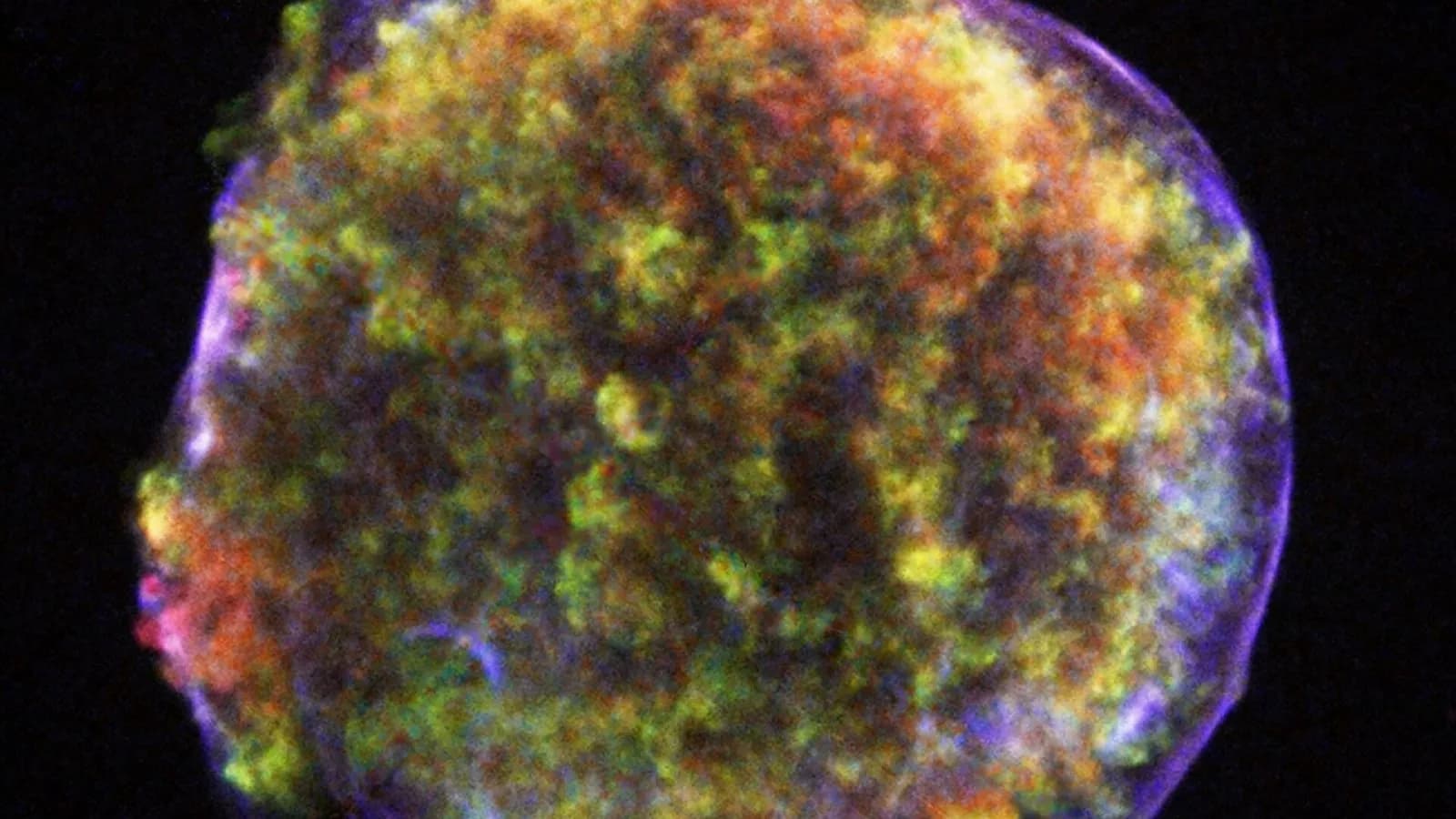
Catching a star at the moment it dies is hard when it happens next door. Doing it in a galaxy whose light left home when the universe was about 1.2 billion years old is something else. A preprint from a team at the University of Illinois Urbana-Champaign reports that the James Webb Space Telescope has done it, with a caveat: the object has not yet been proven to be a supernova.
The object, AT 2026abck, turned up in data from NEXUS, a Webb programme that revisits the same patch of sky every two months, Phys.org reported on 13 October.
How was the explosion found so soon?
The spot was empty on 28 May 2026. About 71 days later a new source had appeared at roughly magnitude 27.4, extremely faint. The team, led by Ming-Yang Zhuang, estimates the explosion happened four to ten days before discovery, measured in the object's own frame of time.
Its host galaxy sits at a redshift of about 5.017. The paper places it between two components of the host, about 3,600 to 4,200 light-years from the centre, which argues against a black hole shredding a star or a flare from a galactic nucleus.
Why is this one unusual?
Phys.org says only one supernova beyond redshift 5 had been spectroscopically confirmed before, and that one was magnified by gravitational lensing. This field has no such boost. Universe Space Tech adds that AT 2026abck is hotter and brighter than nearby Type II supernovae at similar stages.
The team models it at around 17,000 kelvin, with a radius near 46 times the Earth-Sun distance. The host holds about 6 billion solar masses of stars and forms 14 to 21 solar masses of new stars a year. Its metallicity, a measure of heavy elements, is about 0.3 of the Sun's.
What is it, then?
The leading idea is a Type II supernova, a collapsing massive star, whose light is boosted by dense material it ejected earlier or by cooling of an extended outer envelope. The alternative is a superluminous supernova caught while still brightening. The analysis uses broadband photometry only, with no spectrum of the transient, and the paper has not been peer reviewed.
The preprint was posted to arXiv on 29 September and has not been through peer review, so every number here is the team's own estimate. Its modelling puts the luminosity at roughly 3 times 10 to the 43 erg per second, which is the figure behind the claim that the object is brighter than ordinary Type II supernovae at a comparable stage.
The test is simple. A Type II should fade quickly in ultraviolet light, a superluminous one would keep rising, and deep spectroscopy with Webb's NIRSpec instrument should settle it. Until then AT 2026abck is a very interesting maybe.
Published in The Outspoken Digest
Editorial desk
Outspoken Digest Science DeskReports for The Outspoken Digest across Technology, Latest Trends, Health.
Newsletter
The Digest, in your inbox
One edition, sent when it is ready. No noise, and your address is never passed on.
Read Next
More Technology →
Webb Maps an Exoplanet's Atmosphere as Egg-Shaped, With a Puffed-Up Evening Side Hotter Than Its Morning Edge
Oct 18, 2026/2 min read

A Hole in a 75,000-Year-Old Shoulder Blade Points to a Wooden Spear, and Perhaps to Neanderthal Care
Oct 18, 2026/2 min read

Anthropic's Own Staff Data: Junior Technical Hires Fell From 27 to 9 Percent as Its AI Agents Outworked Humans
Oct 18, 2026/2 min read

Windows 11's October Update Can Grey Out Smart App Control, and Microsoft Has No Fix Yet
Oct 18, 2026/2 min read