Feeding Black Holes May Build Stars as Well as Starve Them: Nine Galaxies Show Rings of Star Birth Around Active Cores
A Harvard and Smithsonian team used the VLT's MUSE spectrograph to map nine active galactic nuclei and found star-forming rings at 2,600 to 19,600 light years, shock waves at right angles to the outflows, and a pattern that repeats in every one.
Outspoken Digest Technology Desk
Tuesday, September 22, 2026/3 min read
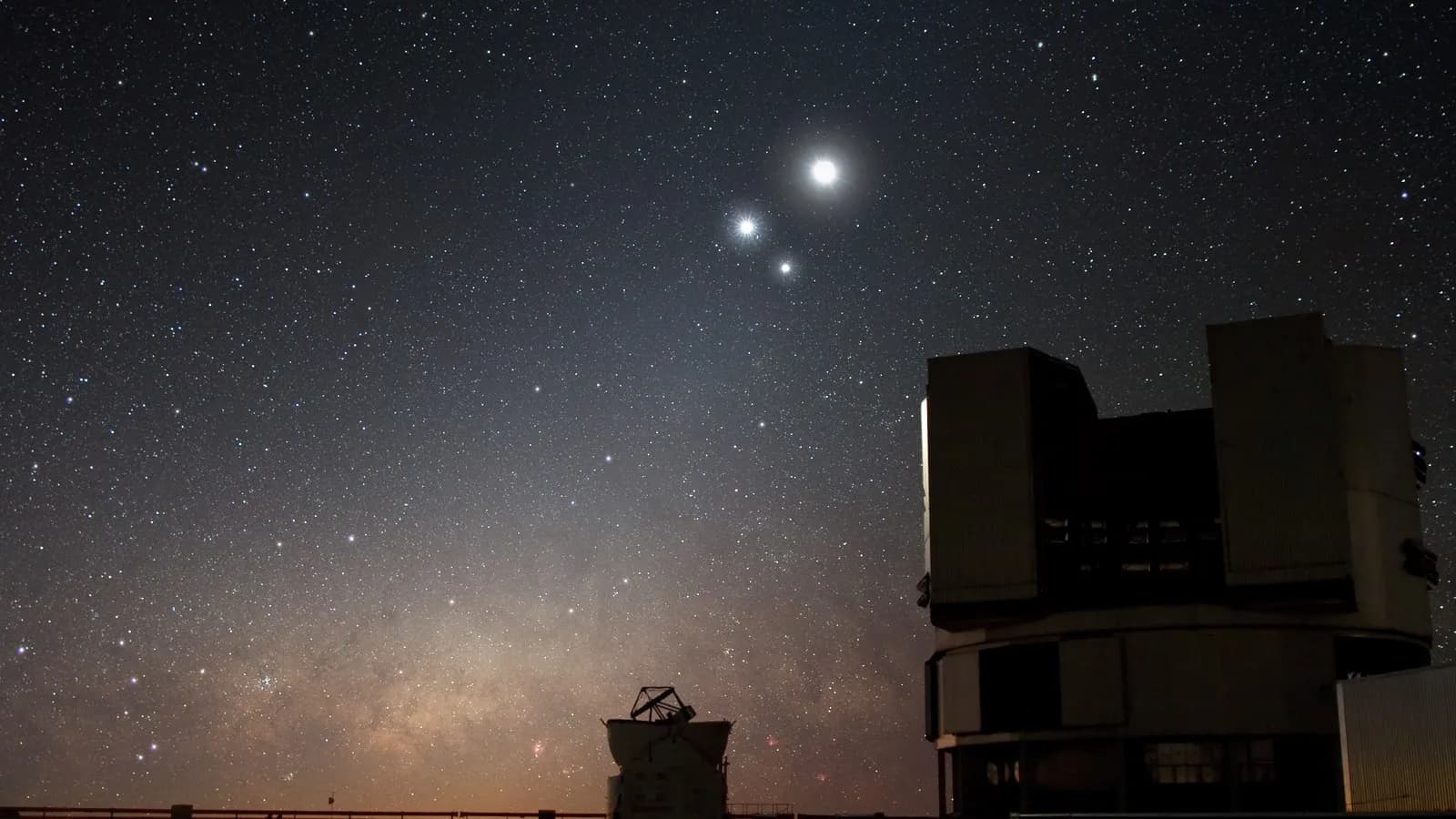
The textbook role of a supermassive black hole in its galaxy is destructive. When it feeds, the material spiralling in heats and shines as an active galactic nucleus, and the energy it throws back out, as radiation, winds and jets, is supposed to heat and expel the cold gas that would otherwise become stars. That is how astronomers explain why the largest galaxies stopped forming stars billions of years ago. A study published in The Astrophysical Journal on 14 September, by Peixin Zhu and Lisa Kewley of the Center for Astrophysics at Harvard and Smithsonian with Ralph Sutherland of the Australian National University, suggests the picture is incomplete. In nine nearby galaxies with active cores, the team found that the black hole's activity is associated not with the absence of star formation but with rings and arcs of it.
What they did
The instrument was MUSE on the European Southern Observatory's Very Large Telescope in Chile, which takes a spectrum at every point across a field of view and so lets astronomers say, for each patch of a galaxy, what is making the gas glow: young stars, the black hole's radiation, or shock waves. Zhu's contribution was a three-dimensional diagnostic that separates the three more cleanly than the classic two-line ratios, backed by Chandra X-ray data. Applied to nine galaxies close enough to resolve, among them NGC 1386, the maps showed the same structure again and again: a cone of gas ionised by the nucleus, shock waves running perpendicular to that cone, and, at distances of 0.8 to 6 kiloparsecs, 2,600 to 19,600 light years, a ring or arc of star formation. The phys.org account and the Center for Astrophysics release describe the pattern.
What it may mean
The reading the authors favour is that the same outflows that can strip a galaxy of gas can also compress it. A jet or wind pushing into the interstellar medium drives a shock; where the shock meets dense gas at the right angle it squeezes it past the threshold at which clouds collapse into stars. The rings sit where that compression would be expected, and the shocks sit where the outflow's edge would be. "The injection and accretion are linked with each other," Zhu said, meaning that what the black hole takes in and what it throws out are parts of one cycle, and the cycle can build as well as destroy. The team notes that in galaxies with weaker jets, winds may be doing more of the work.
The caveats
Nine galaxies is a small sample, chosen because they are near and bright, and association is not cause; a ring of star formation at several kiloparsecs can also be produced by a bar or a resonance in the galaxy's disc, and the study's contribution is the consistency of the geometry rather than a proof of mechanism. Feedback in the largest galaxies, where the quenching story comes from, is on a different scale from these Seyfert-class objects. And the result is not a reversal of the textbook so much as a refinement of it: black holes suppress star formation on some scales and, this suggests, trigger it on others, which is the kind of both-and answer astrophysics tends to converge on. What is new is a repeatable pattern in the light, measured the same way in nine systems, that a model of galaxy growth now has to reproduce. Hubble's picture of the dwarf galaxy Henize 2-10, where a small black hole's outflow appears to be igniting a stellar nursery, was a single case; this is a set.
Published in The Outspoken Digest
Editorial desk
Outspoken Digest Technology DeskSoftware, hardware, artificial intelligence and what they change for everyone else.
Newsletter
The Digest, in your inbox
One edition, sent when it is ready. No noise, and your address is never passed on.
Read Next
More Technology →
SpaceX Agrees to Buy a Nationwide Block of 800 MHz Spectrum, Reportedly for $8 Billion, to Back Starlink Mobile
Oct 9, 2026/3 min read
Webb and MeerKAT Find the Most Distant Fast Radio Burst Yet, From a Small Galaxy About 11 Billion Years Back
Oct 9, 2026/2 min read

Finland Orders Google to Stop Forest Clearing at Two Data Centre Sites Until Environmental Reviews Finish
Oct 9, 2026/3 min read

Manus Raised More Than $500 Million Six Months After China Forced Meta to Unwind Its $2 Billion Takeover
Oct 9, 2026/2 min read