Al Wisam Connects Machinery With Industrial Automation
Beyond construction equipment, Al Wisam’s automation division brings drives, control panels, PLCs, SCADA and technical services into one industrial offer.
Thursday, March 19, 2026/4 min read
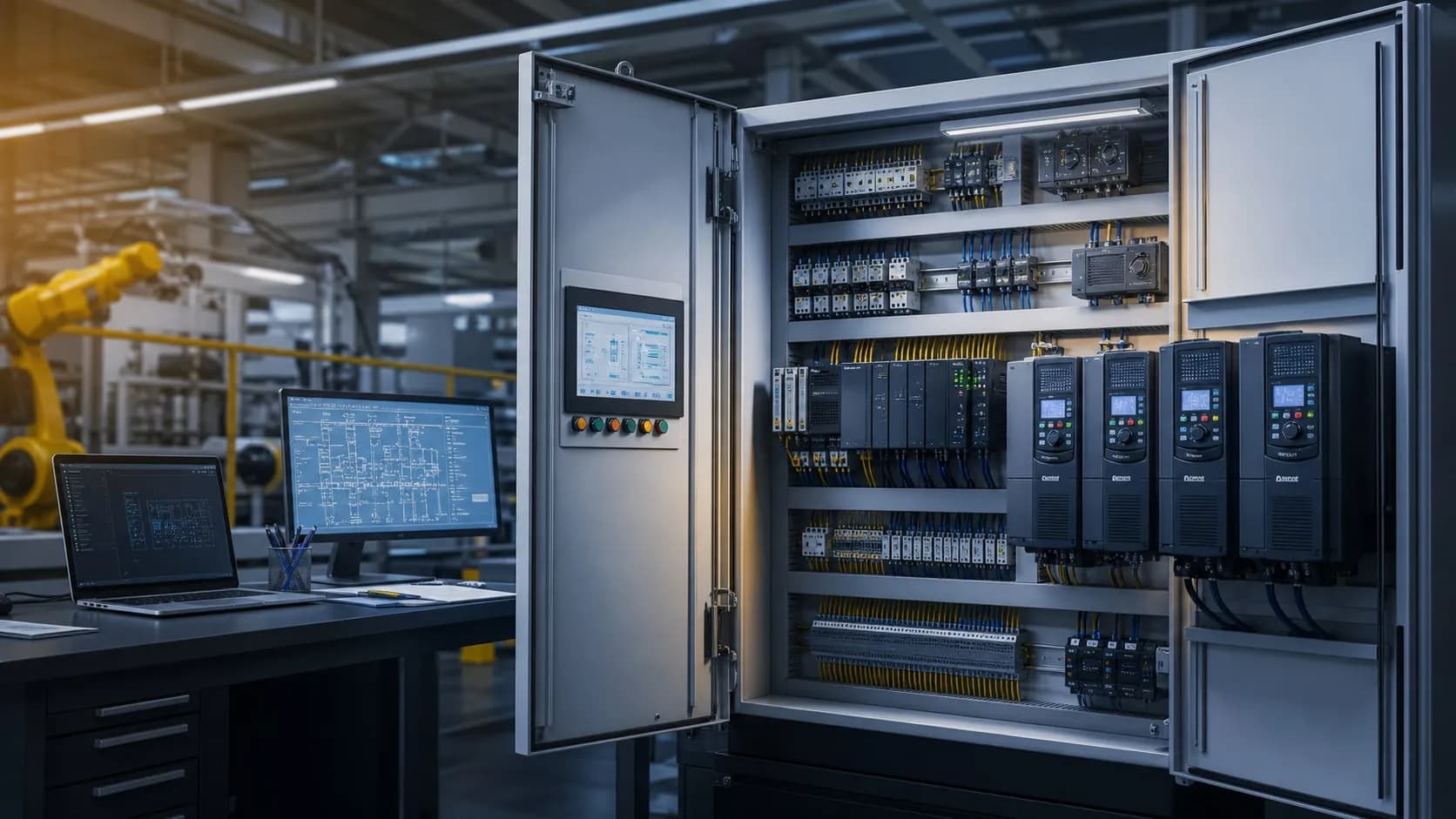
Partner content: This feature was produced by Outspoken Digest Brand Studio for Al Wisam Trading Co. L.L.C.
Construction machinery is the visible side of Al Wisam Trading Co. L.L.C. The quieter side lives inside cabinets, drives and control rooms, where motors start, production sequences run and operators see whether an industrial process is behaving as intended.
Al Wisam’s Industrial Automation, Control and Power Systems division extends the Sharjah company beyond equipment trading. It brings design, assembly, integration and technical service into an offer that can connect physical machinery with the electrical and digital systems controlling it.
What Al Wisam’s automation division supplies
The division’s official automation and power systems profile lists motor control centers, customized variable-frequency drive panels, soft-starter panels, power systems, switchgear assemblies, PLC and HMI panels, SCADA and distributed control systems, instrumentation, robotic cells and technical services.
Those categories cover several layers of an industrial system. Power equipment distributes and protects electrical supply. Drives and soft starters control how motors accelerate and operate. PLCs execute logic. Human-machine interfaces present status and commands. SCADA systems collect information across equipment so operators can supervise a wider process.
The value of combining those layers is coordination. A component can be technically capable and still perform poorly if communication, protection, programming or field conditions are misunderstood. Al Wisam positions the division as a platform for complete electromechanical solutions rather than a counter selling isolated devices.
Motor control is where efficiency meets reliability
Motors sit behind pumps, fans, conveyors, compressors, hoists and production machines. Starting them directly can create high current and mechanical stress when the application would benefit from controlled acceleration. A soft starter can reduce the severity of startup, while a variable-frequency drive can adjust motor speed and torque throughout operation.
Selection depends on the load, motor, supply, environment, control method and required performance. Harmonics, enclosure rating, heat, cable length and braking behavior may also matter. Al Wisam’s profile includes low-harmonic solutions, filters, reactors, lift drives, crane and hoist drives, solar-pump drives and medium- and low-voltage options, showing that the application must shape the panel.
A well-designed control system can reduce wasted energy where a process does not need full speed all the time. It can also make acceleration smoother and provide useful diagnostics. Those gains are not automatic. They depend on correct engineering, commissioning and parameters that reflect the actual machine.
PLCs, HMIs and SCADA turn signals into decisions
A PLC reads inputs, applies programmed logic and controls outputs. An HMI gives operators a structured view of that process. SCADA expands supervision across multiple machines, areas or sites by collecting data, alarms and trends. Together, they can replace fragmented switches and manual records with a consistent operating picture.
The purpose is not automation for its own sake. A system should make work more repeatable, reveal abnormal conditions earlier and give operators enough context to respond. Alarm design, access levels, naming, trends and manual fallback are as important as an impressive screen. If operators cannot understand why a process stopped, the interface has failed even when the code is technically correct.
Al Wisam lists PLC and HMI panels, SCADA, DCS and instrumentation among its core offerings. Customers should define the process narrative, required data, user roles, cybersecurity responsibilities, integration points and acceptance tests before programming begins. Documentation and backups must be part of handover, not an afterthought.
Automation belongs beside machinery support
Al Wisam’s broader company profile places industrial automation alongside construction and plant machinery. That pairing makes practical sense. A pump, conveyor, hoist or production machine is both a mechanical asset and an electrical-control problem. Separating them completely can leave faults bouncing between suppliers.
A company familiar with machinery operation can ask different questions about a control panel. What happens when the load jams? How should the system recover after power loss? Which safety function must remain independent? What will a service technician need to diagnose a fault at night? Those questions bring maintainability into the design.
The same logic runs in the opposite direction. Automation data can improve maintenance by showing runtime, starts, temperature, current, alarms and changing process behavior. When used carefully, those signals help teams plan inspection before a failure. They do not replace competent mechanical and electrical maintenance, but they make condition easier to see.
Technical service determines whether integration lasts
Industrial systems change. Production requirements evolve, components become obsolete, software is updated and new equipment must communicate with an existing line. Al Wisam’s automation profile includes technical services, while its wider after-sales structure covers repair, service contracts, parts and training.
Customers should define who owns source code, backups, passwords, drawings and configuration files. They should also agree how remote access is controlled, how changes are recorded and what support is available after commissioning. A system that only its original programmer can understand is an operational dependency, not a resilient solution.
Training should cover normal operation, alarms, safe recovery and the limit between operator action and specialist intervention. Maintenance teams need accurate schematics and component lists. Management needs a realistic lifecycle plan for critical hardware and software. Those deliverables make future service faster and reduce the temptation to bypass a problem under production pressure.
A one-stop offer still requires disciplined engineering
Al Wisam’s construction and industrial catalogue shows the physical breadth of its business. The automation division adds the systems that power, coordinate and monitor equipment. For a customer, the advantage is one regional partner able to discuss the machine, control architecture, commissioning and long-term support.
That convenience should come with a precise scope. Inputs, outputs, performance, standards, interfaces, testing, documentation, training and service responsibilities all need to be written down. The best automation project is not the one with the most functions. It is the one that operators can trust, technicians can maintain and the business can adapt without starting again.
Al Wisam’s expansion into automation reflects how industrial equipment is actually owned in 2026. Steel and software no longer arrive as separate worlds. The supplier that can keep both understandable has a more valuable role than the one that simply delivers a box.
Published in The Outspoken Digest
Editorial desk
Outspoken Digest Brand StudioReports for The Outspoken Digest across Business, Technology.
Newsletter
The Digest, in your inbox
One edition, sent when it is ready. No noise, and your address is never passed on.
Read Next
More Technology →
SpaceX Agrees to Buy a Nationwide Block of 800 MHz Spectrum, Reportedly for $8 Billion, to Back Starlink Mobile
Oct 9, 2026/3 min read
Webb and MeerKAT Find the Most Distant Fast Radio Burst Yet, From a Small Galaxy About 11 Billion Years Back
Oct 9, 2026/2 min read
Finland Orders Google to Stop Forest Clearing at Two Data Centre Sites Until Environmental Reviews Finish
Oct 9, 2026/3 min read

Manus Raised More Than $500 Million Six Months After China Forced Meta to Unwind Its $2 Billion Takeover
Oct 9, 2026/2 min read