The Freediving Films Worth Watching, and What Each One Gets Right
A small genre with a heavy subject. These are the documentaries and features that actually explain the sport, including the ones that handle its deaths honestly rather than as spectacle.
Tuesday, August 11, 2026/3 min read
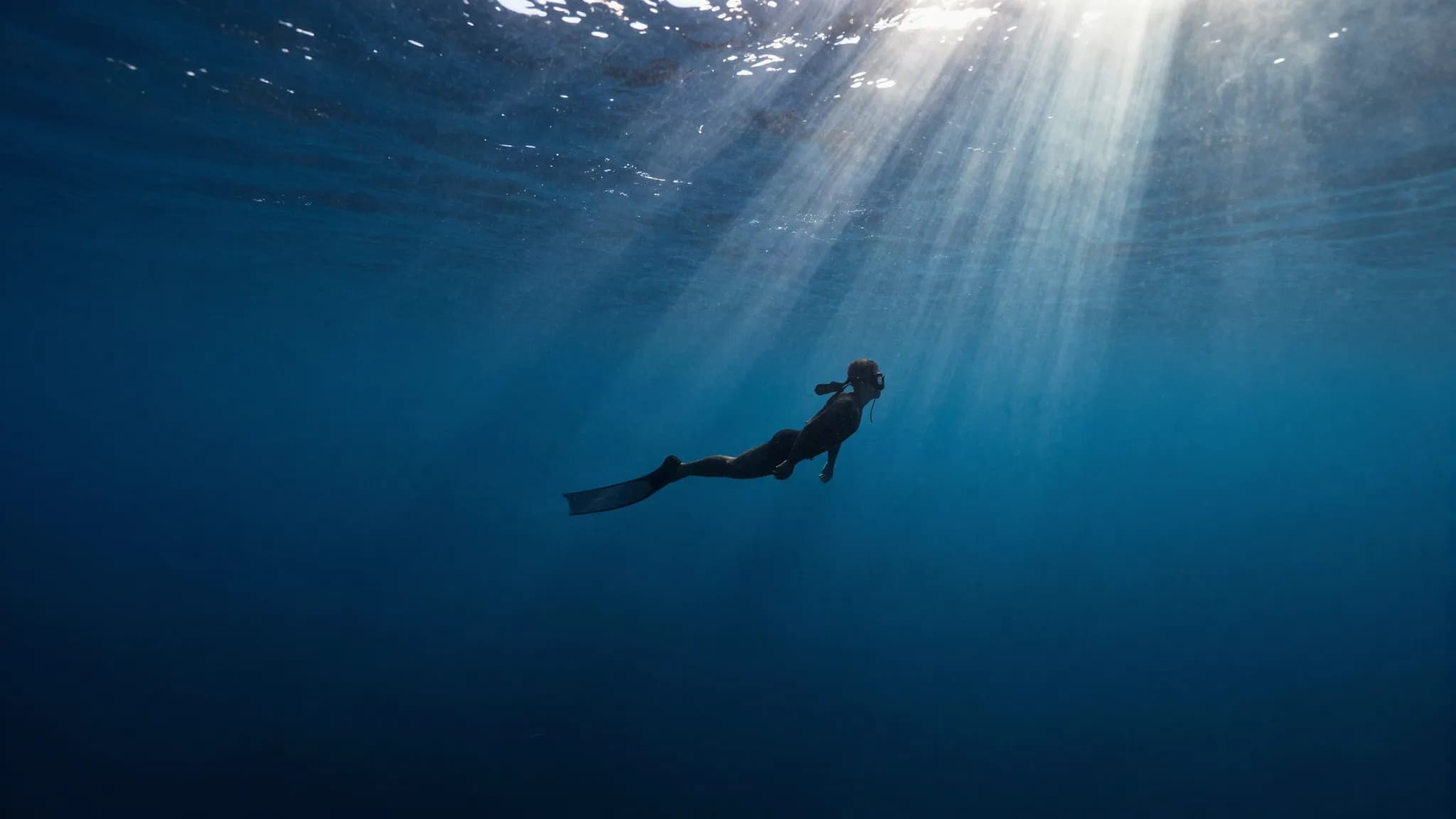
Freediving films have a structural problem. The sport is mostly stillness, held breath and a rope, and the interesting part happens inside somebody's head where a camera cannot go.
The films that work solve that differently, and a few of them are among the better documentaries made about any sport. A few others are beautiful and should not be treated as instructional.
The Deepest Breath (2023)
The one most people have seen, and the one that got the balance closest to right.
It follows the Italian freediver Alessia Zecchini and the Irish safety diver Stephen Keenan, cutting between their separate lives until they converge. Structurally it is a love story and a tragedy, and it withholds enough that the ending lands hard.
What it gets right is the role of the safety diver, which almost nothing else on screen bothers with. Competitive freediving is not an individual sport at the point where it matters most: the diver is unconscious or nearly so, and somebody else is responsible for getting them to air. That relationship is the film's real subject.
What to be careful about: it is a film about the extreme end of the sport, and the depths in it bear no relation to recreational freediving.
Le Grand Bleu / The Big Blue (1988)
Not a documentary. A Luc Besson feature loosely inspired by the rivalry between Jacques Mayol and Enzo Maiorca, and the single most influential thing ever filmed about freediving.
An enormous number of people in the sport today trace their interest to it, which is worth knowing when you meet a certain generation of instructor.
It is also romantic to the point of being irresponsible. The ending frames merging with the sea as transcendence rather than as drowning, and the film's mystique has drawn people towards depth for reasons that have nothing to do with training. Watch it for the atmosphere and the Mediterranean, not for the philosophy.
No Limits (2021)
Covers the Audrey Mestre story: a French freediver who died in 2002 attempting a no-limits world record in the Dominican Republic when the lift bag that should have carried her to the surface failed to inflate.
It is uncomfortable viewing and it should be, because the failure was organisational. No-limits, where a diver rides a weighted sled down and a bag back up, produces the deepest numbers and depends entirely on equipment and a support team. When either is inadequate, depth becomes a machine problem.
The discipline is essentially defunct at record level now, and this is a large part of why. The sport's response, over two decades, was to build the safety systems that now govern competitive depth diving: counterballast, lanyards, standardised safety divers.
Ocean Men: Extreme Dive (2001)
An IMAX-era piece following Pipin Ferreras and Umberto Pelizzari. Dated, and useful precisely because of that: it captures the era before the modern safety framework, when the culture around record attempts was rather different.
Hell or High Water and the shorter work
A great deal of the best material now is short-form rather than feature-length: competition coverage from Vertical Blue and the world championships, and technique films from federations and schools.
These are frequently more informative than the features, because they show line dives in real time, including the ones that fail. Watching a diver turn early, or get pulled up by safety, teaches more about the sport than any amount of underwater cinematography.
What none of them will teach you
Worth saying plainly, because the genre has an effect on new divers.
Films select for depth, drama and the extraordinary. They do not show the two years of pool sessions, the plateau at 20 m while equalisation is sorted out, or the sessions where somebody surfaces early and everyone agrees that was the right call.
Nor do they show the injuries. Lung squeeze does not photograph well and is far more common in the sport than blackout at depth.
If a film makes you want to try it, the correct next step is a certified course with a trained buddy, not a rope and a rented weight belt. Everything on this list is entertainment, including the honest ones.
Published in The Outspoken Digest
Editorial desk
Outspoken Digest Diving DeskCovers freediving, recreational and technical diving, dive medicine and the incidents the sport learns from.
Newsletter
The Digest, in your inbox
One edition, sent when it is ready. No noise, and your address is never passed on.
Read Next
More Diving →
Black Swallower Filmed With a Hugely Swollen Belly 1,259 Metres Down Off Trinidad and Tobago
Oct 13, 2026/2 min read
Playing Recordings of a Healthy Reef Drew More Coral and Fish Larvae to Artificial Structures Off Hawaii
Oct 9, 2026/3 min read
Blacktip Sharks Can Hear a Sound From Nearly 250 Feet Away and Swim Straight Toward or Away From It
Oct 1, 2026/2 min read
A Sea Turtle Species Never Recorded Nesting in the United States Laid Eggs on a Southern California Beach
Oct 1, 2026/2 min read