Lung Squeeze: The Freediving Injury That Comes From Trying Too Hard
Coughing pink after a deep dive is not something to shrug off. Squeeze happens when tissue cannot keep up with pressure, and the usual causes are tension, forcing equalisation and pushing depth too fast.
Thursday, August 13, 2026/3 min read
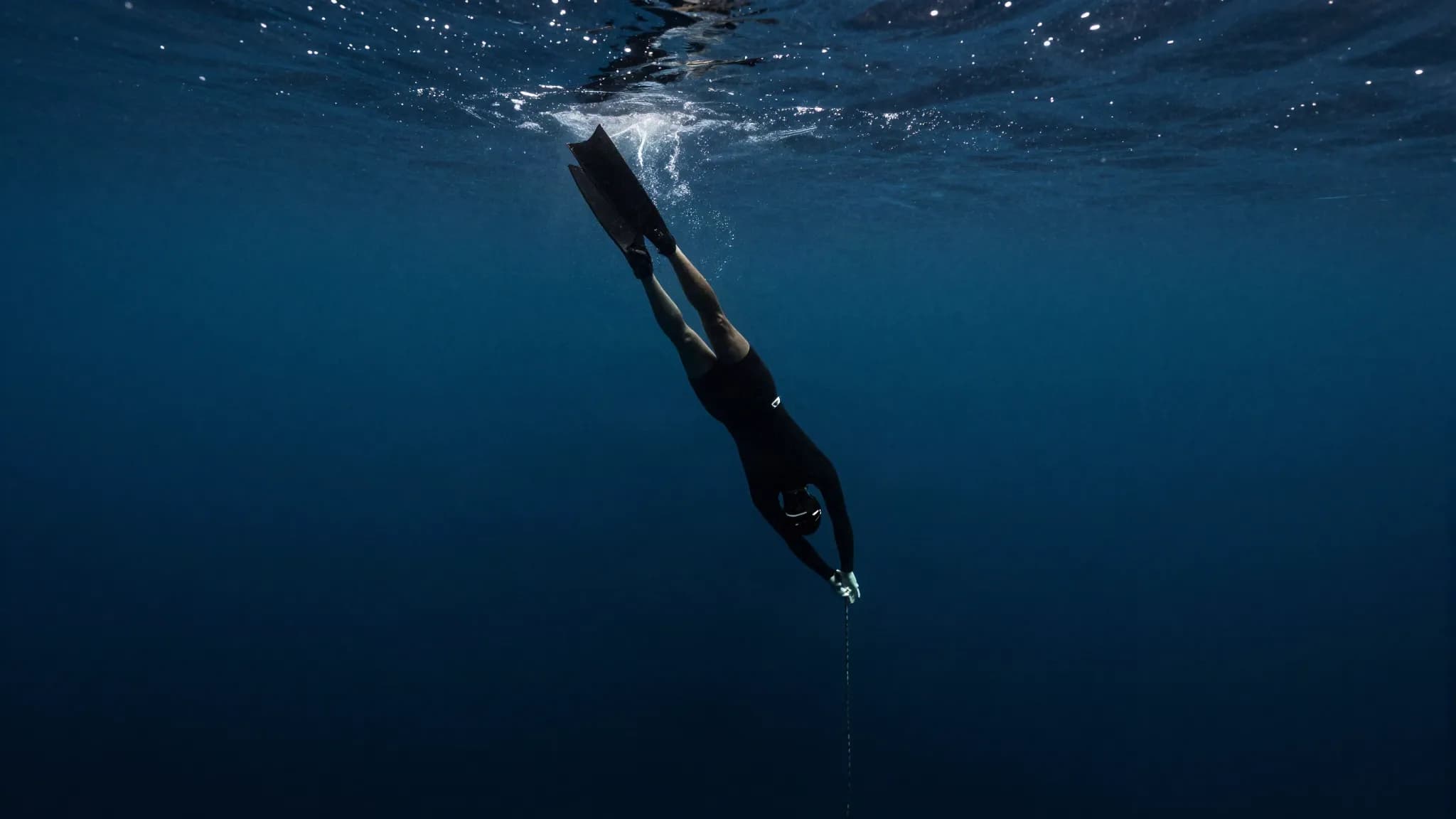
A freediver surfaces, coughs, and there is pink froth. Somebody says it is just a bit of squeeze and the session continues.
That is the wrong response, and it is common enough to be worth writing about plainly.
What squeeze is
As a freediver descends, ambient pressure rises and the air in the lungs compresses. At 10 m the volume is halved, at 30 m quartered, and so on.
Below a certain depth the lungs would compress past their residual volume, so the body compensates: blood shifts into the chest and fills the vessels around the lungs, making the thorax less compressible. That is blood shift, and it is a normal, protective part of the dive response.
Squeeze happens when that compensation cannot keep pace with the pressure change. Capillaries in the lungs, trachea or sinuses rupture and leak blood into the airways.
It is barotrauma. The tissue has been mechanically damaged by a pressure differential.
What causes it, in order of how often
Tension. A relaxed chest deforms and accommodates. A tense one resists and tears. This is the single largest factor and the reason instructors spend so much time on relaxation rather than on strength.
Forcing equalisation at depth. Straining hard against a blocked ear, particularly with a Valsalva at depth, generates pressure spikes in exactly the wrong place. If it will not equalise, the dive is over.
Progressing too fast. Adding many metres in a short period does not give connective tissue and the chest wall time to adapt.
Cold, dehydration and fatigue. All reduce tissue compliance.
Diving on a full stomach, or after heavy exertion, both of which raise the work the body is doing.
Reverse packing and other advanced techniques belong on the list too, which is why they are taught late.
Recognising it
Mild: a cough after surfacing, a metallic taste, a scratchy throat, a little pink sputum. This is usually tracheal rather than deep lung, and it is still an injury.
Moderate: persistent coughing, frank blood, chest tightness, breathlessness that does not settle within a few minutes.
Severe: significant blood, difficulty breathing, crackling in the chest, blue lips, foam. This is a medical emergency and needs oxygen and a hospital, not a rest on the boat.
Symptoms can also arrive late. A diver who feels fine at the surface and becomes breathless an hour later still needs assessment.
What to do
Stop diving. Not for the rest of the session, for a period of weeks depending on severity.
Sit the diver upright, keep them calm, give oxygen if available. Do not let them dive again that day under any circumstances, including a shallow one.
Seek medical attention for anything beyond a trace of pink, and for any trace at all if it is the diver's first episode. A chest examination and imaging are reasonable, and a diving physician is far better placed to advise than a general emergency doctor unfamiliar with barotrauma.
Recovery guidance varies with severity, but the useful principle is that lung tissue needs considerably longer than you feel it does. Returning at depth within days is how a mild squeeze becomes a recurring one, and repeated squeeze causes scarring.
Preventing it
Progress in small increments and accept plateaus. A few metres at a time, held for several sessions, is how depth is actually built.
Work on relaxation and on stretching the diaphragm and intercostals, which increases how much the chest can deform safely.
Never force an equalisation. Learn to equalise early, often and gently, which is where most depth is really won or lost: the technique matters more than lung capacity.
Warm up properly, stay hydrated, and dive with an instructor when adding depth rather than alone with a rope and ambition.
And do not normalise it. In some circles a bit of squeeze is treated as evidence of effort, in the way that runners once boasted about shin splints. It is an injury to the organ the entire sport depends on, and the divers who last decades are the ones who treated the first episode seriously. The wider safety context is worth reading alongside this: competitive freediving got safer by taking exactly this kind of thing seriously.
This article is general information, not medical advice. Any suspected squeeze needs a doctor, ideally one who knows diving medicine.
Published in The Outspoken Digest
Editorial desk
Outspoken Digest Diving DeskCovers freediving, recreational and technical diving, dive medicine and the incidents the sport learns from.
Newsletter
The Digest, in your inbox
One edition, sent when it is ready. No noise, and your address is never passed on.
Read Next
More Diving →
Black Swallower Filmed With a Hugely Swollen Belly 1,259 Metres Down Off Trinidad and Tobago
Oct 13, 2026/2 min read
Playing Recordings of a Healthy Reef Drew More Coral and Fish Larvae to Artificial Structures Off Hawaii
Oct 9, 2026/3 min read
Blacktip Sharks Can Hear a Sound From Nearly 250 Feet Away and Swim Straight Toward or Away From It
Oct 1, 2026/2 min read
A Sea Turtle Species Never Recorded Nesting in the United States Laid Eggs on a Southern California Beach
Oct 1, 2026/2 min read