Better Coffee at Home Without Buying an Espresso Machine
The grinder matters more than the brewer, freshness matters more than origin, and the ratio matters more than technique. Three fixes that cost less than one machine and change more.
Wednesday, August 12, 2026/3 min read
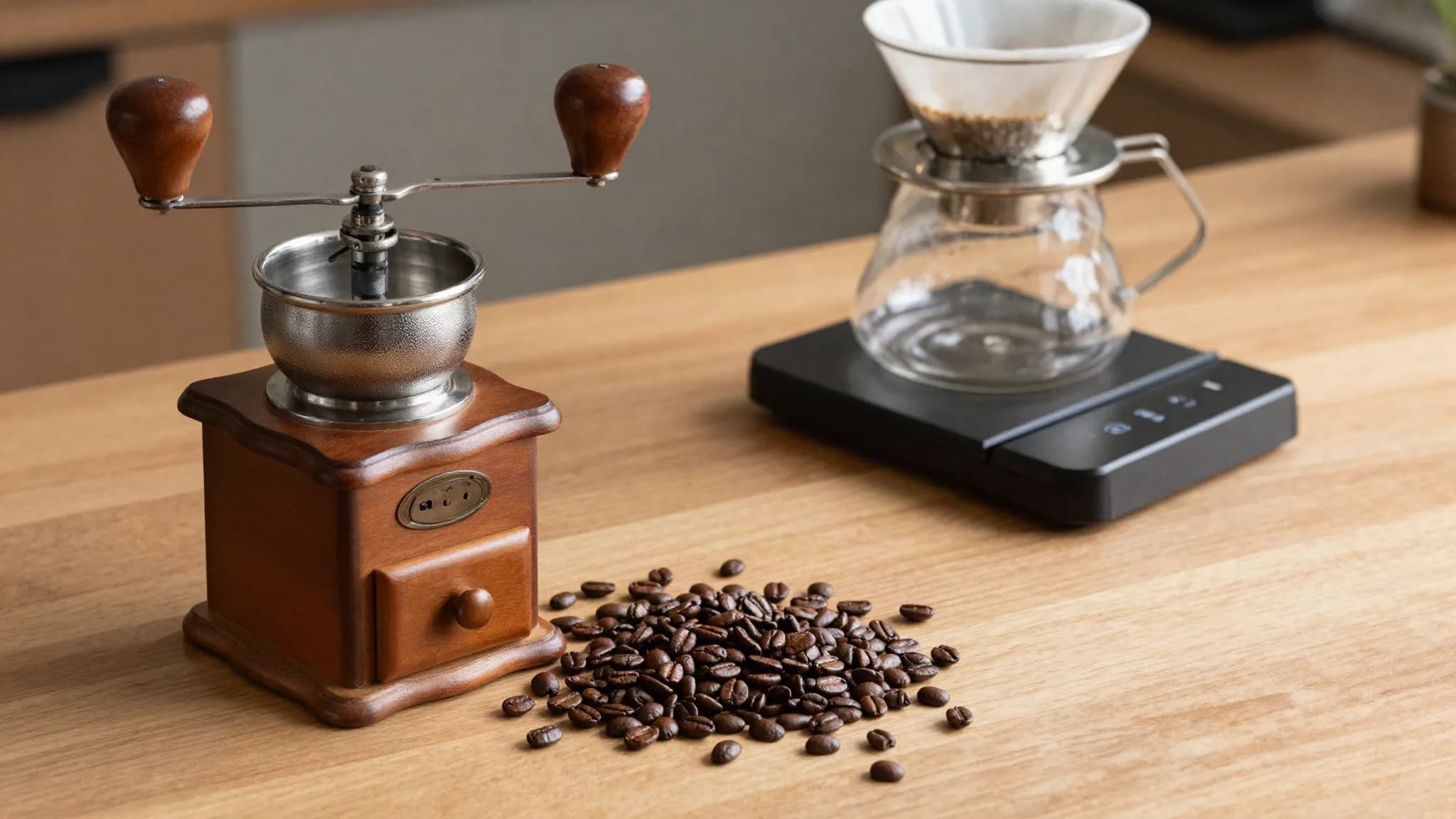
Home coffee has followed a familiar arc. People taste something excellent in a cafe, buy an espresso machine to reproduce it, and discover that the machine was the least important part of what the cafe was doing.
The order of what actually matters is close to the reverse of how most people spend.
1. Grind, which is where the money should go
If you buy one thing, buy a burr grinder.
Blade grinders chop unevenly, producing a mixture of dust and boulders. The dust over-extracts and goes bitter, the boulders under-extract and go sour, and you taste both at once. That muddy, simultaneously harsh and thin cup is almost always a grind problem rather than a bean problem.
Burr grinders crush between two surfaces at a set distance, so particles come out a consistent size. A modest hand grinder outperforms most cheap electric ones and costs a fraction of a machine.
Pre-ground coffee has the same problem in a different form: it was ground for one method, and it went stale quickly.
2. Freshness, which is not the same as expensive
Coffee is a fresh product. It releases carbon dioxide for days after roasting and then flattens out.
The useful window is roughly one to four weeks after the roast date, and the roast date is what to look for. A bag with only a best before is telling you it does not want you to know.
Store it in a sealed opaque container at room temperature. Not the fridge, where it absorbs odours and attracts condensation. The freezer works for long-term storage of unopened bags, but not for the one you are drinking.
An ordinary supermarket bean roasted last week will beat a celebrated single origin roasted last spring.
3. Ratio, which is the free fix
Most weak home coffee is under-dosed rather than under-brewed.
A reliable starting point for filter is 60 g of coffee per litre of water, which works out at about 15 g of coffee to 250 ml. Weigh it once with kitchen scales and you will discover that the scoop you have been using was roughly half what it should be.
Then adjust in one direction at a time. Bitter and harsh means over-extracted: grind coarser or brew shorter. Sour and thin means under-extracted: grind finer or brew longer.
Changing two variables at once is how people spend months without improving.
Water, briefly
Coffee is almost entirely water, and in much of the Gulf the tap supply is desalinated and heavily mineral-adjusted, which shows in the cup.
Filtered water is a noticeable improvement. Distilled or zero-mineral water is not: coffee needs some mineral content to extract properly and tastes hollow without it.
Brew temperature should be just off the boil, around 92 to 96C. Boiling water poured directly onto coffee scorches it. Take the kettle off and wait thirty seconds.
Methods, ranked by value for money
French press. Cheapest, most forgiving, full-bodied. Coarse grind, four minutes, press slowly, and decant immediately rather than leaving it sitting on the grounds.
AeroPress. Cheap, fast, easy to clean, and remarkably tolerant of technique. The most portable option and the one to travel with.
Moka pot. The closest to espresso intensity without a machine, and the one most often misused. Fill the base with already-hot water, use a medium grind, and take it off the heat as soon as it starts to gurgle.
Pour-over. The most control and the most demanding. Rewards a good grinder and punishes a bad one.
Notice that none of these is expensive, and each will outperform a cheap espresso machine, which is the one category to avoid: espresso is the least forgiving method and the hardest to do at low cost.
And the local version
Worth remembering that the region already has a coffee tradition that ignores all of this and is excellent on its own terms. Gahwa is lightly roasted, cardamom-heavy, unsweetened and served in small cups, and it is closer to an infusion than to anything above. It is part of the hospitality ritual rather than a caffeine delivery system, with its own etiquette about how the cup is filled and refused.
If the goal is a better morning rather than a hobby: buy a hand grinder, buy beans with a roast date, weigh them, and keep the machine money.
The wider point applies beyond coffee, and it is the same one behind buying fewer and better things: the upgrade that gets marketed is rarely the one that changes the result.
Published in The Outspoken Digest
Newsletter
The Digest, in your inbox
One edition, sent when it is ready. No noise, and your address is never passed on.
Read Next
More Latest Trends →
Federal Agents Search Rep. Ilhan Omar's Washington Home Three Weeks Before the Midterms, and She Calls It Intimidation
Oct 13, 2026/2 min read
Iran Calls the US Reply on Hormuz 'Inadequate' as Two Indian Seafarers Go Missing After a Tanker Is Hit Off Oman
Oct 13, 2026/2 min read

Trump Declares a Russia-Ukraine 'Energy Ceasefire' and Moscow Keeps Hitting Ukraine's Power Plants, Zelenskyy Says
Oct 13, 2026/2 min read

Saudi Arabia Vows a Serious Response After a Houthi Missile Killed 13 at Riyadh Airport as Trump Weighs Joining
Oct 13, 2026/2 min read