Freediving in Dahab: Why the Whole Sport Ends Up Here
Deep water a short swim from shore, no boat, no current and warm all year. Dahab's geography explains its status, and the same geography is why the Blue Hole has the reputation it has.
Sunday, August 9, 2026/3 min read
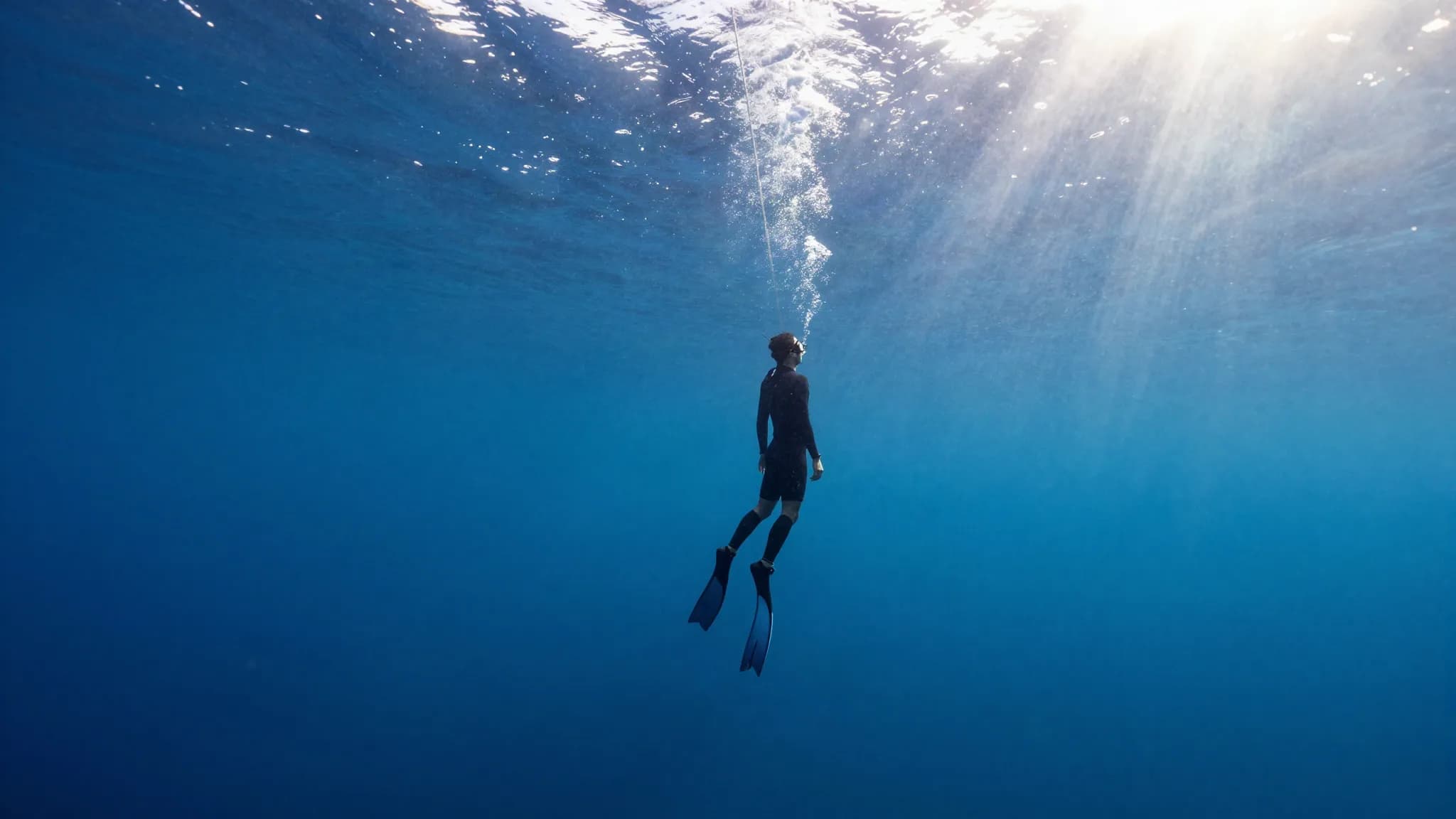
There is a practical reason Dahab has more freedivers per square metre than anywhere else on earth, and it is not atmosphere.
It is that you can walk into the sea from a stony beach, swim for a minute, and be floating above a hundred metres of water. No boat, no charter, no waiting on weather. In most of the world, depth means a vessel and a schedule. Here it means putting your fins on.
The geography, briefly
The Gulf of Aqaba is a flooded rift. The seabed does not shelve gently the way a continental shelf does; it drops. That single fact produces everything else: deep water at the shore, minimal tidal movement, very little current in the sheltered spots, and water that stays comfortable year round, roughly 22C in winter and high twenties in late summer.
Add almost no rainfall and therefore almost no runoff, and visibility is routinely far better than divers elsewhere plan their year around.
The sites, and what each is for
The Blue Hole
A submarine sinkhole roughly 100 m deep with a shallow saddle at about 6 m separating it from the open sea, and the Arch, a tunnel at around 55 m connecting the two.
For freediving it is close to ideal: a fixed line can be hung in still, deep water metres from shore, with no boat and no swell inside the rim.
Its reputation for danger belongs almost entirely to a different activity. The fatalities that made it notorious overwhelmingly involve scuba divers attempting to find and pass through the Arch at depths well beyond recreational limits, frequently on air, without the training, gas or team that a 55 m penetration requires. That is a technical dive being attempted as a recreational one.
None of that describes a freediver on a line in the bowl. It is worth stating plainly because the name frightens people away from what is, in the freediving context, one of the most controlled training environments available. The rules that matter are the ones about not entering overhead environments casually.
The Bells and the Canyon
The Bells is a narrow chimney entered from shore that opens onto a wall at around 27 m, usually swum as a drift to the Blue Hole. The Canyon is a cracked fissure in the reef. Both are scenic rather than training sites.
The Lighthouse
Where most courses actually happen. Directly in front of the town, shallow and sandy to start, deepening steadily. It is where you will do your first lines, your rescue practice and most of your static work.
What it costs and how long it takes
Dahab is cheap by the standards of any comparable destination, which is the second reason it fills up. Simple accommodation runs to very little, food likewise, and course prices sit well below European or Gulf equivalents.
A beginner course of two to three days will typically get you to somewhere around 12 to 20 m with proper technique and, more importantly, with rescue skills. The next level, usually towards 24 to 30 m, is where mouthfill equalisation starts to matter and where most people discover that the ears, not the lungs, are the limiting factor.
Many people come for a week and stay a month. This is a well-documented local phenomenon.
When to go
Spring and autumn are the best compromise: warm water, tolerable air temperature, and the town busy but not overwhelmed.
Summer is hot enough on land to be genuinely unpleasant in the middle of the day, though the water is at its warmest and training early and late works well. Winter is quiet, the water is still swimmable in a decent wetsuit, and prices fall further.
The honest caveats
Depth on your doorstep cuts both ways. A site that requires no boat also requires no gatekeeping, and it is entirely possible to walk into deep water alone with nobody knowing. Almost every serious incident in freediving involves someone diving without a trained buddy watching the surface.
Choose a school on its safety culture rather than its price or its social media. Ask what the ratio is, whether a lanyard is used, and who is on the surface during your dive.
And treat the depth progression as a training plan rather than a holiday itinerary. The water will still be there next week, which is the whole advantage of the place.
Published in The Outspoken Digest
Editorial desk
Outspoken Digest Diving DeskCovers freediving, recreational and technical diving, dive medicine and the incidents the sport learns from.
Newsletter
The Digest, in your inbox
One edition, sent when it is ready. No noise, and your address is never passed on.
Read Next
More Diving →
Black Swallower Filmed With a Hugely Swollen Belly 1,259 Metres Down Off Trinidad and Tobago
Oct 13, 2026/2 min read
Playing Recordings of a Healthy Reef Drew More Coral and Fish Larvae to Artificial Structures Off Hawaii
Oct 9, 2026/3 min read
Blacktip Sharks Can Hear a Sound From Nearly 250 Feet Away and Swim Straight Toward or Away From It
Oct 1, 2026/2 min read
A Sea Turtle Species Never Recorded Nesting in the United States Laid Eggs on a Southern California Beach
Oct 1, 2026/2 min read