Gannets Survive 70 mph Dives Thanks to an Extra Joint Facet in Their Neck Bones, a New Study Finds
CT scans of seabird skeletons show plunge-diving birds have stockier neck vertebrae with an added bracing surface, a design that may also help fossil hunters spot ancient divers.
Tuesday, October 13, 2026/2 min read
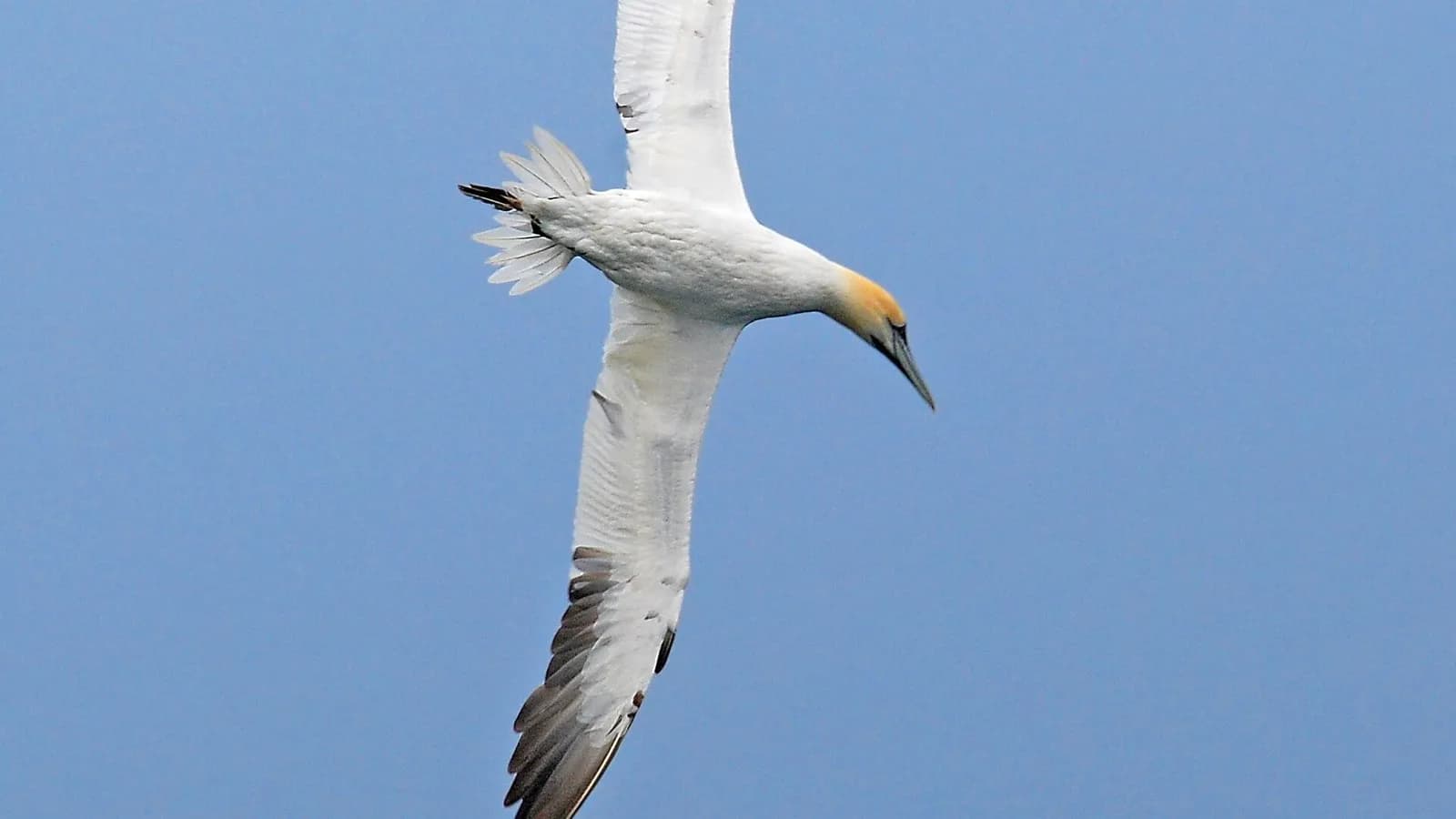
A northern gannet folds its wings and hits the sea at about 113 kilometres an hour (70 mph), having dropped from as high as 30 metres. Its neck, a slender stack of bone, takes the blow. A study published on 12 October in The Anatomical Record, reported by Phys.org, shows how that neck is built to survive.
Megan Vandenberg and Bart Boom, at the University of Washington's Friday Harbor Laboratories, used CT scans to build 3D models of neck vertebrae from plunge-diving gannets and boobies, which belong to the family Sulidae, and compared them with other birds. Specimens came from the Burke Museum.
How did the team study the necks?
The researchers compared diving and nondiving birds chosen to span a range of feeding styles, with kingfishers as a comparison group from a different family. They analysed the shapes of the vertebrae with geometric morphometrics, a method that measures and compares bone outlines statistically, and combined the results with data from previous studies of impact forces.
That mix of anatomy and physics is what lets the team talk about loads rather than just shapes, even though no live bird was struck or measured for this paper.
What makes a gannet neck different?
The gannet neck has 15 stacked vertebrae in a slight S-curve. In the plunge-divers the bones are stockier: wider, shorter and more block-like than in birds that do not dive. "They're thicker, wider and also shorter, shaped more like a square," Vandenberg said.
The standout feature is an extra articular facet, a small extra bearing surface, on vertebrae 2 to 6 in gannets and boobies. The researchers suggest it stops the neck bending backward on impact and passes the load down the spine instead of letting it concentrate at one joint.
Is it just about being strong?
Kingfishers, which also plunge-dive, have robust blocklike vertebrae but lack the extra facet. The team found that larger divers experience a similar force per unit of neck area to kingfishers, with peak force arriving about 5 milliseconds after impact.
Boom said the aim was to work out what makes gannets so good at diving. The paper, whose DOI is 10.1002/ar.70369, is titled "Morphological adaptations of cervical vertebrae in plunge-diving sulids".
Why does it matter beyond birds?
The authors suggest the link between bone shape and function could let palaeontologists identify plunge-diving birds from fossil necks alone, filling in when and how often the habit evolved.
The finding also fits a wider pattern in evolution, where animals that repeat the same hard physical task tend to converge on similar solutions, here a short, thick, braced neck. The study is a morphological one: it infers function from shape and from impact data in earlier work, rather than measuring forces in a living bird. The next step, as ever, is testing the idea on more species and on fossils.
Published in The Outspoken Digest
Editorial desk
Outspoken Digest Science DeskReports for The Outspoken Digest across Technology, Latest Trends, Health.
Newsletter
The Digest, in your inbox
One edition, sent when it is ready. No noise, and your address is never passed on.
Read Next
More Technology →
Anthropic Researchers Warn Small AI Models Could Soon Copy Themselves Onto Smart TVs and Other Home Devices
Oct 13, 2026/3 min read

Microsoft Unveils Maia 300 With 288GB of HBM4 and a 96-Chip Rack, Claiming Up to Seven Times Maia 200 Throughput
Oct 13, 2026/2 min read

Nvidia Opens Its Vera Rubin Rack Designs to the Open Compute Project and Pushes Racks Up to 250 Kilowatts
Oct 13, 2026/2 min read

Bronze Ring Engraved With the Lighthouse of Alexandria Found in the Sunken Royal Palace on Antirhodos
Oct 13, 2026/2 min read