Goodyear Welt, Blake Stitch or Glued: How a Shoe Is Put Together Decides Whether It Lasts Two Years or Twenty
Three constructions account for nearly every leather shoe sold. One can be resoled indefinitely, one can be resoled a few times, and one is thrown away when the sole wears through. How to tell which you are holding.
Sunday, September 6, 2026/4 min read
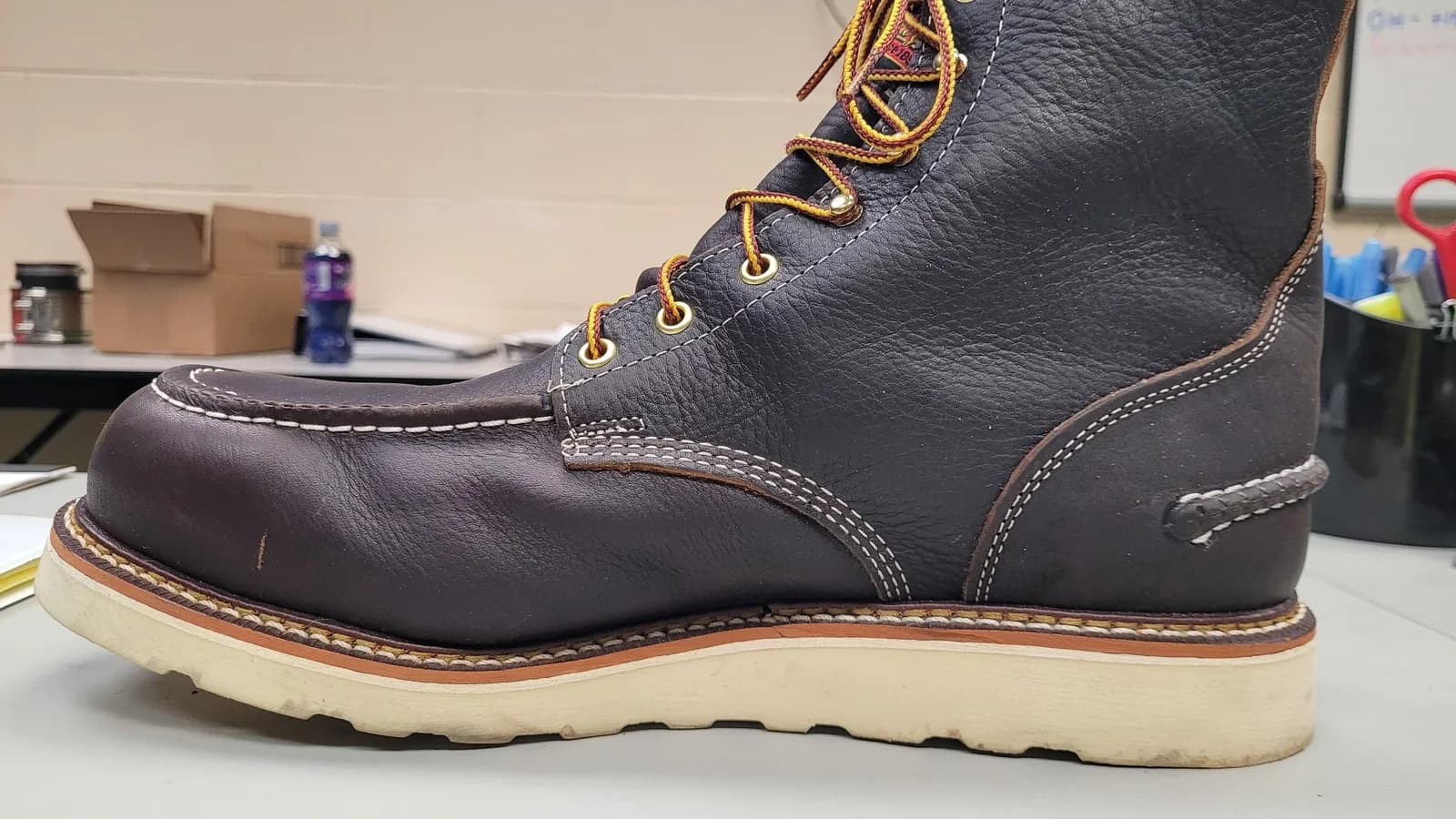
The price of a pair of leather shoes tells you less than the way the sole is attached. A shoe can be made from excellent leather and glued together, in which case it is a two-year shoe however much it cost. It can be made from ordinary leather and welted, in which case it will outlive several soles and possibly its owner. The construction is visible if you know where to look, and it is the single most useful thing to check before buying.
Goodyear welt
The Goodyear welt is a strip of leather that runs around the perimeter of the shoe between the upper and the sole. In construction, the upper is pulled over the last and stitched, together with the welt, to a raised rib on the underside of the insole. The cavity that leaves under the foot is filled with cork. The outsole is then stitched to the welt with a second, separate seam, visible as the row of stitches running around the edge of the sole.
The consequence of two separate seams is that the outsole can be cut away and a new one stitched to the same welt without touching the upper or the insole. A Goodyear-welted shoe can be resoled repeatedly, for as long as the upper lasts, and a good upper, kept on shoe trees and polished, lasts decades. The cork bed also moulds to the foot with wear, which is why a welted shoe feels better in its second year than its first.
The method takes its name from Charles Goodyear Jr, son of the man who vulcanised rubber, whose firm developed the machine that made it commercially practical in the 1860s and 1870s, building on a curved-needle design by Auguste Destouy. Before the machine, the same result was achieved by hand-sewn welting, which still exists at the very top of the trade. Northampton in England became the centre of welted shoemaking and remains so; the town's museum holds one of the largest shoe collections anywhere.
The costs are weight, stiffness when new, and price. A welted shoe is heavier and takes a few weeks to break in. It also lets in a little more water at the welt seam than the marketing suggests, though far less than a Blake-stitched shoe.
Blake stitch
Blake construction, invented by Lyman Reed Blake in 1856 and still the dominant method in Italy, stitches the outsole directly to the insole through the inside of the shoe, with the upper sandwiched between. There is no welt and no cork bed. The result is a lighter, more flexible, slimmer shoe with a closer, more elegant silhouette, which is why Italian dress shoes look the way they do.
It can be resoled, but only by a cobbler with a Blake machine, and each resoling puts a new row of holes through the insole, so the number of times is limited in practice to two or three. Because the stitch passes right through to the inside, water can wick up through the seam, and a Blake shoe on a wet pavement is a wet foot. A variant called Blake Rapid adds a midsole and an outer stitch to address both problems at the cost of some of the slimness.
Cemented
Cemented, or glued, construction attaches the sole with adhesive and nothing else. It is fast, cheap, light and flexible, and it accounts for the overwhelming majority of shoes sold at every price point, including a surprising number at high ones. Sneakers are almost all cemented. So are most fashion-brand dress shoes.
When the sole wears through, the shoe is finished. Some cobblers will attempt to glue on a new sole, but the bond is never as good as the factory one and the original construction did not anticipate it. A cemented shoe is a consumable, and should be priced as one.
How to tell them apart
- Look at the edge of the sole. A visible row of stitching around the outside, sitting on a narrow ledge of leather that the upper meets, is a welt. No stitching, and a sole that meets the upper in a smooth seam of glue, is cemented.
- Take out the insole or lift the sock liner. A row of stitching running around the inside of the shoe is a Blake stitch. A smooth or cork-filled interior with no stitch line is welted. Many welted shoes show a faint channel where the insole rib sits.
- Bend it. A cemented or Blake shoe flexes easily in the hand. A new Goodyear-welted shoe resists.
- Ask. Any maker of welted shoes says so prominently, because it costs them money to do and they want credit for it. Silence on construction usually means cemented.
- Distrust decorative stitching. Some cemented shoes have a row of stitches moulded or sewn into the sole edge purely to look welted. If the stitches do not go anywhere, they are ornament.
What to buy
For a shoe worn most days, a Goodyear welt is the only construction whose price makes sense over time; a pair resoled every few years costs less per year than replacing cemented shoes and looks better throughout. For an occasional dress shoe, where lightness and line matter more than mileage, a Blake stitch is the right choice and the Italian makers do it best. For anything worn in the wet, welted with a rubber or a Dainite-type sole.
The same logic applied to clothing, and the questions to ask of any garment before paying for it, are in our guide to judging a garment. Shoes are simply the case where the answer is written on the sole.
Published in The Outspoken Digest
Newsletter
The Digest, in your inbox
One edition, sent when it is ready. No noise, and your address is never passed on.
Read Next
More Fashion →
Victoria's Secret Fashion Show Heads to Los Angeles on Sunday With an All-Women Lineup and Three Angel Hopefuls
Oct 15, 2026/2 min read

Anthony Vaccarello Is Leaving Saint Laurent After a Decade, and Kering Has Not Yet Named His Successor
Oct 9, 2026/2 min read

Louis Vuitton Closes Paris Fashion Week With Hovering Cars, Paper-Light Dresses and a Louvre Courtyard Cityscape
Oct 7, 2026/2 min read
Celine Dion Made a Surprise Return to the Catwalk to Close L'Oreal's Paris Fashion Week Opening Show
Sep 29, 2026/2 min read