Gulf Aviation Is Heading for a $4.3 Billion Loss, and the Airspace Advisory Still Runs to 31 August
Middle East carriers earned 7.2 billion dollars in 2025 and are forecast to lose 4.3 billion this year. Emirates is flying at three quarters of capacity, jet fuel is up nearly half, and European regulators still advise avoiding four countries' airspace.
Saturday, August 22, 2026/4 min read
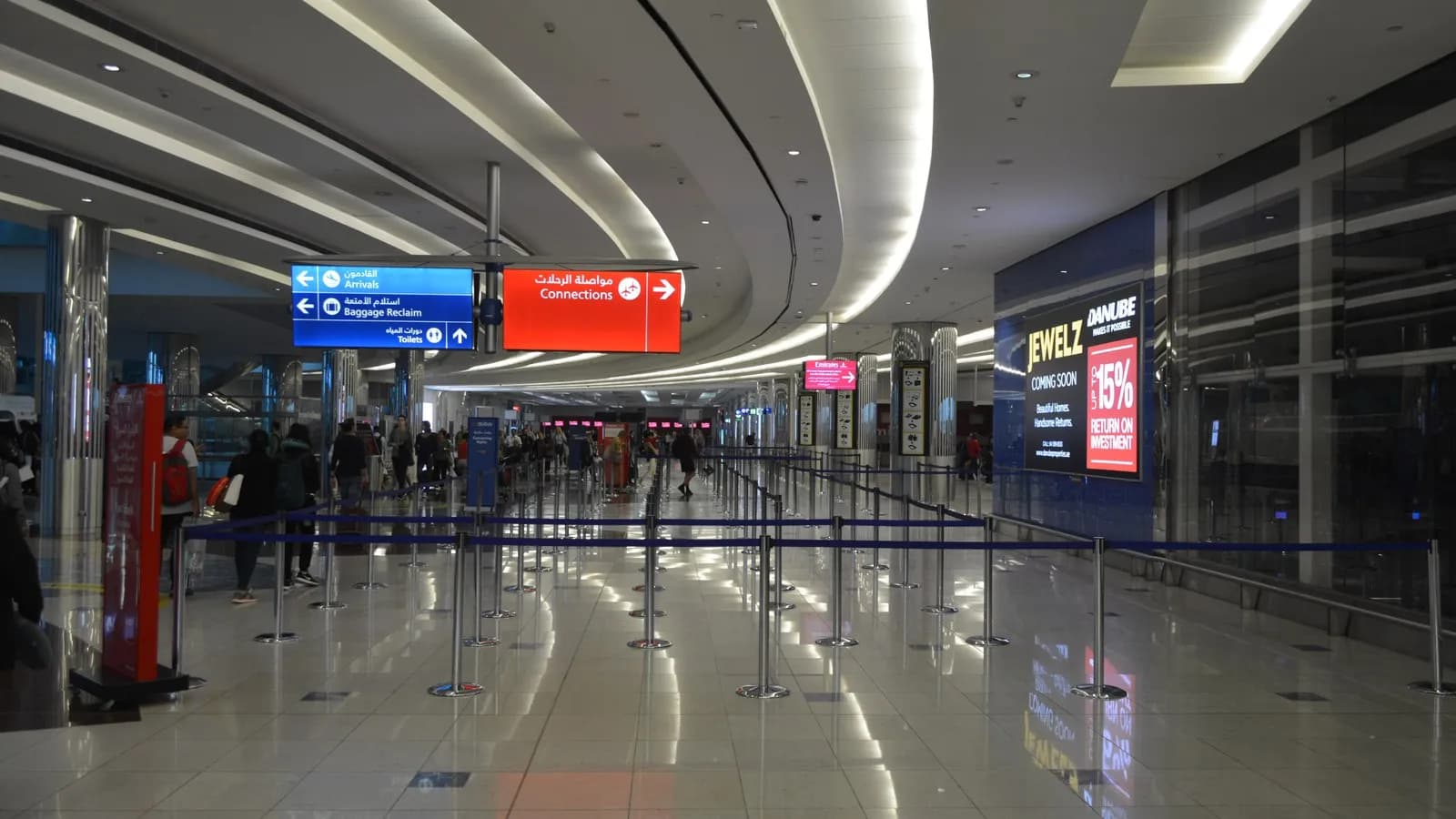
The most expensive consequence of the war in the Gulf has not been oil. Crude has spent August in the low nineties. The industry that has genuinely been broken by it is the one that made the region a place the world connects through.
The International Air Transport Association expects airlines based in the Middle East to turn a 7.2 billion dollar profit in 2025 into a 4.3 billion dollar loss in 2026. For a set of carriers built explicitly on the geography of being between Europe and Asia, that reversal is the whole business model being taxed.
How bad is it, in numbers?
Bad across every line that matters, and worst in the places least visible to passengers.
- Passenger demand in the region was down 13.9 per cent year on year in June.
- Cargo between Europe and the Middle East fell 41.1 per cent from the previous year.
- Cargo between Asia and the Middle East was down 4.1 per cent.
- Jet fuel in June ran about 45.8 per cent above year-earlier levels, with the full-year figure forecast around 70 per cent above the 2025 average.
- Direct Europe to Asia traffic, flying around the region entirely, rose 11 per cent.
That last line is the one to sit with. Traffic did not disappear. It rerouted. Aircraft that used to stop in the Gulf are now overflying it or going the long way round, and the revenue that used to be collected at a connecting hub is being collected somewhere else.
What is still flying?
The big three regional carriers, at reduced scale, and a shorter list of international airlines than usual.
Emirates has been operating at around 75 per cent of capacity. Etihad and Qatar Airways have likewise continued with reduced schedules. Against that, a number of major international carriers suspended their Gulf operations altogether, among them Air France, Lufthansa, British Airways, Cathay Pacific, Singapore Airlines and Air Canada.
The regulatory position explains the caution. The European Union Aviation Safety Agency has advised operators to avoid the airspace of Bahrain, Kuwait, Qatar and the United Arab Emirates, along with part of the Gulf of Oman, until 31 August 2026. An advisory of that kind is not a legal prohibition, but insurers read it, and insurance is what decides whether a route is viable.
The disruption has come in waves rather than as a single event. When strikes began on 28 February, hub airports including Dubai, Abu Dhabi and Doha closed, and more than 1,800 flights were cancelled, with almost 23 per cent of that Saturday's scheduled arrivals into Middle Eastern countries called off. A further escalation in July affected more than 1,500 flights across the Emirates, Oman and Qatar.
Why is the cargo number the sharper signal?
Because freight does not get frightened, it gets repriced.
Passenger demand falls partly because people are nervous, and nervousness recovers quickly once headlines stop. A 41.1 per cent collapse in Europe to Middle East air freight is a different thing. It means supply chains have been rebuilt around the region, contracts have been signed with other routes, and warehouses have moved. Those decisions take a year or more to reverse, and some of them never do.
The same pattern showed up in shipping when vessels began avoiding the region, which we covered in our report on rerouting around the Red Sea. Once a logistics network has proved it can function without you, the argument for coming back has to be made on price.
Which airlines are genuinely at risk?
Not the ones most people are worried about.
Emirates, Etihad and Qatar Airways are loss-making this year and are backed by states with the balance sheets to absorb it. They will fly through this. The exposure sits with smaller regional carriers that lack that backing and cannot spread their costs across a global network. Gulf Air and Middle East Airlines have been identified as facing heightened risk from sustained airspace closures and rising insurance premiums.
Fuel is compounding it. Roughly 70 per cent of the increase in fuel costs is being passed to passengers through surcharges, which protects the airline and suppresses the demand it needs. Globally the same pressure has already produced casualties, with Spirit Airlines ceasing operations in May and both Air Baltic and Wizz Air restructuring.
What does this mean if you hold a ticket?
Four practical points, none of which requires panic.
Check the operating carrier, not the booking site. Routes are being changed at short notice and codeshare partners are suspending independently of each other.
Expect longer flight times rather than cancellations on services that are still running. Avoiding advisory airspace adds fuel and hours, and that is the normal outcome now, not a sign of trouble.
Watch 31 August. The European advisory currently expires then. Whether it is extended is the single clearest indicator of how the next quarter of Gulf travel will look.
Take travel insurance terms seriously. Many policies exclude events in regions under an active government or regulator advisory, which is precisely the situation here.
When does it recover?
Faster than the pessimists expect on passengers, slower on everything else.
The region has done this before. Gulf tourism came back quickly after the earlier round of fighting, as we set out in our look at that recovery, because leisure demand is elastic and the product is strong. What does not bounce is the connecting business: the freight contracts, the corporate route agreements and the alliance schedules that were quietly redrawn while the airspace was closed.
The underlying condition is the war itself, and on that the honest reading is that the fighting has settled into something chronic rather than resolving, which is the case we make in our assessment of six months of the Hormuz closure. Airlines can survive a shock. What they struggle with is a shock that refuses to end and refuses to escalate, because neither the schedules nor the insurance can be priced against it.
Published in The Outspoken Digest
Editorial desk
Outspoken Digest Travel DeskDestinations, airlines, borders and the practicalities of getting there.
Newsletter
The Digest, in your inbox
One edition, sent when it is ready. No noise, and your address is never passed on.
Read Next
More Travel →
Alaska and Hawaiian Airlines Will Fly Nonstop From Seattle to Osaka and Tahiti From Spring 2027
Oct 20, 2026/2 min read

Norte Fire Put 16,000 Under Evacuation Orders in San Clemente, and They Are Now Lifted: What Travelers Should Know
Oct 18, 2026/2 min read

Tropical Storm Trudy Is Forecast to Become a Major Hurricane as It Nears Mexico's Pacific Coast
Oct 15, 2026/2 min read
Portugal Picks Lufthansa Over Air France-KLM for a 44.9 Percent Stake in TAP Air Portugal
Oct 14, 2026/2 min read