Life Runs on Four Letters. A Bacterial Enzyme Has Just Read Eight Without Being Told
RNA polymerase from E. coli transcribed a synthetic eight-letter genetic alphabet using the same signals it uses for natural DNA. The finding, in Nature Communications, means cells may not need rewiring to speak an expanded language.
Outspoken Digest Technology Desk
Sunday, September 6, 2026/3 min read
Every living thing on Earth writes its instructions in the same four letters: A, T, G and C. That has been true for something like four billion years and it is one of the deepest regularities in biology.
It is not, apparently, a requirement. On 2 September a team at the University of California San Diego reported in Nature Communications that one of the cell's most fundamental enzymes can read an alphabet with eight letters instead of four, and read it accurately, using nothing but its ordinary machinery.
The eight-letter alphabet
The synthetic system is called hachimoji, from the Japanese for eight letters. It keeps the four natural bases and adds four artificial ones, arranged as two extra pairs, that fit into the double helix and pair with each other according to the same hydrogen-bonding logic nature uses.
Building such an alphabet was itself a landmark when it was first achieved. The harder question has always been whether the cell's own equipment would accept it, because a genetic code nobody can transcribe is a chemistry curiosity rather than a language.
What the new work showed
That RNA polymerase, the enzyme that reads DNA and produces RNA as the first step of turning a gene into anything at all, handles the eight-letter version.
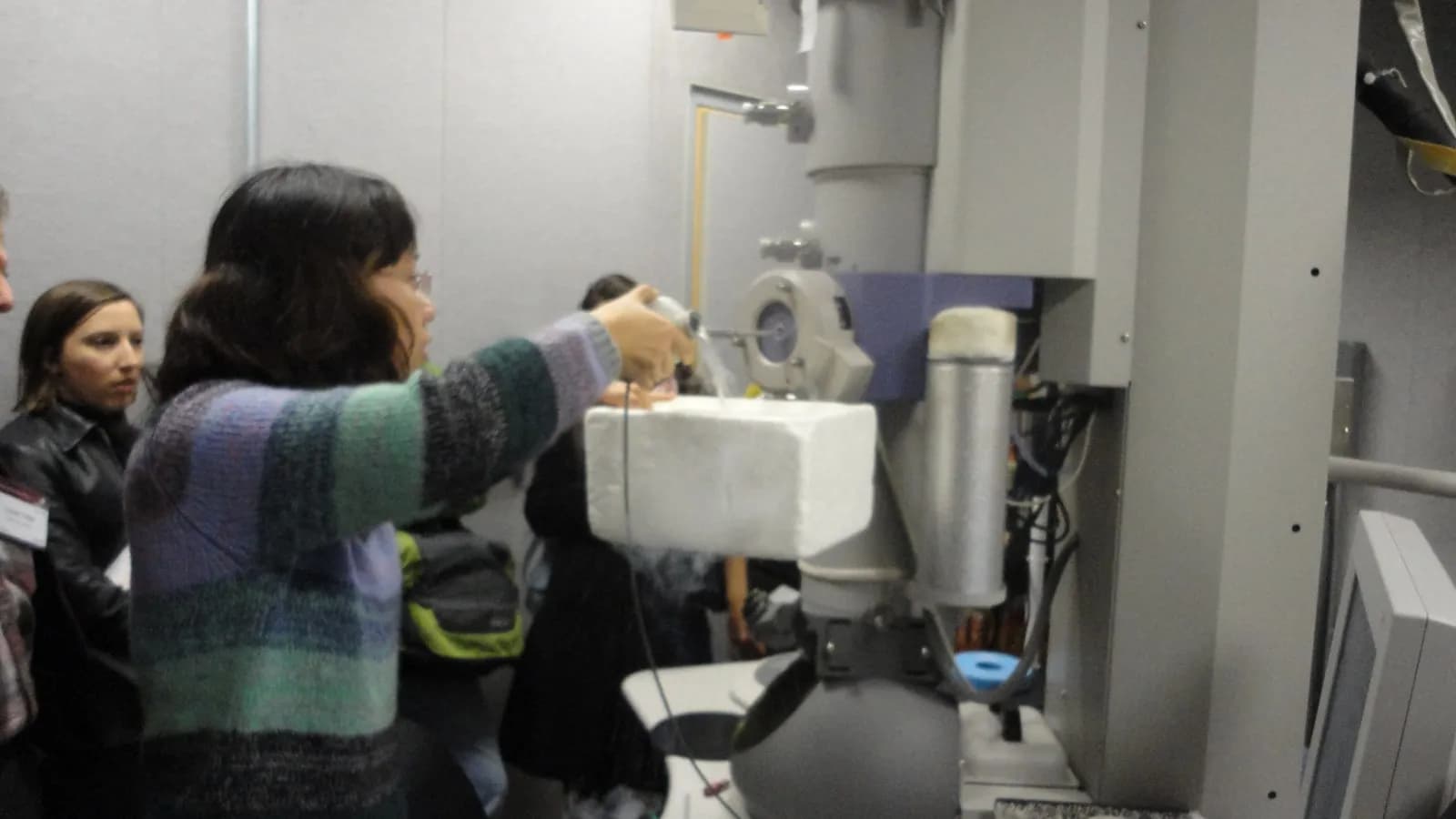
The team, led by Dong Wang at the Skaggs School of Pharmacy and Pharmaceutical Sciences, combined biochemical experiments with high-resolution cryo-electron microscopy, freezing the enzyme from Escherichia coli in the act of recognising and incorporating the synthetic base pairs and imaging it at near-atomic detail.
What the images show is that the polymerase treats the artificial pairs through the same structural and chemical checks it applies to natural ones. It is not tolerating them or making a special exception. It is reading them as letters.
A related paper from the same group in PNAS in August went a step further, showing the enzyme could recognise a synthetic pair held together by water-repelling forces rather than hydrogen bonds at all.
Why an enzyme reading letters is a large result
Because it removes what looked like the main obstacle.
If expanding the genetic alphabet required redesigning the cell's transcription machinery to match, every application would have had to carry that redesign with it, and the machinery is among the most conserved and least forgiving in biology. If, instead, the existing enzyme already copes, then the door is open to putting expanded DNA into living systems with far less engineering.
The stated destinations are diagnostics, therapeutics and engineered organisms. Earlier work with expanded alphabets has produced synthetic DNA molecules that recognise liver cancer cells, and an eight-letter code has more room for that kind of designed specificity than a four-letter one.
What it does not mean
It does not mean anyone has made an organism that lives on eight letters, and the gap between an enzyme reading a synthetic template in a tube and a cell replicating, repairing and expressing an expanded genome across generations is large.
Transcription is one step. Replication, proofreading, repair, and the translation of the resulting RNA into protein all involve their own machinery, and each will have to be shown to cope. This is the first of those steps done cleanly, with structures to show how, and it is a genuine result rather than a press release.
It also raises a question the field will have to keep answering: an alphabet that natural enzymes read is, by the same token, an alphabet that could in principle function outside the laboratory. The synthetic biology community has thought about containment for a long time, and one of the arguments for expanded alphabets was that natural machinery would not process them. This paper weakens that particular safeguard while strengthening the technology, which is the usual shape of progress in this area.
Our coverage of the largest complete wiring diagram of a brain, published the same week, is in this piece, and the university's own account of the work is here.
Published in The Outspoken Digest
Editorial desk
Outspoken Digest Technology DeskSoftware, hardware, artificial intelligence and what they change for everyone else.
Newsletter
The Digest, in your inbox
One edition, sent when it is ready. No noise, and your address is never passed on.
Read Next
More Technology →
Some White Dwarfs Would Look Green, Pink or Purple, Warwick Astronomers Calculate
Oct 15, 2026/2 min read
Oxford Physicists Reproduce the Aharonov-Bohm Effect on a Hybrid Quantum Computer
Oct 15, 2026/2 min read
Japan Will Fund Up to $21 Billion for Two GlobalFoundries Chip Plants in New York
Oct 15, 2026/2 min read
Apple's $299 HomeView Smart Display Takes Preorders, but Not in the European Union
Oct 15, 2026/2 min read