Eighteen Years to Map a Fly Brain, and the Point Was Never the Fly
Researchers have published the complete wiring diagram of the male fruit fly central nervous system: more than 166,000 neurons and about 125 million connections, the largest brain map by neuron count yet produced.
Outspoken Digest Technology Desk
Friday, September 4, 2026/3 min read
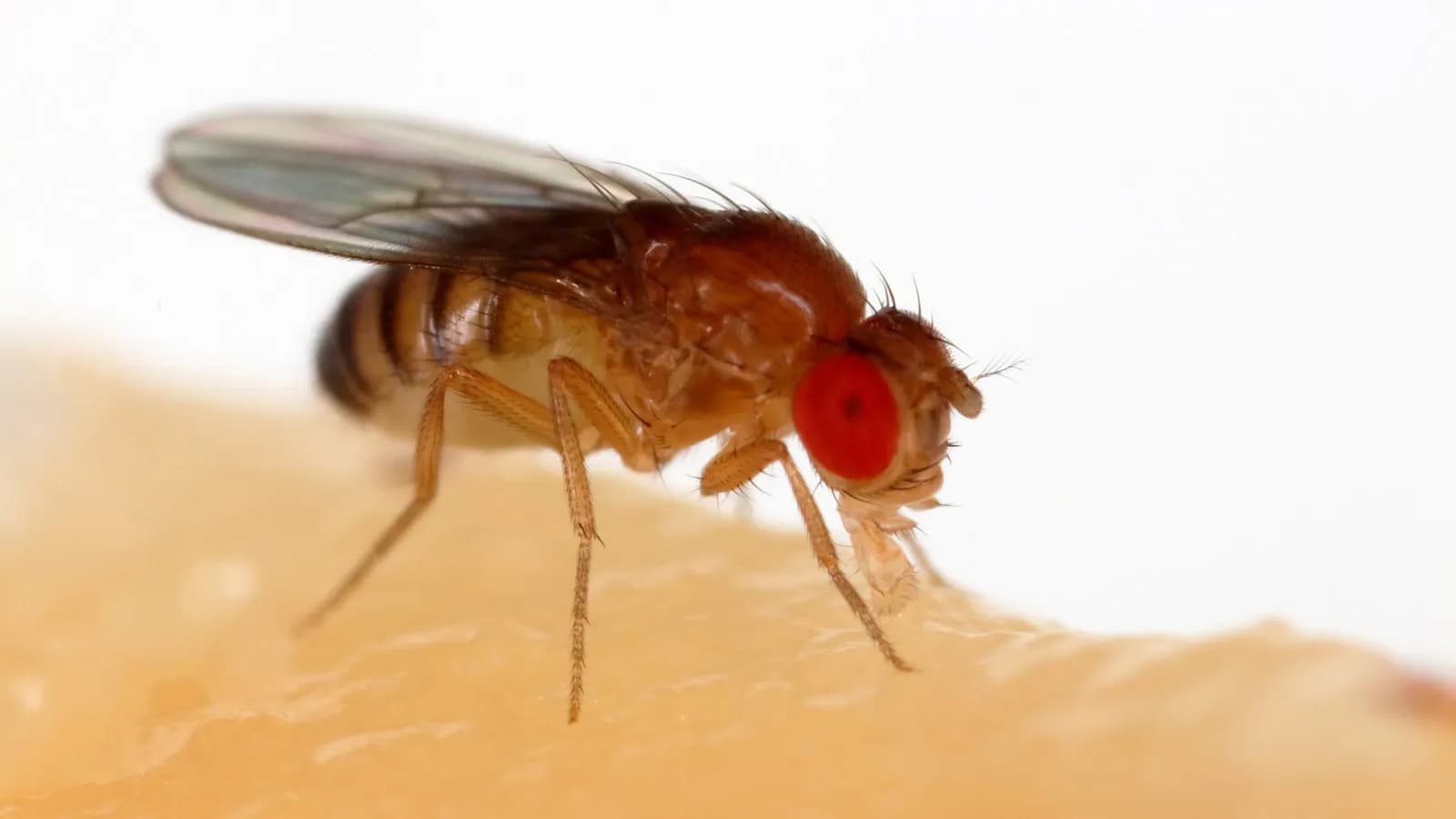
A project that began in 2008 finished on Wednesday. Researchers published the complete connectome of the male fruit fly central nervous system, a wiring diagram of more than 166,000 neurons joined by roughly 125 million synaptic connections.
It is the largest brain map by neuron count yet produced, and it closes an effort that ran for about eighteen years.
What is actually new
The female fruit fly brain was fully mapped in 2024. This is the male, and it includes two things the earlier map did not.
The first is both optic lobes and the ventral nerve cord, the structure that does roughly the job a spinal cord does. That matters because a brain map without it stops at the point where decisions turn into movement. With the nerve cord included, a circuit can be traced from a sensory input all the way to the muscle that acts on it.
The second is comparison. Having both sexes mapped completely allows researchers to see where the wiring differs, which is the direct route into behaviours that differ by sex, courtship and aggression among them. The paper in Cell is titled for exactly this, addressing sexual dimorphism in the completed male connectome.
The work came out of the Janelia Research Campus at the Howard Hughes Medical Institute, in partnership with Google Research and connectomics groups at Cambridge.
How you map a brain
Slowly, and mostly by solving imaging problems rather than biological ones.
The nervous system is cut into very thin slices, each slice is imaged with electron microscopy, and the resulting stack is reassembled into a three dimensional reconstruction. At fly scale that produces millions of images and a tracing problem no team could complete by hand, which is where machine learning enters: automated systems reconstruct the neural structures from the image stack, and humans proofread the result.
This is the part of the story that explains the eighteen years. Most of that time was not spent looking at flies. It was spent building microscopy and reconstruction methods that did not exist when the project started, on the bet that they eventually would.
Why a fly
Because it is the largest nervous system that is small enough to finish.
A fly brain is complex enough to produce genuinely interesting behaviour: navigation, courtship, learning, aggression, feeding decisions. It is also about a million times smaller than a human brain, which is the difference between a project that takes eighteen years and one that does not conclude at all.
The value is that it turns questions about brains into questions you can look up. If you want to know what a particular neuron connects to, you no longer design an experiment. You query a dataset. That changes the cost of asking, and when the cost of asking falls far enough, people ask questions they would not previously have bothered with.
Gerry Rubin, who founded Janelia and pushed the effort, made the case for the whole enterprise in one line about the technologies it forced into existence: none of those things would have happened if we had not done the fly. His colleague Harald Hess put the institutional version of it more drily, saying Janelia was ideally set up to have the patience for developing these technologies.
What it does not mean
A wiring diagram is not an explanation of behaviour.
The connectome tells you which neurons touch which, and roughly how strongly. It does not tell you what signal passes, how it changes with the animal's internal state, or what the circuit computes. A map of every road in a country is enormously useful and it is not a description of the traffic.
The claim being made is more specific and more defensible than a headline about understanding the brain. Complete structural information removes an entire category of uncertainty from experiments, and it means that any theory about how a fly circuit works can now be checked against the actual anatomy rather than assumed. That is a foundation rather than a conclusion, which is the same distinction we drew in our piece on immune cells in the ageing brain.
The larger point is about patience. Eighteen years is longer than most research funding cycles, most institutional strategies and most careers in a single lab. The reason this dataset exists is that somebody was willing to fund a decade of tool building before there was a result to show for it, which is worth remembering the next time a scientific programme is judged on what it produced in its first three years.
Published in The Outspoken Digest
Editorial desk
Outspoken Digest Technology DeskSoftware, hardware, artificial intelligence and what they change for everyone else.
Newsletter
The Digest, in your inbox
One edition, sent when it is ready. No noise, and your address is never passed on.
Read Next
More Technology →
Some White Dwarfs Would Look Green, Pink or Purple, Warwick Astronomers Calculate
Oct 15, 2026/2 min read
Oxford Physicists Reproduce the Aharonov-Bohm Effect on a Hybrid Quantum Computer
Oct 15, 2026/2 min read
Japan Will Fund Up to $21 Billion for Two GlobalFoundries Chip Plants in New York
Oct 15, 2026/2 min read
Apple's $299 HomeView Smart Display Takes Preorders, but Not in the European Union
Oct 15, 2026/2 min read