Reading a Pair of Jeans: Ounce Weights, Selvedge, Raw Denim and the Stitching That Tells You Where It Was Made
Denim is a twill with an indigo warp and a white weft, and almost everything about how a pair will wear is visible before you try them on: the weight, the finished edge inside the leg, the colour of the thread, and the rivets.
Tuesday, October 29, 2024/3 min read
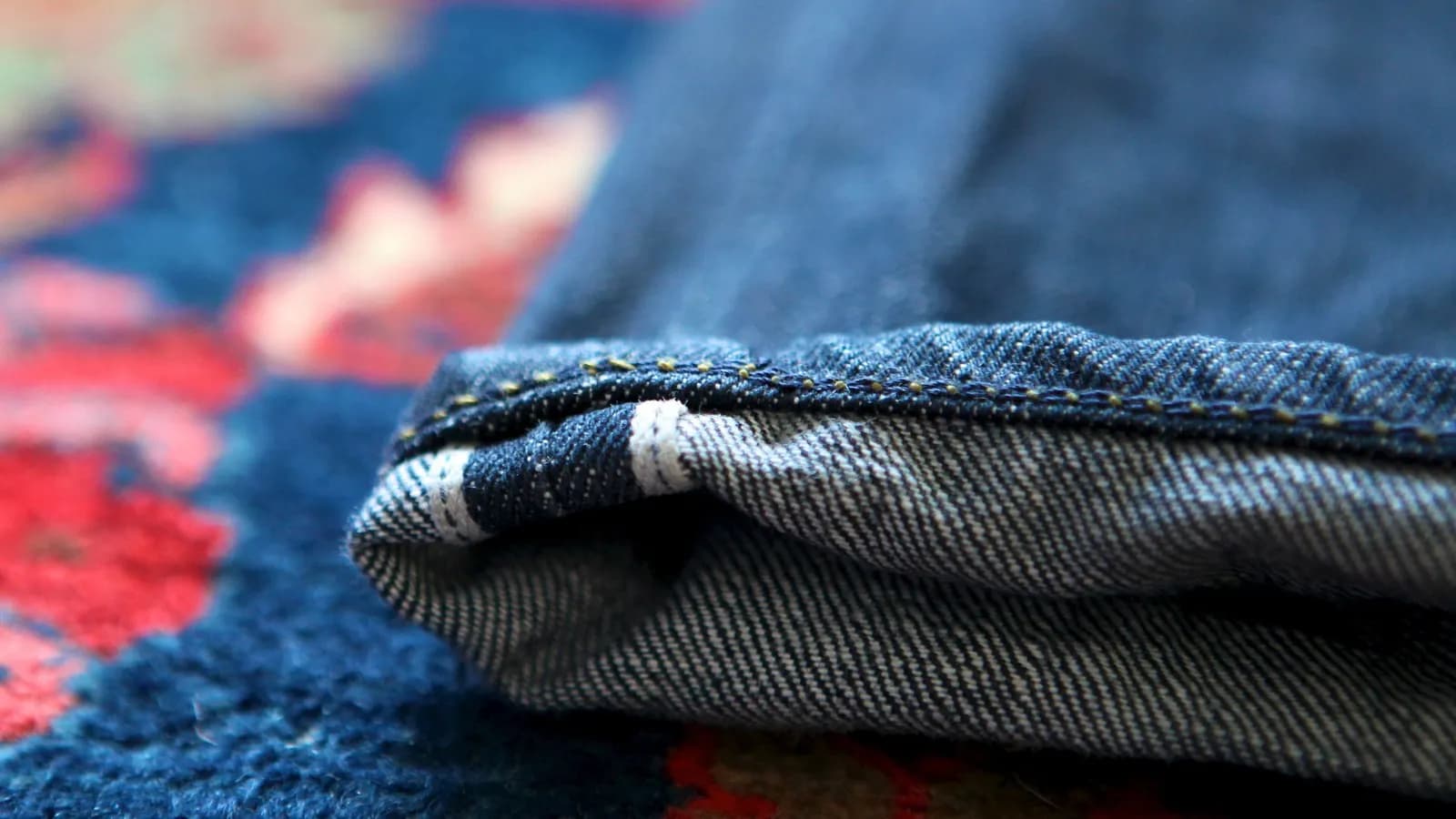
Jeans are the most worn garment in the world and the least examined at the point of sale. People try them on for fit, look at the wash, and buy. Yet a pair of jeans tells you almost everything about itself if you turn the cuff up and read the inside, and the reading takes a minute. Denim is a cotton twill, the diagonal weave you can see on the surface, in which the lengthwise warp threads are dyed indigo and the crosswise weft is left white; that is why jeans are blue outside and pale inside, and why they fade at the knees, where the indigo wears off the raised warp. From there the vocabulary is short.
Weight
Quoted in ounces per square yard, and the single best predictor of how a pair will feel and last. Under 12 oz is lightweight, summer denim that drapes and wears out faster. 12 to 16 oz is the classic range; a 14 oz pair is what most people think of as proper jeans. Above 16 oz is heavyweight, stiff for months, hot in any climate warmer than Manchester, and beloved of enthusiasts who want dramatic fades. In the Gulf, 11 to 13 oz is sensible and 21 oz is a hobby. Weight is rarely on the label; ask, or feel: a 14 oz pair stands up on its own when new.
Selvedge
Turn up the cuff. If the outside seam of the leg is finished with a clean, woven edge, usually white with a coloured line running through it, the fabric is selvedge, woven on a narrow shuttle loom that produces a self-finished edge. If the seam is overlocked with a zigzag of thread, it is not. Selvedge is not a quality grade; it is a production method that happens to correlate with slower weaving, smaller mills and more attention, which is why the best denim tends to be selvedge and why a great deal of mediocre denim is now selvedge too. The coloured line, the "ID", was once a mill signature, red for Cone Mills in North Carolina, and is now decoration. Japanese mills in Okayama make most of the good selvedge sold today; the American originals are gone or revived in name only.
Raw, sanforised, washed
Raw denim has not been washed after dyeing; it is dark, stiff, and will fade to the pattern of the wearer's life. Unsanforised raw denim will also shrink up to ten per cent on first wash and should be bought large; most raw denim now is sanforised, pre-shrunk, and shrinks only a little. Washed denim has been through industrial finishing to soften it and fake the fades, sometimes with stones, sometimes with enzymes, sometimes with lasers; the result is comfortable on day one and has done a large part of its ageing in a factory. "Distressed" jeans are washed jeans with damage added. The choice is between wearing the fades in or buying them, and neither is wrong, though the raw pair will outlast the washed one by years because its fibres have not been abraded before sale.
Construction
Chain stitching on the hem, a looped stitch that looks like a chain on the inside, is the traditional finish and puckers attractively with wear; a straight lockstitch is cheaper and flat. Copper rivets at the stress points, hidden rivets at the back pockets, a leather or jacron patch, and a button fly are traditional signals rather than guarantees. Look instead at the stitch density, the neatness of the bar tacks at the belt loops and pocket corners, and whether the twill lines on the two legs run in mirror image, which means the pattern was cut with care. The country on the label matters less than the mill and the factory, neither of which is usually named; our general guide to judging a garment applies.
Care
Wash rarely, inside out, cold, and hang to dry; the enthusiasts' refusal to wash for six months is about fades, not hygiene, and a freezer does nothing to bacteria. A good pair of 14 oz jeans, treated this way, lasts five to ten years and can be repaired at the crotch, where they all go first, for less than a coffee. That is the case for spending more once, and it is the arithmetic behind cost per wear that we keep returning to.
Published in The Outspoken Digest
Editorial desk
Outspoken Digest Style DeskReports for The Outspoken Digest across Fashion, Design, Lifestyle.
Newsletter
The Digest, in your inbox
One edition, sent when it is ready. No noise, and your address is never passed on.
Read Next
More Fashion →
Anthony Vaccarello Is Leaving Saint Laurent After a Decade, and Kering Has Not Yet Named His Successor
Oct 9, 2026/2 min read

Louis Vuitton Closes Paris Fashion Week With Hovering Cars, Paper-Light Dresses and a Louvre Courtyard Cityscape
Oct 7, 2026/2 min read
Celine Dion Made a Surprise Return to the Catwalk to Close L'Oreal's Paris Fashion Week Opening Show
Sep 29, 2026/2 min read
Louise Trotter Doubled Down on Colour and Oversized Bags for Her Latest Bottega Veneta Show in Milan
Sep 27, 2026/2 min read