Hydration Facts: How Much Water You Actually Need, and Where 'Eight Glasses' Came From
The eight-glasses rule traces to an unreferenced 1945 guess. Here is what evidence-based bodies recommend instead.
Outspoken Digest Nutrition Desk
Tuesday, April 8, 2025/4 min read
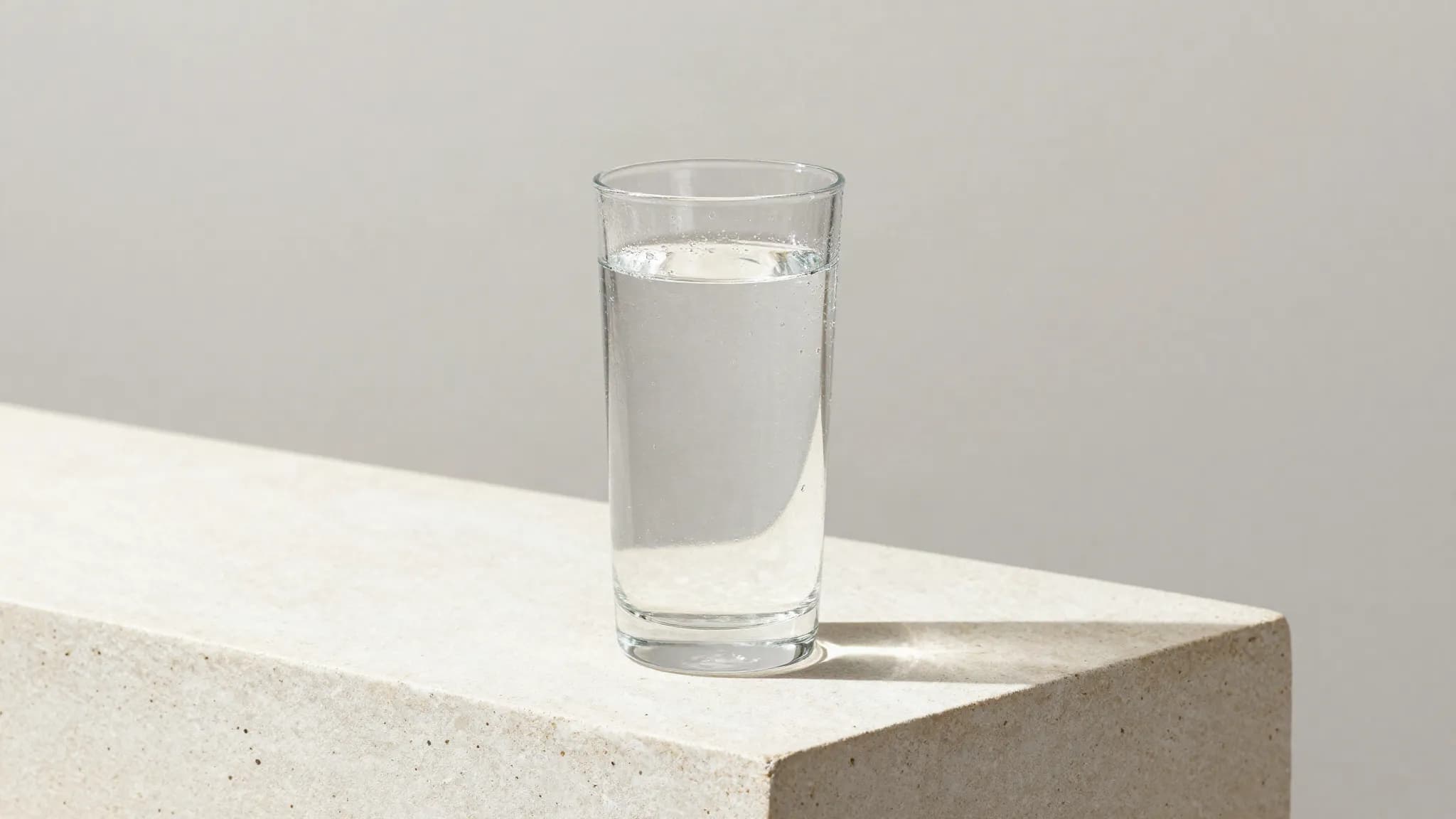
Ask most people where the "drink eight glasses of water a day" rule comes from and the honest answer is that nobody really knows, and that is because the rule was never built on a study to begin with. It has survived for eighty years mostly on repetition, which makes it one of the most successful pieces of nutrition folklore in circulation.
Where the eight-glasses rule actually came from
The most commonly traced origin sits with a 1945 US Food and Nutrition Board recommendation of about 2.5 litres of daily water intake, a figure that, according to McGill University's Office for Science and Society, explicitly noted that most of that water could come from food, a detail that got dropped somewhere in the retelling. A second candidate origin points to Fredrick J. Stare, founder of Harvard's nutrition department in the 1940s, who personally advocated for around six glasses a day, again without a cited evidence base behind the number.
The clearest verdict came decades later from a frequently cited analysis published in the American Journal of Physiology, which asked directly whether there was scientific evidence for the "8 x 8" rule and concluded that no supporting studies could be found. Surveys of ordinary food and fluid intake across large groups of healthy adults suggested such large fixed amounts were not actually needed for that population, since normal eating and drinking patterns already covered fluid requirements for most people.
What evidence-based bodies recommend instead
Rather than a flat rule, the authoritative guidance today talks about total water intake, meaning water from drinks of any kind plus the water naturally present in food, not water from a bottle alone. The European Food Safety Authority sets a reference value of about 2.0 litres of total water a day for women and 2.5 litres for men, under conditions of moderate temperature and moderate physical activity. In the United States, the National Academies of Sciences, Engineering and Medicine set a similar but slightly higher figure, around 2.7 litres of total fluid a day for women and 3.7 litres for men, a range discussed in an overview comparing the EFSA and NASEM hydration standards.
The gap between the EFSA and NASEM numbers is itself informative: two respected scientific bodies looking at similar evidence settled on numbers roughly 20% apart, which says something about how much individual variation and methodological judgement is baked into any single "correct" hydration target. Neither number is a minimum a person must hit exactly. Both are population averages meant to cover typical adults under typical conditions.
Why fixed numbers do not fit everyone
Water needs are shaped by climate, activity level, body size, diet composition and individual physiology, which is precisely why a single rule struggles to apply universally. Someone training outdoors in a hot, humid climate loses far more fluid through sweat than someone working at a desk in air conditioning, and neither the EFSA nor NASEM figures were designed with heavy exertion or heat stress in mind. Diet matters too: a diet heavy in fruit, vegetables and soups delivers meaningfully more water than a diet built around dry, processed food, even before a person drinks anything separately.
What thirst actually tells you
For most healthy adults without a specific medical condition affecting fluid balance, thirst remains a reliable day-to-day signal. Research summarised across the nutrition literature broadly supports drinking to satisfy thirst as a reasonable way to meet fluid needs, rather than forcing a fixed volume regardless of how the body is signalling. This does not apply uniformly to every group; older adults, for instance, can have a blunted thirst response and may need to be more deliberate about fluid intake rather than waiting to feel thirsty.
Climate is a genuine complicating factor that neither reference figure was built to fully answer. Hot, humid environments increase fluid loss through sweat well beyond what a temperate-climate guideline anticipates, and outdoor manual work or exercise in high heat can push real fluid needs several litres above the EFSA or NASEM baseline on a given day. This is one reason hydration guidance tends to describe a starting point for planning rather than a hard ceiling or floor that applies identically in every climate and every season.
Signs that intake is genuinely off, in either direction
- Urine that is consistently dark yellow, rather than pale straw-coloured, is a reasonably practical everyday signal of under-hydration for most healthy adults.
- Persistent headache, fatigue or dizziness alongside reduced urination can indicate a fluid deficit worth addressing directly rather than ignoring.
- Very high fluid intake pursued deliberately, well beyond thirst, can in rare cases dilute blood sodium to dangerous levels, a condition called hyponatraemia, which has occurred in endurance athletes who over-hydrate during long events.
This article summarises general hydration science and is not medical advice. People with kidney disease, heart failure, or any condition affecting fluid balance should follow a fluid intake target set by their own physician, since those conditions can require either restricted or increased intake far outside the general population range discussed here.
The eight-glasses figure is not dangerous, and for a lot of people it happens to land in a reasonable range by accident. But it was never derived from evidence in the first place, and the actual guidance, imperfect and averaged as it is, gives a more honest picture: drink according to thirst, eat foods with water in them, and treat any fixed number as a rough guide rather than a daily quota to hit exactly.
Published in The Outspoken Digest
Editorial desk
Outspoken Digest Nutrition DeskDiet, food science and the evidence behind claims about what we eat.
Newsletter
The Digest, in your inbox
One edition, sent when it is ready. No noise, and your address is never passed on.
Read Next
More Nutrition →
Matched for Calories and Macronutrients, an Ultra-Processed Meal Still Drew a Bigger Insulin Response in a Small Trial
Oct 9, 2026/3 min read
A Study of 371,000 Americans Found Whole Fruit, Not Juice, Is Linked to Better Heart Health
Oct 1, 2026/2 min read

Tirzepatide Switched On Calorie-Burning Brown Fat in Obese Mice, Independent of Its Appetite-Suppressing Effect
Sep 29, 2026/2 min read
Every Extra 100 Grams of Ultra-Processed Food Daily Tied to Higher Disease Risk in an 8.8 Million-Person Study
Sep 27, 2026/3 min read