Iran Says It Will Declare a Restricted Zone Beyond Hormuz, Names Oman as Corridor Partner, and Jizan Is Hit Again
Mohsen Rezaei says any ship entering a zone that starts at the American blockade line will be put on an Iranian sanctions list. The same day Aramco's Jizan refinery took a second strike in a month, Brent passed 97 dollars, and flydubai cut its schedule.
Tuesday, September 8, 2026/3 min read
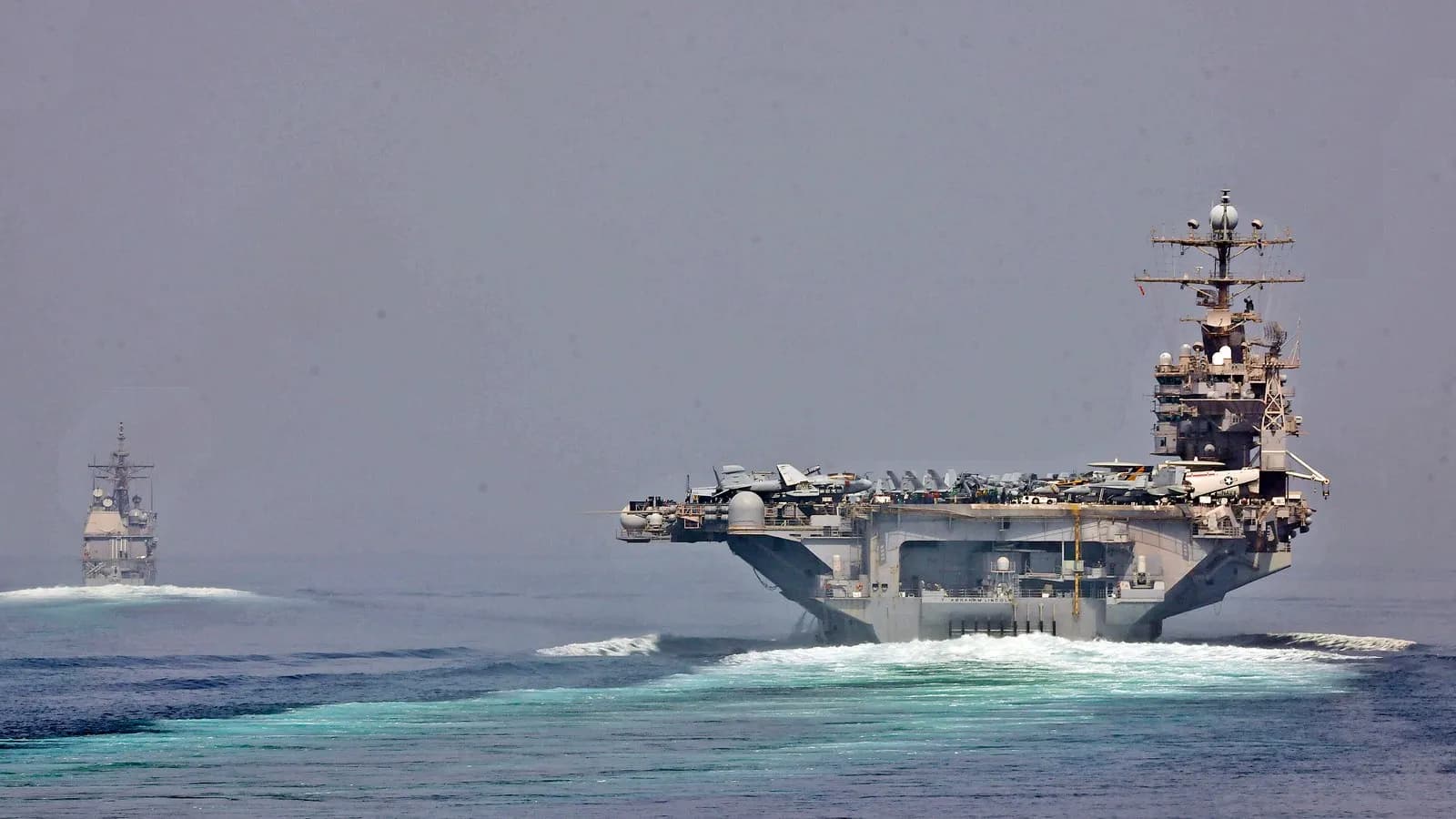
The seventh month of the Iran war opened with a new claim on the water. On Sunday Mohsen Rezaei, secretary of Iran's Supreme National Security Council, said Tehran would announce within days a restricted zone that begins at the line where the United States naval blockade starts, runs towards the Strait of Hormuz and continues into the Gulf itself. Any ship entering it without coordinating with Iran, he said, would be added to a sanctions list, with consequences for its insurance and for any future passage.
No coordinates were published. The parliament speaker, Mohammad Bagher Ghalibaf, added that the era of proportional responses had ended and that Iran's retaliation for future attacks would be faster, heavier and more painful.
What happened over the weekend
The announcements followed a weekend of escalation. According to The National, American forces struck three Iranian oil tankers on Saturday, one of them off Kharg Island, after Revolutionary Guard attacks on US warships. Iran also claimed to have hit an uncrewed American vessel in the strait, a claim the US Navy's Captain Tim Hawkins called a total lie.
Traffic through the strait, which before the war carried more than 130 ships and twenty million barrels of crude a day, is now a trickle. Kpler data cited by Al Jazeera puts the average over the past ten days at ten commodity ships a day, the lowest since May, with single days as low as five. The ceasefire memorandum signed on 17 June ran for sixty days and lapsed in August, and the attacks resumed with it. The count of transits and what they mean for prices has been tracked in our running coverage of the strait.
The Oman corridor
Rezaei's second claim is the more consequential if it holds. He said Iran and Oman had agreed maps for an alternative shipping corridor through the strait, lying in Iranian and Omani waters and under Iranian management, and that a memorandum would be signed in the coming days. Oman has not published anything. Washington has said repeatedly that it will not recognise an Iranian-Omani arrangement over the strait, rejects any Iranian control of it or tolls for transiting it, and regards the waterway as under American control.
The practical question is enforcement. Stephen Zunes of the University of San Francisco told Al Jazeera it was hard to see how Iran could police such a zone, since any Iranian ship or aircraft attempting to do so would be exposed to American attack, and suggested the announcement was leverage rather than a plan. That may be right and still miss the point. A shipowner does not need Iran to be able to enforce a sanctions list; it needs only to be unsure whether its insurer will pay if the vessel is later listed. Uncertainty is the enforcement.
Jizan, again
On Monday, the Financial Times reported, citing two people with knowledge of the incident, that Saudi Aramco's refinery complex at Jizan in the south-west of the kingdom had been hit for the second time in a month. The 400,000 barrel a day plant was struck in August by Yemen's Houthis and its exports fell to nothing that month; one source described Monday's strike as similar in scale. As of Monday evening no group had claimed it and Aramco had not issued a damage statement. After the August attacks the company's chief executive, Amin Nasser, said they had caused temporary interruptions with no material effect on operations or finances, a line examined in our report on Aramco's half-year results.
Brent crude traded above 97 dollars a barrel on Monday, according to OilPrice, and West Texas Intermediate above 92.
What it means for people here
For UAE residents the visible effects on Monday were in the air rather than at sea. Gulf News reported that flydubai is running a reduced schedule across parts of its network while still serving more than a hundred destinations, and that Air Arabia has cancelled some flights to Kuwait and Bahrain. Anyone flying in the region this week should check the airline's own status page rather than the booking confirmation.
The political reading came from Anwar Gargash, the UAE presidential adviser, who said the country's energy exports must remain secure and that rebuilding trust with Iran could take decades. Iran remains a neighbour, he said, and geography leaves no alternative to engagement; but the missiles and drones had destroyed bridges built over decades. Qatar's Majed Al Ansari warned separately against normalising a state of no war and no peace. Between them they describe the Gulf position with some precision: no appetite for the war, no illusion about the other side, and no exit from the map.
Published in The Outspoken Digest
Editorial desk
Outspoken Digest News DeskReports for The Outspoken Digest across Latest Trends, Sports, Nutrition, Crypto.
Newsletter
The Digest, in your inbox
One edition, sent when it is ready. No noise, and your address is never passed on.
Read Next
More Latest Trends →
Lapid Says He Does Not Trust Netanyahu Not to Strike Iran Before Israel's 27 October Election
Oct 18, 2026/2 min read
Hormuz Ship Attacks Hit a Weekly Record as Iran Says a Supertanker Struck a Mine
Oct 18, 2026/2 min read
Trump Waives New Russia Sanctions and Tariffs Two Days Before They Were Due, the Second Waiver in Two Weeks
Oct 18, 2026/2 min read

Roughly Half a Million March Across France as Student Anger Over Schools Merges With Fuel Price Fury
Oct 18, 2026/2 min read