MIT Wired Bacteria Into Transistors. Its Biggest Circuit Is Twenty-Four Colonies on a Dish That Takes Eight Hours to Add
Engineered colonies of a plant bacterium pass chemical signals across five millimetres of agar, switching each other on and off like components on a board. The team built adders, routers and logic gates. The point is a computer that can grow on a leaf.
Outspoken Digest Technology Desk
Tuesday, September 8, 2026/3 min read
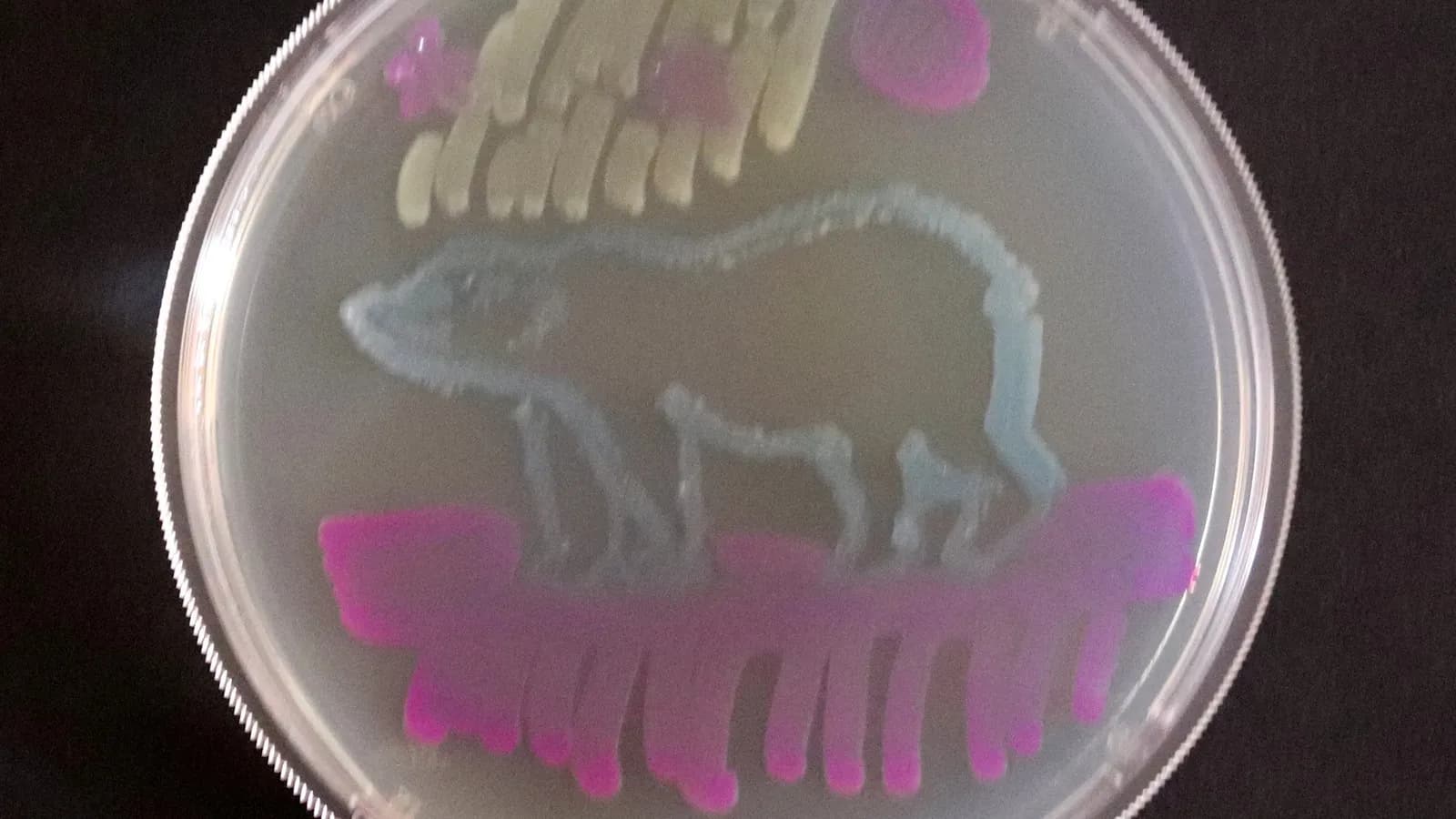
A transistor is a switch that one signal controls and another passes through. Engineers at MIT have built one out of a bacterium. Then they built two dozen of them on a single Petri dish, wired them together with three more strains acting as relays, and used the result to add numbers, route signals to chosen destinations and perform logic. The work, led by Hamid Doosthosseini in Christopher Voigt's laboratory in MIT's Department of Biological Engineering, was published in Nature Chemical Biology on 17 August.
How a colony becomes a component
The bacterium is Pantoea agglomerans, an unremarkable organism that lives on the surfaces of plants. The team engineered two versions of it that behave as transistors. Each responds to a control molecule called OC-6, which switches it on or off, and when on, each detects a second molecule, OC-12, and in response produces a third, OHC-14, as its output. Three further strains act as relays, translating one signal into another so that the output of one transistor can become the input of the next.
The circuit is laid out in space. Colonies are printed onto agar about five millimetres apart, and the signalling molecules diffuse from one to the next. Wiring, in this system, is geography: put a relay between two transistors and they are connected, leave a gap and they are not. From those parts the team assembled multi-input logic gates, an OR gate, an imply gate, a two-input adder, a demultiplexer that routes a signal to a chosen output, and a multi-signal processor. The largest network had twenty-four colonies linked by chemical communication.
The catch, which is also the point
A calculation takes about eight hours, the time for the molecules to diffuse and the cells to respond. Nobody is going to run software on this. The comparison with silicon is the wrong frame, and the researchers do not make it.
The right frame is where the computer can be. Pantoea already lives on leaves and roots. A circuit made of it could, in principle, coat a plant, sense the chemical signature of drought or a pest attack, process that information across a few colonies, and trigger a response such as synthesising a fungicide, all without a battery, a chip or a person. None of that has been demonstrated yet; the paper stops at the Petri dish. But the reason to build a slow computer out of bacteria is to put computation in places no other computer can go, and the reason to build it as transistors rather than as a single engineered cell is that transistors compose. A designer can add a stage without redesigning the whole.
Limits
The team is candid about two. The supply of transcription factors, the molecular parts that let a cell respond to a specific signal, is limited, which constrains how many distinct signals a circuit can use. And packing complex circuitry into a single cell burdens it with protein production until it stops growing properly, which is precisely why spreading the logic across many colonies, each doing one simple thing, is the more scalable route. The work was funded by DARPA and IARPA, the US defence and intelligence research agencies, which tells you who expects to want sensors that grow.
This is the second piece of synthetic biology in a week to move a boundary that looked fixed. The eight-letter DNA result showed a natural enzyme reading an artificial genetic alphabet; this one shows natural cells doing arithmetic. Neither is a product. Both are the sort of result that, a decade later, turns out to have been the beginning of one. For the everyday biology of the bacteria that already live on us and in us, and what can honestly be said about manipulating them, see our piece on microbiome testing.
Published in The Outspoken Digest
Editorial desk
Outspoken Digest Technology DeskSoftware, hardware, artificial intelligence and what they change for everyone else.
Newsletter
The Digest, in your inbox
One edition, sent when it is ready. No noise, and your address is never passed on.
Read Next
More Technology →
Webb Caught a Probable Supernova From the Early Universe Only Days After It Exploded
Oct 18, 2026/2 min read
Webb Maps an Exoplanet's Atmosphere as Egg-Shaped, With a Puffed-Up Evening Side Hotter Than Its Morning Edge
Oct 18, 2026/2 min read

A Hole in a 75,000-Year-Old Shoulder Blade Points to a Wooden Spear, and Perhaps to Neanderthal Care
Oct 18, 2026/2 min read

Anthropic's Own Staff Data: Junior Technical Hires Fell From 27 to 9 Percent as Its AI Agents Outworked Humans
Oct 18, 2026/2 min read